-
FSSAI CEO reviews food safety enforcement activities in Maharashtra [Dated: 01-07-2025]
-
FSSAI CEO Directs 100 Inspection of Packaged Drinking Water Units in Maharashtra [Dated: 01-07-2025]
-
FSSAI CEO Directs 100 Inspection of Packaged Drinking Water Units During Food Safety Review in Maharashtra [Dated: 01-07-2025]
-
Health Minister Nadda launches FSSAI’s ‘Stop Obesity’ campaign on World Food Safety Day 2025 [Dated: 08-06-2025]
-
https://www.lokmattimes.com/health/healthy-food-habits-and-lifestyle-key-for-viksit-bharat-jp-nadda/ [Dated: 07-06-2025]
-
J.P. Nadda Launches FSSAI Drive to Curb Obesity on World Food Safety Day [Dated: 07-06-2025]
-
Healthy India can be ensured through healthy food habits and lifestyle: JP Nadda on World Food Safety Day [Dated: 07-06-2025]
-
फूड प्रोडक्ट की लेबलिंग में 100 शब्द का इस्तेमाल नहीं करना चाहिए... FSSAI ने जारी की एडवाइजरी [Dated: 31-05-2025]
-
FSSAI bans use of 100 on food labels, says term misleads consumers [Dated: 31-05-2025]
-
No 100 claims on food labels as it misleads consumers, says Fssai [Dated: 30-05-2025]
-
FSSAI issued strong advisory for Food Business companies not to use 100 in food labelling [Dated: 30-05-2025]
-
FSSAI bans 100 on food labels [Dated: 30-05-2025]
-
FSSAI asks States/Union Territories to take measures for addressing obesity [Dated: 28-05-2025]
-
FSSAI ask states, UTs to boost efforts against obesity, support PMs call [Dated: 28-05-2025]
-
पीएम मोदी की मोटापे के खिलाफ अपील पर एक्शन में FSSAI, राज्यों को दिए गए तेल-चीनी की खपत घटाने के निर्देश [Dated: 28-05-2025]
-
एफएसएसएआई ने राज्यों, केंद्र शासित प्रदेशों से मोटापे से निपटने के लिए कदम उठाने को कहा [Dated: 28-05-2025]
-
FSSAI urges states and UTs to boost efforts against obesity, supports PMs call for healthier India [Dated: 28-05-2025]
-
FSSAI Calls on States, UTs to Intensify Anti-Obesity Measures in Support of PM’s Health Push [Dated: 28-05-2025]
-
FSSAI directs states to curb illegal fruit ripening and synthetic coatings [Dated: 21-05-2025]
-
FSSAI directs states to curb synthetic colouring, carbide use on fruits [Dated: 20-05-2025]
-
FSSAI calls for crackdown on illegal fruit ripening practices [Dated: 20-05-2025]
-
Carry out inspections to curb use of illegal ripening agents, synthetic coatings on fruits: FSSAI asks states [Dated: 20-05-2025]
-
फलों को केमिकल से पकाने और रंगने पर FSSAI सखà¥à¤¤, राजà¥à¤¯à¥‹à¤‚ को दिठये निरà¥à¤¦à¥‡à¤¶ [Dated: 20-05-2025]
-
FSSAI Empowers Consumers to Report Misleading Claims on Food Products via App and Portal [Dated: 01-05-2025]
-
Report misleading claims on food product labels through a mobile app [Dated: 01-05-2025]
-
Label Awareness: Food Safety Reporting Gets a Boost – You Can Now Report Misleading Labels in Just a Few Taps [Dated: 01-05-2025]
-
FSSAI launches new digital tool for consumers to report misleading claims on labels [Dated: 30-04-2025]
-
Consumers can now directly report misleading claims made on food products: FSSAI [Dated: 30-04-2025]
-
FSSAI Launches Tool For Consumers To Report Misleading Claims On Food Products [Dated: 30-04-2025]
-
Union Health Minister J P Nadda leads the “Liver Health Pledge Ceremony†at the Health Camp organized by the Ministry, in presence of Union MoS Smt. Anupriya Patel [Dated: 21-04-2025]
-
Jadhav inaugurates FSSAI’s National Stakeholder Consultation on sustainable packaging [Dated: 17-04-2025]
-
Jadhav launches rPET guidelines at FSSAIs 2nd National Stakeholder Consultation [Dated: 17-04-2025]
-
Union Minister Announces FSSAI’s New Guidelines and Logo for Recycled PET Food Packaging [Dated: 17-04-2025]
-
Berhampur Jail achieves ‘Eat Right Campus’ certification from FSSAI [Dated: 31-03-2025]
-
Odishas Berhampur jail gets Eat Right Campus certification [Dated: 29-03-2025]
-
Odisha’s Berhampur jail gets FSSAI’s ‘Eat Right Campus’ certificate [Dated: 29-03-2025]
-
Circle Jail gets FSSAI’s ‘Eat Right Campus certificate [Dated: 27-03-2025]
-
Safe festivities: Step up food safety checks on dairy analogues, FSSAI directs States [Dated: 16-03-2025]
-
FSSAI directs States to step up food safety checks on dairy analogues [Dated: 12-03-2025]
-
FSSAI directs States to step up food safety checks on dairy analogues [Dated: 12-03-2025]
-
FSSAI Intensifies Food Safety Checks on Dairy Analogues Amid Festive Demand [Dated: 12-03-2025]
-
FSSAI directs States to step up food safety checks on dairy analogues [Dated: 12-03-2025]
-
FSSAI asks states to step up surveillance on dairy analogues during March [Dated: 11-03-2025]
-
Karnataka cracks down on plastic use in idli preparation; FSSAI intervenes amid cancer risk concerns [Dated: 02-03-2025]
-
इडली खाने के हैं शौकीन तो हो जाà¤à¤‚ सावधान, इस जगह इडली बनाने में पà¥à¤²à¤¾à¤¸à¥à¤Ÿà¤¿à¤• का इसà¥à¤¤à¥‡à¤®à¤¾à¤², à¤à¤«à¤à¤¸à¤à¤¸à¤à¤†à¤ˆ नà [Dated: 02-03-2025]
-
Karnataka to submit report on using plastic sheets for steaming idli [Dated: 02-03-2025]
-
FSSAI seeks report from Karnataka on use of plastic sheets in idli making [Dated: 02-03-2025]
-
FSSAI asks Karnataka to submit report on use of plastic sheets for steaming idli in restaurants [Dated: 02-03-2025]
-
India News | FSSAI Asks Karnataka to Submit Report on Use of Plastic Sheets for Steaming Idli in Restaurants [Dated: 02-03-2025]
-
FSSAI asks Karnataka to submit report on use of plastic sheets for idli steaming in restaurants [Dated: 01-03-2025]
-
इडली खाने वाले हो जाओ सावधान, 52 रेसà¥à¤Ÿà¥‹à¤°à¥‡à¤‚टà¥à¤¸ में मिलाया जा रहा घातक केमिकल वाला पà¥à¤²à¤¾à¤¸à¥à¤Ÿà¤¿à¤•, FSSAI की चे [Dated: 01-03-2025]
-
FSSAI holds first national stakeholder consultation on pesticide residues [Dated: 15-02-2025]
-
Strengthening Food Safety: Pesticide Monitoring in India [Dated: 14-02-2025]
-
Jadhav inaugurates first national stakeholder consultation by FSSAI [Dated: 14-02-2025]
-
Health Ministry urges stricter monitoring of pesticide residues in food [Dated: 14-02-2025]
-
Union Minister Urges Stronger Food Safety Measures, Highlights Farmers Role in Safe Pesticide Use at FSSAI Consultation [Dated: 14-02-2025]
-
India News | FSSAI Stresses Upon Increasing Inspections of High-risk Food Establishments [Dated: 22-01-2025]
-
FSSAI CEO Pushes for Boosted Inspections and Food Safety Enhancements in Tamil Nadu [Dated: 22-01-2025]
-
FSSAI stresses upon increasing inspections of high-risk food establishments [Dated: 22-01-2025]
-
FSSAI stresses upon increasing inspections of high-risk food establishments [Dated: 22-01-2025]
-
FSSAI stresses upon increasing inspections of high-risk food establishments [Dated: 22-01-2025]
-
à¤à¤«à¤à¤¸à¤à¤¸à¤à¤†à¤ˆ ने महाकà¥à¤‚ठ2025 में खादà¥à¤¯ सà¥à¤°à¤•à¥à¤·à¤¾ के किठवà¥à¤¯à¤¾à¤ªà¤• उपाय, फूड सेफà¥à¤Ÿà¥€ ऑन वà¥à¤¹à¥€à¤²à¥à¤¸ की तैनाती [Dated: 20-01-2025]
-
FSSAI Ensures Food Safety And Hygiene For Devotees At Maha Kumbh 2025 [Dated: 20-01-2025]
-
Maha Kumbh 2025: FSSAI deploys mobile food testing labs to ensure safe food [Dated: 20-01-2025]
-
शà¥à¤°à¤¦à¥à¤§à¤¾à¤²à¥à¤“ं को सà¥à¤°à¤•à¥à¤·à¤¿à¤¤ व सà¥à¤µà¤šà¥à¤› à¤à¥‹à¤œà¤¨ के लिठमहाकà¥à¤‚ठमेले में कड़े उपाय लागू : FSSAI [Dated: 20-01-2025]
-
Mahakumbh 2025: FSSAI enforces strict measures to ensure safe food for devotees [Dated: 20-01-2025]
-
FSSAI Takes Stringent Measures to Ensure Food Safety at Maha Kumbh 2025 in Prayagraj [Dated: 20-01-2025]
-
FSSAI Enforces Strict Guidelines to Guarantee Safe Food at Mahakumbh 2025 [Dated: 20-01-2025]
-
FSSAI Rolls Out Food Safety Measures At Mahakumbh 2025 [Dated: 20-01-2025]
-
महाकà¥à¤‚ठ2025 में मोबाइल खादà¥à¤¯-परीकà¥à¤·à¤£ पà¥à¤°à¤¯à¥‹à¤—शालाà¤à¤‚ तैनात [Dated: 20-01-2025]
-
FSSAI Ensures Food Safety at Maha Kumbh Mela 2025 [Dated: 20-01-2025]
-
FSSAI के नई पहल , महाकà¥à¤®à¥à¤ में शà¥à¤°à¤¦à¥à¤§à¤¾à¤²à¥à¤“ं को मिलेगा सà¥à¤µà¤¾à¤¸à¥à¤¥à¥à¤¯à¤µà¤°à¥à¤§à¤• खाना [Dated: 20-01-2025]
-
Mahakumbh 2025: FSSAI enforces strict measures to ensure safe food for devotees [Dated: 19-01-2025]
-
FSSAI says robust mechanisms are in place to ensure food safety at Mahakumbh [Dated: 19-01-2025]
-
FSSAI sets July 1 as annual enforcement date for labelling amendments [Dated: 16-01-2025]
-
Ease of doing business: FSSAI says any changes in labelling regulations will be enforced from July 1 every year [Dated: 15-01-2025]
-
FSSAI: Any change in labelling rules to be implemented from 1 July every year [Dated: 15-01-2025]
-
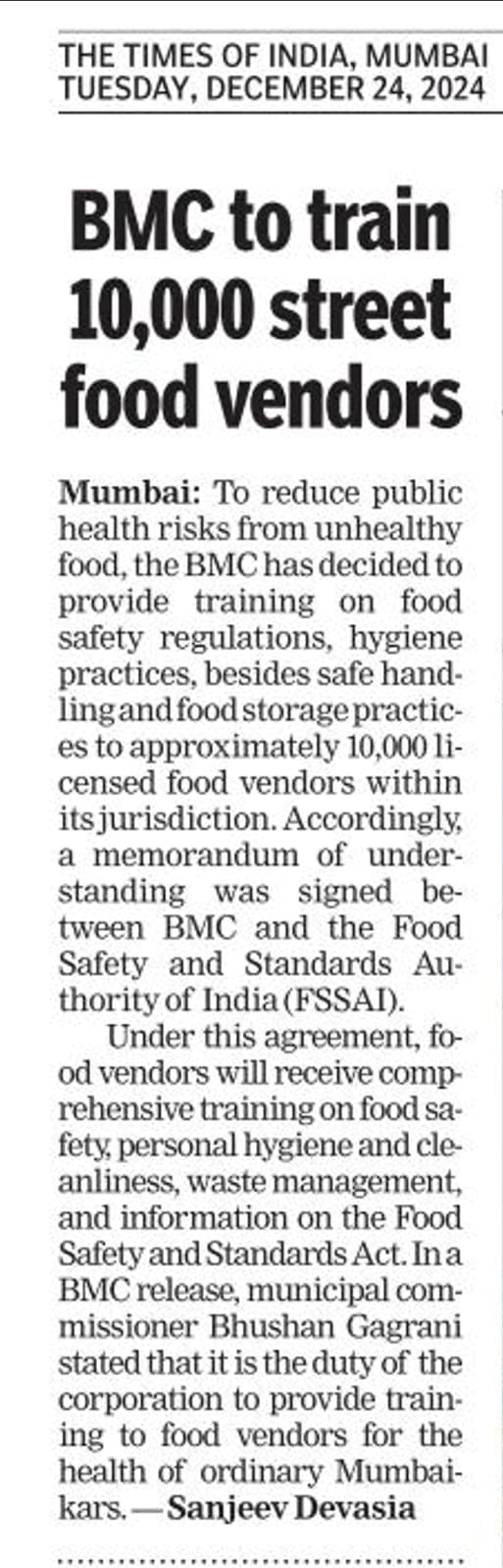
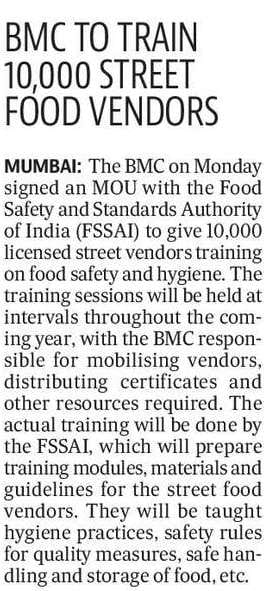
BMC signs MOU with FFSAI to train 10,000 street food vendors [Dated: 24-12-2024]
-
BMC Take Steps to Make Street Food Safer & More Hygienic in Mumbai [Dated: 24-12-2024]
-
FSSAI, BMC partner to take steps to make street food safer & more hygienic in Mumbai [Dated: 24-12-2024]
-
BMC to train 10,000 Street Food Vendors [0.11 MB] [Dated: 24-12-2024]
-
BMC to train 10,000 Street Food Vendors[0.04 MB] [Dated: 24-12-2024]
-
FSSAI reinforces food safety compliance amongst eCommerce food business operators [Dated: 14-11-2024]
-
FSSAI directs e-commerce companies to ensure a 45-day shelf life for food items [Dated: 13-11-2024]
-
FSSAI directs online platforms to deliver food items with minimum 45-day shelf life [Dated: 13-11-2024]
-
FSSAI 45th CAC Meeting Highlights Importance of Enhanced Food Safety for Tourist Destinations in Light of Tourist Season [Dated: 08-11-2024]
-
FSSAI 45th CAC meeting highlights importance of enhanced food safety in tourist destinations [Dated: 08-11-2024]
-
FSSAI discusses challenges faced by rice millers [Dated: 08-10-2024]
-
FSSAI hosts meeting for rice millers and fortified rice kernel manufacturers to enhance food safety standards [Dated: 08-10-2024]
-
FSSAI Convenes Meeting to Strengthen Food Safety Standards and Fortification Compliance [Dated: 08-10-2024]
-
India Pushes for Global Guidelines on Probiotics at Codex Committee [Dated: 07-10-2024]
-
India participates in 44th session of codex committee on nutrition and foods for special dietary uses [Dated: 07-10-2024]
-
First Lady of Maldives Discusses Food Safety Collaboration with India [Dated: 07-10-2024]
-
Maldives 1st Lady visits FSSAI office, discusses aspects of food standards [Dated: 07-10-2024]
-
India leads the way to strengthen global food safety ecosystem [Dated: 24-09-2024]
-
Global food regulators summit 2024 concludes with pledge to strengthen food safety [Dated: 23-09-2024]
-
FSSAI sign MoU with Brazil’s Ministry of Agriculture and Livestock [Dated: 23-09-2024]
-
FSSAI and Bhutans BFDA Strengthen Collaboration to Enhance Food Safety and Trade [Dated: 23-09-2024]
-
India and Bhutan strengthen collaboration on food safety [Dated: 23-09-2024]
-
This Indian state has secured top position in FSSAI’s State Food Safety Index 2024 for second time in a row [Dated: 23-09-2024]
-
Kerala tops food safety index 2024 list, check where other states stand [Dated: 23-09-2024]
-
Kerala Tops The Food Safety Index 2024 For Second Consecutive Year [Dated: 22-09-2024]
-
FSSAI signs MoU with Brazil’s Ministry of Agriculture and Livestock in the area of food safety [Dated: 22-09-2024]
-
Global Food Regulators Summit 2024 concludes with pledge to strengthen food safety systems across globe [Dated: 22-09-2024]
-
Harmonization of food standards is critical to thrive globalized food trade: Anupriya Patel [Dated: 21-09-2024]
-
Global Food Regulators Summit 2024 concludes with pledge to strengthen food safety systems across globe [Dated: 21-09-2024]
-
Global Food Regulators Summit 2024 concludes with pledge to strengthen food safety systems across globe [Dated: 21-09-2024]
-
This Indian State Retains Top Spot In Food Safety Index 2024 [Dated: 21-09-2024]
-
Kerala once again tops food safety ranking, Tamil Nadu is second [Dated: 20-09-2024]
-
Kerala, Tamil Nadu, J&K top three performers in FSSAI’s State Food Safety Index [Dated: 20-09-2024]
-
This Indian state tops food safety ranking, details inside [Dated: 20-09-2024]
-
Govt launches portal to send s on food import rejections [Dated: 20-09-2024]
-
Food regulators role crucial; Ministry developing standards for requirements : JP Nadda [Dated: 20-09-2024]
-
JP Nadda inaugurates second Global Food Regulators Summit 2024 [Dated: 20-09-2024]
-
Nadda unveils logo and brochures of Global Food Regulators Summit 2024 [Dated: 19-09-2024]
-
Union Health Minister J P Nadda unveils logo and brochures of Global Food Regulators Summit 2024 [Dated: 18-09-2024]
-
Nadda unveils logo of Global Food Regulators Summit [Dated: 17-09-2024]
-
India to host 2nd edition of Global Food Regulators Summit from September 19 [Dated: 17-09-2024]
-
India to Host Global Food Regulators Summit 2024 with Focus on Enhancing Food Safety Standards [Dated: 17-09-2024]
-
Union Health Minister JP Nadda unveils logo of Global Food Regulators Summit 2024 [Dated: 17-09-2024]
-
FSSAI 44th CAC meeting underscores importance of strengthening food safety infrastructure & curbing pesticide use [Dated: 27-08-2024]
-
FSSAI proposes Inter-Ministerial committee to reduce pesticide usage [Dated: 24-08-2024]
-
FSSAI 44th CAC Meeting Underscores the Importance of Strengthening Food Safety Infrastructure and Curbing Pesticide Use [Dated: 24-08-2024]
-
FSSAI emphasises need to prohibit use of pesticides to ensure food safety [Dated: 23-08-2024]
-
FSSAI launches project to address microplastic contamination in Indian food products [Dated: 19-08-2024]
-
FSSAI to check microplastic contamination in Indian foods [Dated: 19-08-2024]
-
FSSAI Begins Project on Microplastic Contamination[0.12 MB] [Dated: 19-08-2024]
-
FSSAI launches project to detect microplastics in food [Dated: 18-08-2024]
-
FSSAI begins to take steps to address microplastic contamination in Indian food products [Dated: 18-08-2024]
-
FSSAI launches project to combat Microplastic Contamination in food [Dated: 18-08-2024]
-
Fssai launches project to check microplastic contamination in food [Dated: 18-08-2024]
-
FSSAI launches project to assess prevalence of microplastics in Indian food products [Dated: 18-08-2024]
-
FSSAI launches a project to address microplastic contamination in Indian food [Dated: 18-08-2024]
-
FSSAI launches project to address microplastic contamination in Indian food products [Dated: 18-08-2024]
-
FSSAI scaling up training programmes for street vendors across country: CEO [Dated: 16-08-2024]
-
FSSAI CEO meets BMC Commissioner, on street food safety and adulteration testing [Dated: 16-08-2024]
-
FSSAI chief meets top officials, focus on food safety and hygiene ahead of festival season [Dated: 15-08-2024]
-
Mumbai: FSSAI CEO Meets BMC Commissioner To Enhance Food Hygiene And Testing [Dated: 15-08-2024]
-
Mumbai: FSSAI and BMC Join Hands to Enhance Street Food Safety [Dated: 14-08-2024]
-
Mumbai: FSSAI CEO discusses enhancing food safety, hygiene in city with BMC [Dated: 14-08-2024]
-
FSSAI chief meets civic commissioner to increase safety and hygiene of street food [Dated: 14-08-2024]
-
स्ट्रीट फूड विक्रेताओं का पंजीकरण शुल्क माफ: नड्डा[0.13 MB] [Dated: 21-07-2024]
-
स्ट्रीट फूड विक्रेताओं को प्रति वर्ष पंजीकरण शुल्क नहीं[0.13 MB] [Dated: 21-07-2024]
-
Nadda directs FSSAI to waive off registration fee for street food vendors [Dated: 20-07-2024]
-
J P Nadda directs FSSAI to waive off registration fee of Rs 100 per year for street food vendors [Dated: 20-07-2024]
-
Health Ministry directs FSSAI to waive off registration fee for street food vendors [Dated: 20-07-2024]
-
India News | Health Minister JP Nadda Highlights Importance of Training for Street Food Vendors at FSSAI Awareness Programme [Dated: 20-07-2024]
-
JP Nadda urges street food vendors to embrace learning for business growth at training programme [Dated: 20-07-2024]
-
J P Nadda appreciates remarkable leap taken in the area of food safety by FSSAI [Dated: 17-07-2024]
-
Health Minister JP Nadda reviews various initiatives taken by FSSAI [Dated: 15-07-2024]
-
Nadda visits FSSAI hqs in capital, emphasises on empowering consumers on food safety issues [Dated: 15-07-2024]
-
Total Sugar, Salt And Saturated Fat In Packaged Food To Be Displayed In Bold And Bigger Font On Label: Food Authority [Dated: 08-07-2024]
-
Fat, sugar and salt should be labelled in bold letters, bigger font on packaged food: FSSAI [Dated: 07-07-2024]
-
FSSAI To Make Mandatory Labelling of Salt, Sugar, Fat on Packaged Food Items in Bold Letters, Bigger Font [Dated: 07-07-2024]
-
Nutritional information must be highlighted with bigger fonts and bold letters, says FSSAI [Dated: 07-07-2024]
-
FSSAI approves nutritional labelling for packaged food in bold letters, bigger fonts [Dated: 07-07-2024]
-
FSSAI to make mandatory labelling of salt, sugar and fat on packaged food items in bold letters and bigger font size [Dated: 07-07-2024]
-
FSSAI says nutritional information must be highlighted with bigger fonts and bold letters [Dated: 07-07-2024]
-
FSSAI approves proposal for bolder nutritional information on food packets [Dated: 06-07-2024]
-
Food safety body okays proposal for bolder nutritional info on packaged food [Dated: 06-07-2024]
-
FSSAI introduces bigger font & bold letters for nutrition labels of sugar, salt, & saturated fat [Dated: 06-07-2024]
-
‘Bold letter, bigger font’: Check out food safety body’s new labelling rules [Dated: 06-07-2024]
-
Codex Alimentarius Commissions 86th Session: Global Leaders Push for Enhanced Food Safety and Trade Standards [Dated: 05-07-2024]
-
India participates in 86th session of Executive Committee of Codex [Dated: 05-07-2024]
-
India pitches for strengthening quality standards for spices at global meet [Dated: 04-07-2024]
-
मसालों के लिठगà¥à¤£à¤µà¤¤à¥à¤¤à¤¾ मानकों को मजबूत करने के पकà¥à¤· में à¤à¤¾à¤°à¤¤ [Dated: 03-07-2024]
-
India pitches for strengthening quality standards for spices [Dated: 03-07-2024]
-
India supports advancement of standards for spices to enhance international trade [Dated: 03-07-2024]
-
FSSAI orders food businesses to remove misleading claims of ‘100 fruit juice’ from packaging; here’s what you need to know [Dated: 05-06-2024]
-
Reconstituted products cant have 100 fruit juice tag: FSSAI [Dated: 04-06-2024]
-
Remove claim of 100 fruit juice from labels, ads: FSSAI directs FBOs [Dated: 04-06-2024]
-
No more claims of 100 fruit juice on labels & ads, FSSAI issue directions [Dated: 04-06-2024]
-
FSSAI Mandates Immediate Removal of ‘100 Fruit Juice’ Claims from Labels and Ads [Dated: 04-06-2024]
-
Remove 100 fruit juice claims, FSSAI asks food business operators [Dated: 03-06-2024]
-
Remove claim of ‘100 fruit juice’ from label and ads, FSSAI directs food businesses [Dated: 03-06-2024]
-
Food companies cant claim 100 fruit juice: FSSAI [Dated: 03-06-2024]
-
FSSAI directs beverage companies to remove “100 fruit juice†claim from labels and ads [Dated: 03-06-2024]
-
Food Regulator Cracks Down On Misleading 100 Fruit Juice Labels [Dated: 03-06-2024]
-
FSSAI launches awareness campaign on food safety aspects at prominent markets of Delhi [Dated: 09-04-2024]
-
FSSAI launches awareness campaign on food safety aspects at prominent markets of Delhi [Dated: 09-04-2024]
-
FSSAI Launches Extensive Food Safety Awareness Campaign in Delhi Markets [Dated: 09-04-2024]
-
FSSAI advises e-comm platforms to ensure appropriate categorisation of food products sold on their website [Dated: 05-04-2024]
-
FSSAI asks e-commerce platforms to ensure appropriate categorization of energy drinks [Dated: 03-04-2024]
-
BackBack E-commerce firms to ensure proper classification for health, energy drinks, says food regulator [Dated: 02-04-2024]
-
E-commerce sites told to classify food items correctly [Dated: 02-04-2024]
-
FSSAI directs e-commerce platforms to adhere to norms for health, energy drinks classification [Dated: 02-04-2024]
-
FSSAI directs e-commerce FBOs to classify food being sold as health drinks [Dated: 02-04-2024]
-
FSSAI asks all e-commerce Food Business Operators to ensure appropriate categorization of food products being sold on their websites [Dated: 02-04-2024]
-
FSSAI asks States to prepare surveillance plan on anti-microbial resistance [Dated: 20-03-2024]
-
100 jails certified as Eat Right Campuses as part of FSSAI’s nationwide campaign for safe, healthy and sustainable food [Dated: 19-03-2024]
-
FSSAI looks to train tea planters to help reduce pesticide levels [Dated: 18-03-2024]
-
Modernization of Food Streets: India’s SOP discussed at the 54th session of the Codex Committee on Food Hygiene in Nairobi, Kenya [Dated: 14-03-2024]
-
Modernisation of Food Streets: India’s SOP discussed at Codex Committee on Food Hygiene session in Kenya [Dated: 13-03-2024]
-
Modernisation Of Food Streets: Indias SOP Discussed At Codex Committee On Food Hygiene Session In Kenya [Dated: 13-03-2024]
-
India’s SOP discussed at Codex Committee on Food Hygiene session [Dated: 13-03-2024]
-
India presents modernization SOP for food streets at Codex Committee Meeting [Dated: 13-03-2024]
-
Modernisation of Food Streets: Indias SOP discussed at Codex Committee on Food Hygiene session in Kenya [Dated: 13-03-2024]
-
Modernisation of Food Streets: Indias SOP discussed at Codex Committee on Food Hygiene session in Kenya [Dated: 13-03-2024]
-
Modernization of Food Streets: India’s SOP discussed at the 54th session of the Codex Committee on Food Hygiene in Nairobi, Kenya [Dated: 13-03-2024]
-
Modernization of Food Streets: India’s SOP discussed at the 54th session of the Codex Committee on Food Hygiene in Nairobi, Kenya [Dated: 13-03-2024]
-
India Launches Modernization SOP for Food Streets at 54th Codex Committee Meeting [Dated: 13-03-2024]
-
Modernisation of Food Streets: Indias SOP discussed at Codex Committee on Food Hygiene session in Kenya [Dated: 13-03-2024]
-
150 railway stations achieve ‘Eat Right Station’ certification from FSSAI [Dated: 29-02-2024]
-
FSSAI says 150 railway stations are now certified as “Eat Right Stations†[Dated: 29-02-2024]
-
150 railway stations achieve ‘Eat Right Station’ certification from FSSAI [Dated: 29-02-2024]
-
FSSAI Awards Eat Right Station Certification to 150 Railway Stations Nationwide [Dated: 29-02-2024]
-
इन 150 सà¥à¤Ÿà¥‡à¤¶à¤¨à¥‹à¤‚ में मिलता है सबसे साफ खाना, FSSAI ने दिया Eight Right Station सरà¥à¤Ÿà¤¿à¤«à¤¿à¤•à¥‡à¤Ÿ [Dated: 29-02-2024]
-
Safety first: FSSAI imparts training to food handlers of government canteens [Dated: 17-02-2024]
-
FSSAI Empowers Food Safety: Training Initiative Expands to Government Bhawans Nationwide [Dated: 17-02-2024]
-
FSSAI certifies 500 Hospitals across the nation as ‘Eat Right Campus’ [Dated: 16-02-2024]
-
FSSAI takes stride towards ensuring food safety in all bhawans of states, UTs [Dated: 16-02-2024]
-
FSSAI conducts training programs to guarantee food safety in all government buildings across states, union territories, and government office cafeterias in Delhi [Dated: 16-02-2024]
-
Safe food at workplace: FSSAI certifies 500 hospitals as ‘Eat Right Campuses’ [Dated: 15-02-2024]
-
More than 500 hospitals certified as Eat Right Campus by FSSAI [Dated: 14-02-2024]
-
More than 500 hospitals certified as Eat Right Campus by FSSAI [Dated: 14-02-2024]
-
à¤à¤«à¤à¤¸à¤à¤¸à¤à¤†à¤ˆ ने 500 से अधिक असà¥à¤ªà¤¤à¤¾à¤²à¥‹à¤‚ को ‘ईट राइट कैंपस’ के रूप में किया पà¥à¤°à¤®à¤¾à¤£à¤¿à¤¤ [Dated: 14-02-2024]
-
à¤à¤«à¤à¤¸à¤à¤¸à¤à¤†à¤ˆ ने 500 से अधिक असà¥à¤ªà¤¤à¤¾à¤²à¥‹à¤‚ को ‘ईट राइट कैंपस’ के रूप में किया पà¥à¤°à¤®à¤¾à¤£à¤¿à¤¤ [Dated: 14-02-2024]
-
FSSAI approves amendments in regulations to do away with Agmark, BIS certification for food products [Dated: 06-02-2024]
-
FSSAI approves amendments in regulations to do away with Agmark, BIS certification for food products [Dated: 06-02-2024]
-
Top food regulator plans to make its certification must for all food products [Dated: 05-02-2024]
-
FSSAI approves amendments in regulations to do away with Agmark, BIS certification for food products [Dated: 05-02-2024]
-
Govt amends food safety rules, only FSSAI nod mandatory for products [Dated: 05-02-2024]
-
FSSAI cracks down on violations in Delhi, advocates bio-pesticides for safe tea production[0.46 MB] [Dated: 25-01-2024]
-
FSSAI Finds Rs 1 Crore Worth Expired Beer[0.26 MB] [Dated: 24-01-2024]
-
FSSAI seizes 45 metric ton of expired beer, Takes Swift Action against Violation of Food Safety and Standards Act 2006 [Dated: 24-01-2024]
-
FSSAI takes firm action, directs airlines and caterers to prioritize food safety compliance [Dated: 24-01-2024]
-
FSSAI seizes 45 metric ton of expired beer, conducts further investigation [Dated: 23-01-2024]
-
FSSAI directs airline caterers to comply with food safety regulations [Dated: 23-01-2024]
-
FSSAI directs airline caterers to comply with food safety regulations [Dated: 23-01-2024]
-
FSSAI uncovers stockpile of expired beer, takes swift action against violation of FSS Act 2006 [Dated: 22-01-2024]
-
FSSAI CEO Urges To Ban Use Of Unauthorised Pesticides In Tea Farms [Dated: 22-01-2024]
-
FSSAI engages in discussion with tea growers and planters in Assam to ensure safety and quality of tea production [Dated: 22-01-2024]
-
FSSAI Seizes Stockpile Of Expired Beer From Dwarka, Delhi; Probe Undergoing [Dated: 19-01-2024]
-
FSSAI uncovers stockpile of expired beer, takes swift action [Dated: 19-01-2024]
-
चाय उतà¥à¤ªà¤¾à¤¦à¤¨ में जैव-कीटनाशकों का करें उपयोग: खादà¥à¤¯ नियामक [Dated: 19-01-2024]
-
FSSAI CEO stresses on adoption of bio-pesticides in tea production [Dated: 19-01-2024]
-
CEO, FSSAI Engages in Discussion with Tea Growers and Planters in Assam to Ensure Safety and Quality of Tea Production [Dated: 19-01-2024]
-
FSSAI Emphasises On Adoption Of Bio-Pesticides In Tea Production [Dated: 19-01-2024]
-
FSSAI Directs Airline Caterers To Comply With Food Safety Rules [Dated: 19-01-2024]
-
Airlines Food Safety : केंदà¥à¤° सरकार ने विमानन कंपनियों को दिठनिरà¥à¤¦à¥‡à¤¶, खाने-पीने में लापरवाही पर होगा à¤à¤•à¥à¤¶à¤¨ [Dated: 19-01-2024]
-
फà¥à¤²à¤¾à¤‡à¤Ÿ में सà¥à¤°à¤•à¥à¤·à¤¿à¤¤ खान-पान सà¥à¤¨à¤¿à¤¶à¥à¤šà¤¿à¤¤ कराà¤à¤‚, à¤à¤¯à¤°à¤²à¤¾à¤‡à¤‚स-कैटररà¥à¤¸ को FSSAI का निरà¥à¤¦à¥‡à¤¶, पैसेंजरà¥à¤¸ के लिठà [Dated: 19-01-2024]
-
Food safety authority finds stockpile of expired beer, takes swift action [Dated: 18-01-2024]
-
à¤à¤«à¤à¤¸à¤à¤¸à¤à¤†à¤ˆ ने दिलà¥à¤²à¥€ के दà¥à¤µà¤¾à¤°à¤•à¤¾ से ‘à¤à¤•à¥à¤¸à¤ªà¤¾à¤¯à¤°â€™ हो चà¥à¤•à¥€ बियर का जखीरा जबà¥à¤¤ किया [Dated: 18-01-2024]
-
à¤à¤«à¤à¤¸à¤à¤¸à¤à¤†à¤ˆ ने दिलà¥à¤²à¥€ के दà¥à¤µà¤¾à¤°à¤•à¤¾ से ‘à¤à¤•à¥à¤¸à¤ªà¤¾à¤¯à¤°â€™ हो चà¥à¤•à¥€ बियर का जखीरा जबà¥à¤¤ किया [Dated: 18-01-2024]
-
पैसेंजरà¥à¤¸ के खाने-पीने में लापरवाही पड़ेगी à¤à¤¾à¤°à¥€, विमानन कंपनियों को मिले सरकार से ये निरà¥à¤¦à¥‡à¤¶ [Dated: 18-01-2024]
-
FSSAI Directs Airline Caterers To Prioritise Food Safety, Asks To Label Containers of Flight Meals [Dated: 18-01-2024]
-
Food Authority Directs Airline Caterers To Prioritize Food Safety [Dated: 18-01-2024]
-
Mandaviya inaugurates first healthy & hygienic food street at Neelkanth Van[0.32 MB] [Dated: 17-01-2024]
-
FSSAI directs airline caterers to comply with food safety regulations [Dated: 17-01-2024]
-
FSSAI directs airlines and caterers to prioritize food safety compliance [Dated: 17-01-2024]
-
Worm in IndiGo sandwich fallout: Enhance food safety protocols, flight caterers told [Dated: 17-01-2024]
-
FSSAI directs airlines, flight caterers to comply with food safety norms [Dated: 17-01-2024]
-
Airlines, caterers to now reveal info on nature, origin, manufacturing-related details of food served on flights [Dated: 17-01-2024]
-
Mandaviya inaugurates 1st healthy & hygienic food street ‘PRASADAM’ at Ujjain[unknown file size] [Dated: 15-01-2024]
-
Dr Mansukh Mandaviya inaugurates Healthy & Hygienic Food Street, PRASADAM, at Neelkanth Van, Mahakal Lok, in Ujjain[0.37 MB] [Dated: 15-01-2024]
-
CEO, FSSAI, visits Kardnur in Telangana as part of Viksit Bharat Sankalp Yatra[0.21 MB] [Dated: 10-01-2024]
-
Indias First Healthy Food Street Prasadam Launched In Ujjain[0.33 MB] [Dated: 09-01-2024]
-
Towards Swastha Bharat with healthy and hygienic food streets [Dated: 09-01-2024]
-
FSSAI and Central Armed Police Forces to sign Mou for promotion of millet[0.15 MB] [Dated: 01-11-2023]
-
Global Food Regulators Summit 2023 pledges to strengthen global food safety systems[0.71 MB] [Dated: 08-08-2023]
-
The Global Food Regulators Summit 2023 shows a new direction for transforming the global food regulatory landscape[0.41 MB] [Dated: 31-07-2023]
-
MoD & FSSAI sign MoU to promote use of millets & healthy eating practices among armed forces[0.78 MB] [Dated: 29-07-2023]
-
FSSAI organizes Global Food Regulators Summit in New Delhi[0.6 MB] [Dated: 28-07-2023]
-
Global Food Regulators Summit 2023 shows new direction for transforming global food regulatory landscape[0.35 MB] [Dated: 26-07-2023]
-
Global Food Regulators Summit 2023 paves way for robust food safety[0.43 MB] [Dated: 24-07-2023]
-
Maiden Global Food Regulators meet discusses regulatory challenges, explores ways to boost food safety[0.21 MB] [Dated: 23-07-2023]
-
Global Food Regulators Summit 2023 paves way for robust food safety[0.56 MB] [Dated: 23-07-2023]
-
Global Food Regulators Summit 2023 paves way for robust food safety[0.48 MB] [Dated: 23-07-2023]
-
2-Day Global Food Regulators Summit concludes[0.2 MB] [Dated: 22-07-2023]
-
Global Food Regulators Summit 2023 Concludes With Pledge To Strengthen Food Safety Systems[0.33 MB] [Dated: 22-07-2023]
-
Strengthening food safety systems through global collaboration [Dated: 22-07-2023]
-
Union Health Minister inaugurates first-ever Global Food Regulators Summit 2023[0.44 MB] [Dated: 20-07-2023]
-
Universal, Country-Specific Food Safety Standards Needed: Union Health Minister[0.38 MB] [Dated: 20-07-2023]
-
India to host global summit of food safety regulators[0.34 MB] [Dated: 19-07-2023]
-
Union Health Minister Dr. Mansukh Mandaviya to inaugurate Global Food Regulators Summit 2023[0.47 MB] [Dated: 19-07-2023]
-
Union Health Minister Dr. Mansukh Mandaviya to inaugurate Global Food Regulators Summit 2023[0.47 MB] [Dated: 19-07-2023]
-
Global Food Regulators Summit 2023 Tomorrow In Delhi To Draw Delegates From 40 Countries[0.72 MB] [Dated: 19-07-2023]
-
G-20 Global Food Regulators Summit to be held in Delhi on July 20-21[0.57 MB] [Dated: 18-07-2023]
-
G20 Global Food Regulators Summit in Delhi to focus on crucial aspects of food safety[0.58 MB] [Dated: 18-07-2023]
-
G20 Global Food Regulators Summit To Be Held In New Delhi On 20 & 21 July[0.7 MB] [Dated: 18-07-2023]
-
Ministry of Defence & FSSAI Sign MoU to Promote Millets Use Among Armed Forces[0.65 MB] [Dated: 17-07-2023]
-
G20 global food regulators summit to be held in New Delhi on July 20-21[0.58 MB] [Dated: 17-07-2023]
-
FSSAI warns nutraceutical companies in Himachal Pradesh[0.56 MB] [Dated: 13-07-2023]
-
Defence ministry, FSSAI to promote use of millets, healthy eating habits among armed forces[0.64 MB] [Dated: 13-07-2023]
-
Healthy millet menu in messes, MoD signs pact with food standards body[0.76 MB] [Dated: 13-07-2023]
-
Assuring High Standards With Quality Food [Dated: 29-06-2023]
-
FSSAI Warns HP Nutraceutical Firms; Launches Drive To Curb Menace Of Spurious Products[0.39 MB] [Dated: 21-06-2023]
-
FSSAI warns nutraceutical firms in Himachal Pradesh, takes 111 samples for inspection[0.37 MB] [Dated: 20-06-2023]
-
FSSAI warns nutraceutical cos in Himachal, orders action against FBOs allegedly producing spurious drugs[0.49 MB] [Dated: 20-06-2023]
-
FSSAI takes the first step towards scaling up training and capacity building[0.43 MB] [Dated: 17-06-2023]
-
Union Health Minister Dr Mansukh Mandaviya releases fifth State Food Safety Index in New Delhi[0.5 MB] [Dated: 07-06-2023]
-
Quality standards form bedrock of food safety [Dated: 06-06-2023]
-
Mansukh Mandaviya inaugurates National Training Centre for Food Safety and Standards Authority of India[0.41 MB] [Dated: 02-06-2023]
-
National Training Centre for FSSAI opens in Ghaziabad[0.42 MB] [Dated: 02-06-2023]
-
Dr. Mansukh Mandaviya Inaugurates National Training Centre & Launches FoSTaC App for Street Vendors[0.31 MB] [Dated: 02-06-2023]
-
National Training Centre Inaugurated for Food Safety and Standards Authority of India[0.54 MB] [Dated: 01-06-2023]
-
Food Regulator To Conduct Nationwide Survey On Milk And Milk Products, Heres Why[0.22 MB] [Dated: 26-05-2023]
-
Amid reports of shortage, FSSAI to conduct pan-India milk and milk products surveillance[0.52 MB] [Dated: 25-05-2023]
-
FSSAI To Conduct Pan-Indian Milk And Milk Products Surveillance To Curb Adulteration[0.26 MB] [Dated: 25-05-2023]
-
FSSAI To Conduct PAN-India Surveillance Of Milk, Milk Products[0.49 MB] [Dated: 25-05-2023]
-
Indias food safety authority to begin anti-adulteration drive for milk and milk products[0.38 MB] [Dated: 25-05-2023]
-
FSSAI Announces To Conduct Nationwide Surveillance Of Dairy Products To Curb Adulteration[0.46 MB] [Dated: 25-05-2023]
-
Food regulator FSSAI to conduct PAN-India milk and milk products surveillance[0.26 MB] [Dated: 25-05-2023]
-
FSSAI working on standards for nutraceuticals[0.26 MB] [Dated: 17-05-2023]
-
FSSAI reconstitutes scientific panels to notify food standards[0.2 MB] [Dated: 17-05-2023]
-
Panel on standards for processed food[0.21 MB] [Dated: 07-05-2023]
-
Food Safety and Standards Authority CEO stresses on raising awareness[0.22 MB] [Dated: 03-05-2023]
-
FSSAI seizes 575 kg of mangoes ripened using ethylene in unapproved way from Coimbatore shops[0.34 MB] [Dated: 30-04-2023]
-
FSSAI took action in 32 cases for making misleading claims[0.26 MB] [Dated: 29-04-2023]
-
FSSAI sends notices to food business operators for misleading advertisements[0.18 MB] [Dated: 28-04-2023]
-
FSSAI finds 32 new cases of misleading ads, claims by food biz operators[0.32 MB] [Dated: 28-04-2023]
-
Misleading ads: FSSAI may slap notices on food business operators[0.22 MB] [Dated: 28-04-2023]
-
FSSAIs FOSCOS web application[0.35 MB] [Dated: 22-04-2023]
-
FSSAI Action Against Misleading Claims & Advertisements by FBOs[0.57 MB] [Dated: 22-04-2023]
-
Actions against food companies involved in misleading claims[0.28 MB] [Dated: 22-04-2023]
-
FSSAI’S FOSCOS web application to be available in regional languages[0.32 MB] [Dated: 21-04-2023]
-
FOSCOS web application of FSSAI to be available in regional languages[0.25 MB] [Dated: 21-04-2023]
-
FSSAI talks tough against unauthorised use of calcium carbide for fruit ripening[0.31 MB] [Dated: 20-04-2023]
-
Telangana: Yadadri, Wargal temples get Eat Right Place of Worship certification[0.41 MB] [Dated: 29-03-2023]
-
Eat Right Challenge for Districts Ranking[0.52 MB] [Dated: 25-03-2023]
-
In a first, FSSAI releases a compendium on millet standards[0.41 MB] [Dated: 20-03-2023]
-
FSSAI mulls guidelines on use of health supplements, nutraceuticals[0.51 MB] [Dated: 17-03-2023]
-
FSSAI asks traders, FBOs to follow correct procedure for artificial ripening[1.22 MB] [Dated: 12-03-2023]
-
States to deploy mobile testing vans to check milk adulteration[0.12 MB] [Dated: 07-03-2023]
-
FSSAI specifies comprehensive group standard for millets[0.34 MB] [Dated: 24-02-2023]
-
FSSAI notifies regulatory standards for basmati rice[0.53 MB] [Dated: 13-01-2023]
-
Regulatory standards for Basmati rice[0.3 MB] [Dated: 13-01-2023]
-
Regulatory standards for Basmati rice[0.45 MB] [Dated: 13-01-2023]
-
Regulatory standards for Basmati rice[0.49 MB] [Dated: 13-01-2023]
-
फतेहपà¥à¤° में जिला खादà¥à¤¯ सà¥à¤°à¤•à¥à¤·à¤¾ टीम ने लिठखादà¥à¤¯ पदारà¥à¤¥à¥‹à¤‚ के लिठसैंपल[0.31 MB] [Dated: 23-02-2022]
-
Explained: What Is Eat Right Campus Tag Given By FSSAI[0.29 MB] [Dated: 22-02-2022]
-
FSSAI issues notice on use of recycled plastics as food contact materials[0.11 MB] [Dated: 18-02-2022]
-
FSSAI issues direction on declaration of RDA on label[0.11 MB] [Dated: 17-02-2022]
-
Siegwerk Launches VEGA - Mineral Oil Free Inks in India[0.27 MB] [Dated: 17-02-2022]
-
4 police stations declared ‘EatRight campus’ by FSSAI[0.19 MB] [Dated: 16-02-2022]
-
Sweets FBOs need not get licence modified under new category 18[0.28 MB] [Dated: 23-10-2021]
-
States told to conduct drive against black salt adulteration; report sought[0.28 MB] [Dated: 23-10-2021]
-
SMVD Shrine Board Adopts Project ‘BHOG’ Under Eat Right Initiative[0.41 MB] [Dated: 23-10-2021]
-
Chairperson FSSAI reviews functioning of J&K Drug & Food Control Department[0.29 MB] [Dated: 22-10-2021]
-
Now, radiation processing of food, new kind of business in FoSCoS portal[0.12 MB] [Dated: 27-09-2021]
-
FSSAI to develop standards for fortified rice kernels[0.43 MB] [Dated: 26-09-2021]
-
FSSAI notifies norms specifying stds for food supplements for sportspersons[0.22 MB] [Dated: 25-09-2021]
-
Karnataka ranks 9th in food safety among 20 large states Kerala and Tamil Nadu are ranked second and third, respectively[0.29 MB] [Dated: 24-09-2021]
-
Mansukh Mandaviya releases FSSAIs 3rd State Food Safety Index[0.22 MB] [Dated: 21-09-2021]
-
Union Health Minister Shri Mansukh Mandaviya releases 3rd State Food Safety Index[0.33 MB] [Dated: 21-09-2021]
-
Gujarat, Kerala and Tamil Nadu top FSSAI food safety index for 2020-21[0.07 MB] [Dated: 20-09-2021]
-
FSSAI plans to introduce ‘front of package label’ to regulate junk foods[0.4 MB] [Dated: 20-09-2021]
-
FSSAI to develop clean street food hub in Doon[0.25 MB] [Dated: 31-08-2021]
-
25 anganvadis bag FSSAI’s ‘Hygiene Rating Certificate’[0.29 MB] [Dated: 30-08-2021]
-
Goa: Hygiene audit must for food, sweet outlets, says FDA[0.13 MB] [Dated: 29-08-2021]
-
Vitamin B12 Rich Foods: 7 Foods That May Load You Up With Energy[0.35 MB] [Dated: 29-08-2021]
-
Experts demand rollout of strict front packaging norms at the earliest[0.19 MB] [Dated: 28-08-2021]
-
FSSAI makes it easy for small businesses with registration for proprietary food[0.31 MB] [Dated: 10-08-2021]
-
Food safety everyone’s responsibility’[0.35 MB] [Dated: 09-08-2021]
-
FSD holds ‘food safety training and certification course’[0.29 MB] [Dated: 08-08-2021]
-
Clean Street Food Hub to be set up in Tiruchi soon[0.34 MB] [Dated: 07-08-2021]
-
CCPs hygiene rating scheme draws good response[0.33 MB] [Dated: 07-08-2021]
-
Online campaign on FSSAI registration[0.24 MB] [Dated: 01-08-2021]
-
FSSAI to reoperationalise norms governing feed for milk producing animals[0.14 MB] [Dated: 31-07-2021]
-
FSSAI bans reuse of cooking oil in Jammu[0.18 MB] [Dated: 31-07-2021]
-
KFC’s India Sahyog supports 100 small food businesses in Bangalore[0.16 MB] [Dated: 31-07-2021]
-
Simplification of regulatory regime key priority towards food safety[0.17 MB] [Dated: 30-07-2021]
-
NSRLM conducts FSSAI registration for SGHs across 11 districts[0.21 MB] [Dated: 30-07-2021]
-
FSSAI withdraws notice on salmonella in dried oregano from Chile[0.11 MB] [Dated: 27-07-2021]
-
600 litres of used oil collected from Meenakshi temple[0.09 MB] [Dated: 27-07-2021]
-
FSSAI mulling using next-gen technology tools to ensure food safety, quality[0.35 MB] [Dated: 27-07-2021]
-
FSSAI issues directions for FBOs manufacturing Indian sweets & snacks[0.13 MB] [Dated: 27-07-2021]
-
US apple shipments to India ‘disrupted’[0.13 MB] [Dated: 27-07-2021]
-
US says FSSAI’s non-GMO certification requirement has hit its apple exports[0.5 MB] [Dated: 27-07-2021]
-
Parliament Passes Bill To Declare Two Food Technology Institutes As Institutions Of National Importance[0.25 MB] [Dated: 26-07-2021]
-
Protein Week 2021: Experts Call For Attention to Protein Quality[0.27 MB] [Dated: 26-07-2021]
-
Food businesses need to conduct mandatory product testing twice a year[0.31 MB] [Dated: 22-07-2021]
-
With 80 Indians deficient in Vitamin D, right nutrition is the need of the hour[0.68 MB] [Dated: 21-07-2021]
-
FSSAI withdraws recall order for imported dried oregano[0.28 MB] [Dated: 20-07-2021]
-
Ludhiana MC to promote healthy eating habits under ‘Eat Smart Challenge’[0.42 MB] [Dated: 16-07-2021]
-
Customs reduces clearance time for edible oil consignments at ports[0.53 MB] [Dated: 16-07-2021]
-
We are what we eat[0.61 MB] [Dated: 16-07-2021]
-
FSSAI asks port officials to clear import consignments of pulses on priority[0.46 MB] [Dated: 15-07-2021]
-
Sweets Shops in Kashmir awarded Hygiene Rating Certificate by FSSAI[0.49 MB] [Dated: 15-07-2021]
-
‘Langars’ & ‘Prasads’ to Get FSSAI’s BHOG Certifications[0.49 MB] [Dated: 14-07-2021]
-
Temple kitchens inspected by FSSAI for Bhog certification[0.3 MB] [Dated: 02-07-2021]
-
Pre-audit carried out at three temples for BHOG certification[0.49 MB] [Dated: 01-07-2021]
-
Maha & Guj crack down on food adulteration, ace food safety initiatives[0.5 MB] [Dated: 01-07-2021]
-
FSSAI extends date for complying with packaged drinking water regulations[0.38 MB] [Dated: 29-06-2021]
-
HRAWI holds online training on FSSAI Covid-19 focused FoSTaC programme[0.39 MB] [Dated: 29-06-2021]
-
Ban on blending of mustard oil will benefit farmers, lead to more production of healthier[0.46 MB] [Dated: 28-06-2021]
-
FHRAI request food safety regulator FSSAI to existing deadline for implementing new rules[0.32 MB] [Dated: 28-06-2021]
-
5 Trichy temples selected for FSSAI’s Bhog certification[0.29 MB] [Dated: 27-06-2021]
-
Temples asked to go for BHOG certification[0.4 MB] [Dated: 26-06-2021]
-
IIT Delhi’s New COVID-19 Test Kit Gives Results in 5 Minutes & Costs Just Rs 50[0.54 MB] [Dated: 26-06-2021]
-
Here’s how walnuts may help with yoga goals on International Yoga Day[0.58 MB] [Dated: 23-06-2021]
-
Impact Of Nutraceutical Sector In Post COVID Era[0.56 MB] [Dated: 23-06-2021]
-
Arun Singhal, CEO, FSSAI: Our technology-driven voluntary Hygiene Rating Scheme for food service establishments is getting a great response[0.6 MB] [Dated: 22-06-2021]
-
Lab test s fortified rice, not plastic[0.48 MB] [Dated: 21-06-2021]
-
Here’s how walnuts may help with yoga goals on International Yoga Day[0.58 MB] [Dated: 21-06-2021]
-
FSSAI to not allow modification of licence under FoSCoS beyond Jan 1[0.38 MB] [Dated: 21-06-2021]
-
Nagaland: Plastic Rice lab test shows presence of fortificants[0.42 MB] [Dated: 21-06-2021]
-
Need for Urgent and Rapid Implementation of WHO and FSSAI Guidelines[0.39 MB] [Dated: 21-06-2021]
-
An eye on nutritional security[0.44 MB] [Dated: 19-06-2021]
-
Fortified milk is critical for boosting health and immunity during Covid[0.48 MB] [Dated: 08-06-2021]
-
FSSAI celebrates World Food Safety Day[0.74 MB] [Dated: 08-06-2021]
-
Commissioner, FDA Reviews Food Safety Measures[0.46 MB] [Dated: 08-06-2021]
-
FSSAI has approved 65 rapid food testing kits/devices and this is the newest addition to the approved kits/ equipment[0.48 MB] [Dated: 07-06-2021]
-
World Food Safety Day 2021: Is our food safe for consumption?[0.53 MB] [Dated: 07-06-2021]
-
Food safety must be everyone’s business[0.5 MB] [Dated: 06-06-2021]
-
Scientific “cut offs†for salt, sugar and fats in processed foods is mandatory if India wants to prevent the looming NCD crisis[0.52 MB] [Dated: 05-06-2021]
-
Bakery products & fortification, regulations for fortification[0.49 MB] [Dated: 15-04-2021]
-
Eatsmart Cities Challenge and Transport 4 All Challenge Launched[0.33 MB] [Dated: 15-04-2021]
-
FSSAI reoperationalises licensing and regn amendment regulations 2020[0.46 MB] [Dated: 12-04-2021]
-
Finally, FSSAI issues order relating to determining ‘iron filings’ in tea[0.46 MB] [Dated: 10-04-2021]
-
Chandigarh Model Jail India’s first ‘Eat Right Campus’[0.51 MB] [Dated: 10-04-2021]
-
Food safety officials conduct raids on oil repackaging, manufacturing units[0.52 MB] [Dated: 08-04-2021]
-
BIS licence, a prerequisite for FSSAI licence to manufacture packaged drinking water[0.25 MB] [Dated: 06-04-2021]
-
Food Safety Cell Dimapur conducts ‘Eat Right’ campaigns[0.47 MB] [Dated: 04-04-2021]
-
Nations comply with FSSAI regulations on GM food imports[0.51 MB] [Dated: 24-03-2021]
-
Strong Front Of Package Labelling Must To Stem The Scourge Of Non Communicable Diseases[0.55 MB] [Dated: 23-03-2021]
-
Reports from govt-recg labs accepted for hygiene ratings to FBOs[0.47 MB] [Dated: 18-03-2021]
-
Plan to test anganwadi food by FSSAI labs[0.46 MB] [Dated: 17-03-2021]
-
Food fortification, a potent way to fight hidden hunger[0.32 MB] [Dated: 16-03-2021]
-
Department informs[0.29 MB] [Dated: 15-03-2021]
-
Rajya Sabha Passes Bill To Declare Two Food Technology Institutes As Institutions Of National Importance[0.52 MB] [Dated: 15-03-2021]
-
VMSIIHE – First Hospitality Institute In India Awarded By FSSAI With The Prestigious ‘Eat Right Campus’ Certification[0.49 MB] [Dated: 15-03-2021]
-
It is proposed to include ‘export’ to be regulated by FSSAI under FSS Act[0.54 MB] [Dated: 08-03-2021]
-
Supply fortified staples to fight morbidity, say experts[0.3 MB] [Dated: 07-03-2021]
-
Food fortification need of the hour[0.45 MB] [Dated: 07-03-2021]
-
FDA drive against erring five star hotel in Mumbai; kitchen sealed[0.46 MB] [Dated: 06-03-2021]
-
Food Fortification for Sustainable Community Nutrition[0.57 MB] [Dated: 03-03-2021]
-
FSSAI organises programme on hygiene[0.46 MB] [Dated: 03-03-2021]
-
Odisha plans to bolster food testing capacity, manpower[0.32 MB] [Dated: 03-03-2021]
-
Packaged food companies request FSSAI to keep some products out of front-of-pack labelling regulations[0.44 MB] [Dated: 03-03-2021]
-
FSSAIs GMO threshold for imported food crops ‘unacceptably high’, says letter to health minister[0.42 MB] [Dated: 25-02-2021]
-
FSSAI allows FBOs to import Inborn Errors of Metabolism food products until June 2021[0.47 MB] [Dated: 25-02-2021]
-
Veterinary college gets ‘Eat Right Campus’ tag[0.46 MB] [Dated: 25-02-2021]
-
FSSAI lays conditions for extension of lab accreditation[0.47 MB] [Dated: 18-02-2021]
-
FSSAI’s new policy limits industrial trans fats to 2 in all food items by Jan 2022[0.48 MB] [Dated: 18-02-2021]
-
Aspirational districts gear up for children’s nutrition[0.48 MB] [Dated: 18-02-2021]
-
FSSAI proposes proviso for use of coloured bottle for water packaging[0.48 MB] [Dated: 17-02-2021]
-
Plan for vending zones in GHMC areas yet to take off[0.53 MB] [Dated: 17-02-2021]
-
FSSAI notifies amendment regarding alcoholic beverage regulations specifying limit[0.48 MB] [Dated: 16-02-2021]
-
FSSAI notifies amendment regarding alcoholic beverage regulations specifying limit[0.48 MB] [Dated: 16-02-2021]
-
Non-compliance of mandatory declaration Provisions by E-commerce[0.61 MB] [Dated: 16-02-2021]
-
Vitamin D fortification necessary to fight deficiency, study says[0.41 MB] [Dated: 15-02-2021]
-
Cutting trans fat: On healthier food[0.49 MB] [Dated: 10-02-2021]
-
FSSAI notifies prohibition regulations with clarity on industrial trans fats[0.33 MB] [Dated: 09-02-2021]
-
FSSAI sets norms limiting use of industrial trans-fats by 2022[0.44 MB] [Dated: 09-02-2021]
-
FSSAI notifies regulations to limit trans fat in food items[0.5 MB] [Dated: 09-02-2021]
-
Assam: Jorhat in list of 150 districts selected for participation in FSSAI’s Eat Right Challenge[0.49 MB] [Dated: 09-02-2021]
-
FSSAI notifies prohibition regulations with clarity on industrial trans fats[0.47 MB] [Dated: 09-02-2021]
-
Trans-fatty acids to be limited to 2 in food products from January 2022[0.54 MB] [Dated: 09-02-2021]
-
FSSAI clarifies food crop importers will need to declare non-GMO status from March 1[0.33 MB] [Dated: 08-02-2021]
-
FSSAI notifies FBOs regarding rules to fortify ‘processed food’ sans fat, salt & sugar[0.47 MB] [Dated: 05-02-2021]
-
Food safety app to enable hassle-free licensing by officials[0.61 MB] [Dated: 05-02-2021]
-
Hygiene Rating & Safety of Food[0.47 MB] [Dated: 05-02-2021]
-
PAU holds training on food safety, handling[0.47 MB] [Dated: 03-02-2021]
-
EAT RIGHT CHALLENGE’ INITIATIVE OF FSSAI INAUGURATED BY DR. MK SHARMA[0.52 MB] [Dated: 01-02-2021]
-
FBOS asked to apply for FSSAI license online[0.47 MB] [Dated: 31-01-2021]
-
HRAWI continues FSSAIs FoSTaC Programme in 2021[0.72 MB] [Dated: 29-01-2021]
-
FSSAI modifies rules regarding enforcement of limits for trans fatty acid in veg oils[0.46 MB] [Dated: 29-01-2021]
-
FSSAI asks state authorities to form helpdesk for smoother licensing & regn[0.47 MB] [Dated: 27-01-2021]
-
CAIT alleges Amazon, Flipkart, Zomato and Swiggy of flouting rules[0.47 MB] [Dated: 25-01-2021]
-
Home chefs come under food safety dept lens[0.28 MB] [Dated: 21-01-2021]
-
FSSAI notifies on FSS Act and Good Agri Practices to address contaminants[0.25 MB] [Dated: 19-01-2021]
-
‘Do Not Eat Half-boiled Eggs, Undercooked Chicken’, Warn FSSAI’s Guidelines on Poultry Safety[0.71 MB] [Dated: 16-01-2021]
-
Eat Right India among top visionaries for Food Systems Vision Prize[0.46 MB] [Dated: 12-01-2021]
-
Folic acid awareness week: Why folic acid is an important public health issue[0.35 MB] [Dated: 08-01-2021]
-
Obtaining food safety licence made easy[0.48 MB] [Dated: 08-01-2021]
-
FSSAI caps trans fatty acids to 2 in all oils & fats by Jan 2022 to prevent thousands of deaths[0.48 MB] [Dated: 07-01-2021]
-
Trans Fatty Acids: Definition, Usage, Harmful effects, and Key Facts[0.66 MB] [Dated: 07-01-2021]
-
The future plan is to get Eat Right certificates for jails of Gujarat[0.51 MB] [Dated: 04-01-2021]
-
FSSAI’s new policy limits trans fats to 2 in all oils & fats by Jan 2022[0.48 MB] [Dated: 04-01-2021]
-
FSSAI slashes limit for trans fat levels in foods[0.49 MB] [Dated: 03-01-2021]
-
FSSAI issues draft for mandatory fortification of edible oil & packaged milk[0.47 MB] [Dated: 02-01-2021]
-
FSSAI gives 6 more months to comply with calcium, magnesium limits in packaged drinking water[0.42 MB] [Dated: 02-01-2021]
-
FSSAI prescribes labelling requirements of pre-packaged foods and display[0.47 MB] [Dated: 30-12-2020]
-
FBOs can make online request to reactivate rejected applications under FoSCoS[0.46 MB] [Dated: 29-12-2020]
-
Under FoSCoS, FBOs need to file annual return online only[0.47 MB] [Dated: 28-12-2020]
-
The colour of food must not blind us to its effects[0.47 MB] [Dated: 27-12-2020]
-
Make burger patty with sweet potato and oats; recipe inside[0.54 MB] [Dated: 26-12-2020]
-
‘Eat Right Pudukottai’ launched[0.46 MB] [Dated: 25-12-2020]
-
FSSAI notifies norms for permissible levels of micronutrients for fortifying processed food products[0.56 MB] [Dated: 23-12-2020]
-
FSSAI notifies standards for fortification of processed food products[0.31 MB] [Dated: 22-12-2020]
-
ADC Kupwara Reviews Functioning of ICDS[0.39 MB] [Dated: 21-12-2020]
-
FSSAI issues new manual for analysing aflatoxin in food[0.47 MB] [Dated: 21-12-2020]
-
CII’s 11th Food Safety Awards ceremony 2020[0.5 MB] [Dated: 21-12-2020]
-
FSSAI recommends these easy ways to make food more tasty and nutritious for adolescents[0.66 MB] [Dated: 19-12-2020]
-
KFC’s India Sahyog to support and revive 500 local & small food businesses[0.48 MB] [Dated: 19-12-2020]
-
Odisha gets better food safety ranking[0.23 MB] [Dated: 17-12-2020]
-
खाना सरà¥à¤µ करने से पहले रेसà¥à¤Ÿà¥‹à¤°à¥‡à¤‚ट खà¥à¤¦ आपको बताà¤à¤‚गे कैलोरी काउंट, जानिठये सरकारी नियम[0.65 MB] [Dated: 16-12-2020]
-
Quality Council of India & FSSAI launch scheme to approve Hygiene Rating Audit Agencies[0.39 MB] [Dated: 16-12-2020]
-
FSSAI blocks Category 13 related to nutritional use from proprietary food[0.47 MB] [Dated: 02-12-2020]
-
FSSAI sets up framework for Food Safety Emergency Response system[0.47 MB] [Dated: 02-12-2020]
-
FSSAI licence: Only 91 home-based food operators registered in district[0.3 MB] [Dated: 04-11-2020]
-
FHRAI hails FSSAI rules making regn mandatory for home-cooked food sellers[0.47 MB] [Dated: 03-11-2020]
-
No change in provisions for licensing & regn; online since 2011: FSSAI[0.48 MB] [Dated: 03-11-2020]
-
Centre to extend fortified rice scheme to 112 districts[0.48 MB] [Dated: 03-11-2020]
-
FCI asked to prepare comprehensive plan for fortified rice distribution[0.3 MB] [Dated: 03-11-2020]
-
Food safety van launched to check adulteration in Ludhiana[0.47 MB] [Dated: 03-11-2020]
-
New, Stricter Rules Limiting Trans Fat in Food Will Be Rolled Out Next Year: Centre[0.31 MB] [Dated: 03-11-2020]
-
FSSAI clarifies on Food for Special Medical Purpose in foods akin to drugs[0.46 MB] [Dated: 02-11-2020]
-
Simple tips to identify adulterated and fake food items[0.67 MB] [Dated: 26-10-2020]
-
Is it safe to eat out? | India Today Insight[0.65 MB] [Dated: 25-10-2020]
-
Check sweets for adulteration[0.3 MB] [Dated: 24-10-2020]
-
Renewed focus on nutrition, health, immunity, sustainability, meet told[0.48 MB] [Dated: 23-10-2020]
-
Is Your Khoya And Mawa For Festive Sweets Safe? FSSAI Suggests Getting Them Tested For Adulteration[0.51 MB] [Dated: 23-10-2020]
-
FSSAI initiates pan-India khoa quality survey[0.3 MB] [Dated: 22-10-2020]
-
Odisha: Home chefs to satiate your food cravings during pandemic[0.32 MB] [Dated: 20-10-2020]
-
FSSAI notifies norms on nutritional claims for groundnut, mustard, other oils[0.47 MB] [Dated: 20-10-2020]
-
Experts see fast food industry willing and on track to eliminate trans fats[0.47 MB] [Dated: 20-10-2020]
-
FDA Maha to conduct food safety campaigns till March 2021 under Eat Right[0.48 MB] [Dated: 24-09-2020]
-
Fortified rice ready in Trichy, to be distributed from Oct 1[0.29 MB] [Dated: 24-09-2020]
-
National Nutrition Month: Akshaya Patra Foundation Is Improving Nutritional Quality Of Mid-day Meals Through Fortification[0.81 MB] [Dated: 24-09-2020]
-
POSHAN Maah 2020: Food Safety Regulator Bans Selling Of Junk Food To Schoolchildren To Inculcate The Habit Of Healthy Eating[0.68 MB] [Dated: 23-09-2020]
-
No more milawat in mustard oil as FSSAI cracks down on adulteration[0.69 MB] [Dated: 23-09-2020]
-
POSHAN Maah 2020: Three Different Ways Of Food Fortification Explained[0.79 MB] [Dated: 15-09-2020]
-
National Nutrition Month: Can India Piggy Bank On Food Fortification To Achieve The Goal Of POSHAN Abhiyaan?[0.78 MB] [Dated: 15-09-2020]
-
Sale of junk food within 50 metres of school campus banned: FSSAI[0.74 MB] [Dated: 15-09-2020]
-
Over of food safety key, FSSAI fortification norms for bakery soon: Expert[0.33 MB] [Dated: 10-09-2020]
-
Healthy diet: FSSAI bans sales, ads of junk foods in school canteens, within 50 metres of campus[0.47 MB] [Dated: 08-09-2020]
-
FSSAI notifies regulations to ensure safe and wholesome food in schools[0.29 MB] [Dated: 07-09-2020]
-
National Nutrition Week: Experts Give Tips On Nutrition And Eating Habits During COVID-19[0.75 MB] [Dated: 07-09-2020]
-
Govt to provide loans to Street Vendors[0.49 MB] [Dated: 07-09-2020]
-
Food service cos with 10 or more outlets must mention calories against items[0.47 MB] [Dated: 07-09-2020]
-
Food Safety Authority Promotes Healthy Eating Habits And Food Sustainability Through A District Level Competition[0.78 MB] [Dated: 04-09-2020]
-
State receives seven Mobile Food Testing laboratories[0.5 MB] [Dated: 03-09-2020]
-
रांची:रिमà¥à¤¸ परिसर के कैंटिन व हाॅसà¥à¤Ÿà¤² में चल रहे मेस के खादà¥à¤¯ पदारà¥à¤¥à¤¾à¥‡à¤‚ की हà¥à¤ˆ जांच[0.71 MB] [Dated: 03-09-2020]
-
Let Your Kabuli Wala Help You Count On Tree Nuts To Enhance Immunity During COVID-19[0.61 MB] [Dated: 03-09-2020]
-
FSSAI to make GM Free certificate compulsory for 24 imports from Jan 1[0.47 MB] [Dated: 03-09-2020]
-
Enpowering India towards a Healthy Future[0.78 MB] [Dated: 02-09-2020]
-
9 Important Facts about Trans Fats or Trans Fatty Acids (TFAs)[0.61 MB] [Dated: 02-09-2020]
-
40 of Punjabis are Overweight : Call to Eliminate Artificial Trans Fats[0.48 MB] [Dated: 31-08-2020]
-
When Rajkummar Rao asked Indians to follow a healthy diet[0.45 MB] [Dated: 31-08-2020]
-
FSSAI launches drive against adulteration in the edible oil[0.3 MB] [Dated: 31-08-2020]
-
Food safety regulator cracks down on adulterated edible oil[0.55 MB] [Dated: 29-08-2020]
-
FSSAI collects cooking oil samples for quality tests[0.5 MB] [Dated: 28-08-2020]
-
FSSAI completes nationwide quality survey of edible oils[0.5 MB] [Dated: 28-08-2020]
-
FSSAI Launches Drive Against Adulteration In Edible Oil[0.6 MB] [Dated: 28-08-2020]
-
FSSAI gazettes stds for rice, cassava, chana sattu, mixed masala, spices[0.48 MB] [Dated: 24-08-2020]
-
Reducing trans fats content in foods to 2 by 2022 is possible: Experts[0.48 MB] [Dated: 24-08-2020]
-
‘No-GM’ certificate mandatory for imported food crops from January[0.29 MB] [Dated: 24-08-2020]
-
IITGN bags Eat Right Campus Award[0.3 MB] [Dated: 24-08-2020]
-
Hotel serves stale food to RDO, gets notice[0.28 MB] [Dated: 20-08-2020]
-
Trans-fats must go from Indian foods by 2022: Experts[0.61 MB] [Dated: 20-08-2020]
-
Government to finalize regulation to limit trans fats during covid - 19 pandemic[0.32 MB] [Dated: 20-08-2020]
-
FSSAI kick-starts Eat Right Challenge[0.3 MB] [Dated: 19-08-2020]
-
Strong Immunity Key for Fighting Covid-19, Says Health Min Harsh Vardhan[0.61 MB] [Dated: 19-08-2020]
-
Dr Harsh Vardhan presides over online orientation workshop held by FSSAI[0.35 MB] [Dated: 19-08-2020]
-
Chaat, paan cravings make people of Kanpur more vulnerable to Covid-19[0.35 MB] [Dated: 19-08-2020]
-
61.8 pc of deaths of Indians directly or indirectly related to faulty diet[0.44 MB] [Dated: 19-08-2020]
-
COVID Shows Different Response Based On Peoples Immunity Acquired Through Nutrition: Harsh Vardhan[0.59 MB] [Dated: 19-08-2020]
-
COVID shows different response based on peoples immunity acquired through nutrition: Harsh Vardhan[0.49 MB] [Dated: 19-08-2020]
-
Dr Harsh Vardhan digitally addresses FSSAI’s Eat Right Challenge Orientation Workshop[0.53 MB] [Dated: 19-08-2020]
-
FSSAI to finalise regulations for sale, promotion of ‘unhealthy’ products in schools soon[0.33 MB] [Dated: 18-08-2020]
-
FSSAI postpone written exam scheduled in September[0.26 MB] [Dated: 18-08-2020]
-
FSSAI gazettes stds for frozen beans, cauliflower, peas; compliance by ‘21[0.47 MB] [Dated: 18-08-2020]
-
New draft norms to include amendment on permission for 2 Khesari Dal[0.46 MB] [Dated: 14-08-2020]
-
FSSAI notifies amended norms on micro stds for meat, milk, fruits, chicken[0.39 MB] [Dated: 10-08-2020]
-
No sale of junk food within 50 metres of school campus: FSSAI[0.38 MB] [Dated: 09-08-2020]
-
Dr Harsh Vardhan presides over signing of MoU between CSIR and FSSAI for Collaborative Research and Information Dissemination regarding Food and Nutrition[0.1 MB] [Dated: 09-08-2020]
-
Norms limiting trans fats to 2 to be notified soon, Bakshi tells webinar[0.26 MB] [Dated: 08-08-2020]
-
Eat Right India Gets International Recognition[0.11 MB] [Dated: 08-08-2020]
-
Rockefeller Foundation selects FSSAI as finalist for Food System Vision Prize[0.2 MB] [Dated: 08-08-2020]
-
Relief for FBOs as FSSAI decides to extend validity of orders till Dec 31[0.47 MB] [Dated: 07-08-2020]
-
Covid-19: Centre asks states to strengthen scrutiny over slaughter houses[0.47 MB] [Dated: 06-08-2020]
-
The Rockefeller Foundation Announces 10 Finalists for the Food System Vision Prize[0.14 MB] [Dated: 06-08-2020]
-
Protein Week 2020: FSSAI urges citizens to include protein in diet, check details[0.49 MB] [Dated: 04-08-2020]
-
FSSAI extends grace period for renewal/registration of FSSAI licenses with HRANI efforts[0.6 MB] [Dated: 04-08-2020]
-
Food adulteration: How to test quality of food products? FSSAI releases booklets for students[0.47 MB] [Dated: 04-08-2020]
-
Mr Arun Singhal shared the intense efforts being made by FSSAI to regulate and organise the Indian food industry.[0.54 MB] [Dated: 29-07-2020]
-
ASCI cracks the whip on brands claiming to boost immunity in covid ad campaigns[0.36 MB] [Dated: 27-07-2020]
-
Save vegetable From Covid-19: FSSAI ने बताया सबà¥à¤œà¥€ को कोरोना पà¥à¤°à¥‚फ करने का तरीका[0.49 MB] [Dated: 27-07-2020]
-
Will food safety guidelines for sweets come to force in Tamil Nadu from August 1?[0.25 MB] [Dated: 26-07-2020]
-
Sweet Revolution: World Class Honey Testing Lab at Anand inaugurated[0.39 MB] [Dated: 26-07-2020]
-
Food Safety Authority cracks down on illegal meat shops, wet markets in Assam[0.4 MB] [Dated: 26-07-2020]
-
कमजोर इमà¥à¤¯à¥‚निटी वाले डाइट में शामिल करें 5 चीजें, FSSAI की सलाह[1.12 MB] [Dated: 26-07-2020]
-
FSSAI Recommends 6 Foods Rich In Vitamin-C To Boost Immunity[0.23 MB] [Dated: 25-07-2020]
-
Health dept teams collect nine samples of milk products from Sangrur, Ludhiana[0.51 MB] [Dated: 24-07-2020]
-
Greater quality checks soon on milk, edible oil, honey, meat & poultry, says FSSAI new CEO[0.52 MB] [Dated: 24-07-2020]
-
Food Safety Authority Cracks Down On Illegal Meat Shops, Wet Markets In Assam[0.39 MB] [Dated: 24-07-2020]
-
Greater quality checks soon on milk, edible oil, honey, meat & poultry, says FSSAI new CEO[0.45 MB] [Dated: 24-07-2020]
-
Deadline to display best before, mfg date for loose sweets extended till Oct 1: FSSAI[0.4 MB] [Dated: 24-07-2020]
-
FOOD SAFETY AUTHORITY CRACKS DOWN ON ILLEGAL MEAT SHOPS, WET MARKETS IN ASSAM[0.39 MB] [Dated: 24-07-2020]
-
Mission Fateh: Health Department Conduct Raids[0.31 MB] [Dated: 23-07-2020]
-
FSSAI to scale up `Eat Right Campus programme over next two years[0.41 MB] [Dated: 16-07-2020]
-
How To Keep Packaged Milk Clean Amid COVID-19? FSSAI Shares Some Tips[0.5 MB] [Dated: 15-07-2020]
-
Are you cleaning your veggies, fruits right?[0.5 MB] [Dated: 14-07-2020]
-
FSSAI prescribes new labelling rules for honey[0.49 MB] [Dated: 07-07-2020]
-
While The World Talks About China, How Safe Are Indian Wet Markets?[0.32 MB] [Dated: 06-07-2020]
-
“FDCA Gujarat is very strict, Rs 15 cr fine imposedâ€[0.52 MB] [Dated: 06-07-2020]
-
FSSAI asks state authorities to up surveillance on use of stapled tea bags[0.4 MB] [Dated: 04-07-2020]
-
Trans Fats: The Devil Is In The Details[0.25 MB] [Dated: 03-07-2020]
-
FSSAI extends compliance with distribution of surplus food norms to Jan 1[0.39 MB] [Dated: 03-07-2020]
-
FBOs told to finish 6 monthly testing of foods in 2 months post-lockdown[0.47 MB] [Dated: 30-06-2020]
-
Unhealthy fat in street and snack foods in low socio-economic settings in India[0.4 MB] [Dated: 29-06-2020]
-
Coronavirus: FSSAI urged to promote plant-based food as immunity builder[0.3 MB] [Dated: 22-06-2020]
-
FSSAI directs authorities to strictly implement RDA for health supplements[0.47 MB] [Dated: 22-06-2020]
-
Street food vendors are back after Covid safety training, now hoping for business to return[0.49 MB] [Dated: 21-06-2020]
-
FSSAI extends mandatory food safety audit of businesses date to Sept 30[0.47 MB] [Dated: 16-06-2020]
-
FSSAI notifies to reinstate SMR as testing method for honey standards[0.16 MB] [Dated: 15-06-2020]
-
FSSAI directs States to ensure health supplements, nutraceuticals comply with RDA norms[0.29 MB] [Dated: 15-06-2020]
-
Only one regulation for fortified food now as FSSAI operationalises norms[0.47 MB] [Dated: 10-06-2020]
-
M’laya in list of small states to top in FSI[0.46 MB] [Dated: 10-06-2020]
-
FSSAI Exam 2020 Date out for Assistant Director, Deputy Manager and Other Posts[0.6 MB] [Dated: 10-06-2020]
-
Food safety dept to launch drive to allay people’s dining-out fears[0.3 MB] [Dated: 09-06-2020]
-
With launch of FoSCoS, FSSAI issues order regarding modification of licences[0.4 MB] [Dated: 08-06-2020]
-
Bread outlets violating rules: NGO[0.36 MB] [Dated: 08-06-2020]
-
Gujarat, Tamil Nadu, Maharashtra top in FSSAI food safety[0.25 MB] [Dated: 08-06-2020]
-
Gujarat, TN, Maharashtra top in FSSAI food safety index for 2019-20[0.6 MB] [Dated: 08-06-2020]
-
FSSAI training for Jharkhand street food vendors[0.52 MB] [Dated: 08-06-2020]
-
Goa, Gujarat and Chandigarh leads FSSAIs State Food Safety Index[0.5 MB] [Dated: 08-06-2020]
-
Gujarat Tops India’s FSSAI Food Safety Index 2019-2020[0.51 MB] [Dated: 08-06-2020]
-
FSSAI guidance and notification on nutraceuticals – An insight[0.49 MB] [Dated: 08-06-2020]
-
Gujarat, Goa, Chandigarh lead India’s food safety index: Food Safety and Standards Authority of India[0.65 MB] [Dated: 08-06-2020]
-
Guj, TN, Maha top in FSSAI food safety index for 2019-20[0.39 MB] [Dated: 07-06-2020]
-
World Food safety day 2020: Know the keys to safer food[0.36 MB] [Dated: 07-06-2020]
-
Guj, TN, Maha top in FSSAI food safety index for 2019-20[0.41 MB] [Dated: 07-06-2020]
-
Observing of Food Safety Standards mandatory[0.2 MB] [Dated: 07-06-2020]
-
Food safety and security must become everyone’s business in India[0.46 MB] [Dated: 06-06-2020]
-
FSSAI issues advisory for hotels, restaurants[0.39 MB] [Dated: 06-06-2020]
-
Evolution of food services in the post-Covid-19 era[0.4 MB] [Dated: 06-06-2020]
-
Restaurants gear up to ‘serve with safety’[0.54 MB] [Dated: 05-06-2020]
-
FSSAI seeks clarity on import of golden syrup to stop misuse in honey[0.43 MB] [Dated: 04-06-2020]
-
New online portal to simplify food licencing norms[0.29 MB] [Dated: 03-06-2020]
-
FSSAI launches cloud-based compliance platform Food Safety Compliance System[0.4 MB] [Dated: 03-06-2020]
-
FSSAI launches Food Safety Compliance System; license, registration, inspection & more to be done through it[0.43 MB] [Dated: 03-06-2020]
-
Regulatory compliance post-Corona virus pandemic - FSSAI guidance[0.5 MB] [Dated: 01-06-2020]
-
Arun Singhal Appointed Food Safety Regulator Chief[0.47 MB] [Dated: 31-05-2020]
-
FoSCoS will be launched from June 1: FSSAI[0.29 MB] [Dated: 31-05-2020]
-
FSSAI Launches New Online Platform to Issue License to Food Biz[0.46 MB] [Dated: 31-05-2020]
-
Restaurants upskill staff to serve better post lockdown[0.48 MB] [Dated: 31-05-2020]
-
FSSAI launches new online platform to issue license, registration to food businesses[0.46 MB] [Dated: 30-05-2020]
-
States need to ensure wearing of masks, social distancing for food safety[0.47 MB] [Dated: 30-05-2020]
-
Manipur among 9 states for FSSAIs 1st phase of online launch[0.58 MB] [Dated: 30-05-2020]
-
Senior bureaucrat Arun Singhal named the Chief Executive Officer of FSSAI[0.56 MB] [Dated: 30-05-2020]
-
Gujarat following food hygiene guidelines and educating FBOs on pandemic[0.48 MB] [Dated: 29-05-2020]
-
FSSAI to launch one-stop compliance, regulatory platform for food companies from June 1[0.3 MB] [Dated: 29-05-2020]
-
Relaxation in writing manufacturing date on sweets[0.46 MB] [Dated: 28-05-2020]
-
As markets open, Goa enforcement staff going as per new guidelines by FSSAI[0.47 MB] [Dated: 27-05-2020]
-
Major checkposts in Kerala to come under Food Safety Department scanner[0.53 MB] [Dated: 18-05-2020]
-
FSSAI gearing up to meet emerging challenges in post-Corona virus crisis[0.46 MB] [Dated: 16-05-2020]
-
FSSAI notice on format for submitting data to support claims made by FBOs[0.48 MB] [Dated: 13-05-2020]
-
Street food vendors to be trained in hygiene, social distancing[0.32 MB] [Dated: 12-05-2020]
-
Consumer Affairs dept partners with 2 startups to power ‘Suraksha Store initiative’[0.31 MB] [Dated: 11-05-2020]
-
FHRAI initiates training programme for hospitality industry on coronavirus awareness[0.48 MB] [Dated: 11-05-2020]
-
Coronavirus: Authorities lift 62 food samples for screening in Jammu and Kashmir[0.22 MB] [Dated: 10-05-2020]
-
Hospitality professionals to receive post-lockdown training[0.49 MB] [Dated: 08-05-2020]
-
FSSAI launches online training programme for food businesses[0.31 MB] [Dated: 07-05-2020]
-
FSSAI trains food businesses to mitigate Covid-19 risk[0.48 MB] [Dated: 06-05-2020]
-
FSSAI trains food businesses to mitigate Covid-19 risk[0.5 MB] [Dated: 06-05-2020]
-
FSSAI jobs 2020 for the post of Advisor FSSAI[0.3 MB] [Dated: 05-05-2020]
-
Coronavirus doesn’t spread through food: FSSAI[0.48 MB] [Dated: 05-05-2020]
-
FSSAI writes to Chief Secretaries to allow food labs to function in lockdown[0.46 MB] [Dated: 29-04-2020]
-
International alignment: FSSAI updates imported food code system for over 1500 items[0.38 MB] [Dated: 23-04-2020]
-
Food Import Clearance System to be notified as essential service in lockdown[0.47 MB] [Dated: 22-04-2020]
-
FSSAI to operationalise amendments to licensing norms in testing, audit[0.41 MB] [Dated: 13-04-2020]
-
Liquor companies seek nod for online, on-call sale[0.3 MB] [Dated: 13-04-2020]
-
Std Op Procedure for offline FSSAI licences in pandemic like situation[0.4 MB] [Dated: 10-04-2020]
-
NGOs ensure children in Kolkata’s slums, orphanages get vitamin-fortified milk during lockdown[0.48 MB] [Dated: 08-04-2020]
-
FSSAI to conduct e-inspection of high risk food businesses during lockdown[0.39 MB] [Dated: 08-04-2020]
-
Allow companies to issue ID cards for workers in essential services, says T.N. Chamber of Commerce and Industry[0.59 MB] [Dated: 05-04-2020]
-
Coronavirus: FSSAI says food import clearances and testing labs operations are essential services[0.48 MB] [Dated: 31-03-2020]
-
FSSAI declares import clearance of food items, testing at notified labs as essential services[0.53 MB] [Dated: 31-03-2020]
-
FSSAI declares import clearance of food items, testing at notified labs as essential services[0.47 MB] [Dated: 31-03-2020]
-
Piyush Goyal meets CEOs of e-commerce firms to take stock of supply chain issues[0.58 MB] [Dated: 31-03-2020]
-
Food testing labs, import clearance of food items are essential services: FSSAI[0.47 MB] [Dated: 31-03-2020]
-
FSSAI Comes Up Do’s, Dont’s For Chefs, Food Handlers[0.44 MB] [Dated: 24-03-2020]
-
FSSAI ropes in Ananda Oil Corporation to collect used cooking oil[0.29 MB] [Dated: 23-03-2020]
-
Six Steps Towards A Sustainable, ‘Suposhan Bharat’[0.6 MB] [Dated: 23-03-2020]
-
FSSAI reoperationalises Food Safety & Stds Amendment Regulations 2020[0.43 MB] [Dated: 16-03-2020]
-
कोरोना वायरस से किसे सबसे जà¥à¤¯à¤¾à¤¦à¤¾ खतरा? à¤à¤®à¥à¤¸ डायरेकà¥à¤Ÿà¤° ने दिठ8 सवालों के जवाब[0.89 MB] [Dated: 15-03-2020]
-
FSSAI urges food safety depts to conduct searches for counterfeit food[0.24 MB] [Dated: 14-03-2020]
-
FSSAI directs state officials to conduct surveillance to prevent sale of counterfeit food products[0.39 MB] [Dated: 13-03-2020]
-
Delhi gets 1st ‘5-star Eat Right Station’! Indian Railways passengers to get certified food at Anand Vihar[0.51 MB] [Dated: 12-03-2020]
-
Coronavirus scare: Crack down on food linked rumours; curb commotion about corona on curry[0.47 MB] [Dated: 12-03-2020]
-
Fat-free approach: FSSAI is trying to make India vanaspati free[0.23 MB] [Dated: 09-03-2020]
-
Coronavirus Is Not Spread Through Sea Foods Chicken And Mutton[0.24 MB] [Dated: 09-03-2020]
-
Coronavirus has no connection with non-veg food, says Giriraj Singh[0.21 MB] [Dated: 07-03-2020]
-
The Tamil Nadu Food Safety and Drug Administration has recently asked the temple administrators to obtain BHOG certificate from FSSAI[0.4 MB] [Dated: 06-03-2020]
-
Nutraceuticals, available in various categories, novel health catalysts[0.44 MB] [Dated: 06-03-2020]
-
Coronavirus outbreak: Imported food safe, says FSSAI[0.27 MB] [Dated: 06-03-2020]
-
FSSAI directs food safety depts to conduct enforcement for adulterated oil[0.39 MB] [Dated: 05-03-2020]
-
Opinion | Food companies are watchful of adding nutrition[0.44 MB] [Dated: 05-03-2020]
-
No scientific data to prove non-veg, including poultry, seafood responsible for coronavirus[0.24 MB] [Dated: 05-03-2020]
-
Mumbai: CSMT Becomes Eat Right Station, Gets 5-Star Rating By FSSAI[0.53 MB] [Dated: 04-03-2020]
-
Forged order in the name of FSSAI, mentioning fine, being circulated[0.39 MB] [Dated: 04-03-2020]
-
“Foremost we are aiming at setting up our own labsâ€[0.65 MB] [Dated: 02-03-2020]
-
Coronavirus ‘leverage’: FSSAI ups meat hygiene auditing and manpower in India[0.22 MB] [Dated: 02-03-2020]
-
FSSAI deliberating on scheme to reduce fat, sugar & salt from namkeens[0.29 MB] [Dated: 29-02-2020]
-
Street-food hubs to start in Ranchi and Jamshedpur by mid-2020[0.34 MB] [Dated: 29-02-2020]
-
Display of ‘best before date’ on non-packaged sweets must from June[0.59 MB] [Dated: 26-02-2020]
-
Health ministry plans kits to make you eat right[0.42 MB] [Dated: 25-02-2020]
-
Marico to expand Eat Right programme; Australian chef speaks to students about better eating choices[0.77 MB] [Dated: 25-02-2020]
-
FSSAI mapping food classifications under FSS Act with those of HS Code[0.3 MB] [Dated: 24-02-2020]
-
Authorities collect used cooking oil for bio-diesel production[0.3 MB] [Dated: 22-02-2020]
-
Food safety a marathon[0.3 MB] [Dated: 22-02-2020]
-
Waste mgmt, health checks, snack bar, free ticket for 30 squats at Anand Vihar Railway Stn, Delhi[0.48 MB] [Dated: 22-02-2020]
-
Hygiene rating for eating joints on Punjab’s platter[0.47 MB] [Dated: 21-02-2020]
-
15 tonnes of used cooking oil dispatched from Madurai to Telangana for bio-fuel production[0.43 MB] [Dated: 19-02-2020]
-
Coronavirus outbreak: Non vegetarians take note! FSSAI to start hygiene ratings of meat and fish shops[0.58 MB] [Dated: 18-02-2020]
-
Your favourite samosa and gulab jamun may soon be a ‘healthy’ food option, thanks to FSSAI[0.52 MB] [Dated: 18-02-2020]
-
Customers make hygiene a prerequisite for hotels, eateries[0.49 MB] [Dated: 17-02-2020]
-
FSSAI to improve hygiene at fish & meat markets on account of Covid-19 outbreak[0.67 MB] [Dated: 17-02-2020]
-
FSSAI working to improve hygiene at meat mkts in view of coronavirus outbreak[0.65 MB] [Dated: 17-02-2020]
-
Eat Right India: Daily power-packed tips for every home[0.69 MB] [Dated: 17-02-2020]
-
Many hotels in Madurai dont care a hoot about hygiene[0.39 MB] [Dated: 17-02-2020]
-
Senior officers transferred amidst bureaucratic reshuffle by Centre[0.53 MB] [Dated: 17-02-2020]
-
FSSAI decides to set up 10 new offices to establish Pan-India presence[0.51 MB] [Dated: 17-02-2020]
-
Eight hotels in Salem get hygiene rating from FSSAI[0.5 MB] [Dated: 16-02-2020]
-
UT eyes eat right station rankings[0.29 MB] [Dated: 15-02-2020]
-
Delhi High Court favours jail terms for using chemicals to ripen fruits[0.33 MB] [Dated: 30-01-2020]
-
IIFPT signs pact with FSSAI to ensure food safety in preparation, distribution of temple prasadam[0.31 MB] [Dated: 30-01-2020]
-
FSSAI reveals RDA for vitamins & minerals to enable review of products[0.47 MB] [Dated: 28-01-2020]
-
Doon food safety dept issues notices to restaurants, online food delivery cos, asks them to ensure their personnel aren’t delivering drugs[0.36 MB] [Dated: 28-01-2020]
-
MoU signed between FSSAI and NIOS[0.21 MB] [Dated: 23-01-2020]
-
Artificial colour found in food samples: SFL Report[0.39 MB] [Dated: 23-01-2020]
-
Mid-day meal fortification being examined in Rajasthan[0.4 MB] [Dated: 23-01-2020]
-
FSSAI lists out minor labelling defects to be rectified sans adjudication[0.4 MB] [Dated: 23-01-2020]
-
FSSAI asks govt/UT to deal with cases involving minor labelling defects[0.4 MB] [Dated: 22-01-2020]
-
FSSAI removes ammonium sulphate from milk adulterants under Testing Scheme[0.39 MB] [Dated: 22-01-2020]
-
HRANI hosts training session on Food Safety in Jaipur[0.22 MB] [Dated: 22-01-2020]
-
Street food vendors unaware of training by FSSAI[0.4 MB] [Dated: 22-01-2020]
-
FDA proposes prohibition on OFSAs and FBOs sans hygiene rating[0.4 MB] [Dated: 21-01-2020]
-
Budget 2020 | Economic revival has agriculture as a good starting point[0.54 MB] [Dated: 21-01-2020]
-
FSSAI restricts any entity to register website with domain name comprising ‘FSSAI’ word or to use its name & logo[0.48 MB] [Dated: 21-01-2020]
-
IIT-Bombay develops plastic-like films for packaging industry[0.48 MB] [Dated: 20-01-2020]
-
Nellaiappar temple in Tirunelveli bags first FSSAI certification for offerings[0.3 MB] [Dated: 19-01-2020]
-
Food vans test meals served to rail passengers[0.29 MB] [Dated: 19-01-2020]
-
Thanks to FSSAI’s scheme, Telangana to have clean street food hubs soon[0.4 MB] [Dated: 18-01-2020]
-
Gujarat FDCA to start checking milk in villages[0.36 MB] [Dated: 17-01-2020]
-
FSSAI to extend deadline for implementing packaged water stds to July 1[0.48 MB] [Dated: 17-01-2020]
-
FSSAI to extend deadline for implementing packaged water stds to July 1[0.48 MB] [Dated: 17-01-2020]
-
New Era of Quality Production being ushered in India: Piyush Goyal[0.3 MB] [Dated: 16-01-2020]
-
FSSAI should take the lead to look at issue of standards, observes Goyal[0.48 MB] [Dated: 16-01-2020]
-
No Imports in ‘Others’ Category Without HSN Code: Piyush Goyal[0.51 MB] [Dated: 16-01-2020]
-
FDA team collects samples from sweetshops in Karond[0.3 MB] [Dated: 15-01-2020]
-
Eliminating high fat, salt & sugar top priority, doc presented to Modi[0.48 MB] [Dated: 15-01-2020]
-
Piyush Goyal calls for zero tolerance for substandard products, services[0.51 MB] [Dated: 15-01-2020]
-
Chennai Mothers Pledge Complete Nutrition On Pongal[0.61 MB] [Dated: 15-01-2020]
-
Restriction on registration of websites with FSSAI abbreviation & logo[0.54 MB] [Dated: 14-01-2020]
-
Food safety officials conduct special drive covering hotels and shelters providing facility to Sabarimala pilgrimage[0.33 MB] [Dated: 14-01-2020]
-
Battling the threat of adulteration and other food fraud[0.73 MB] [Dated: 14-01-2020]
-
Rude Food by Vir Sanghvi: The annual street food festival report[1.19 MB] [Dated: 12-01-2020]
-
Food safety department launches ‘Eat Right Kerala’[0.45 MB] [Dated: 11-01-2020]
-
FSSAI appoints Jamias professor in scientific panel on oils and fats[0.6 MB] [Dated: 11-01-2020]
-
FDA seizes Rs 33L worth Nutralite brand stocks[0.79 MB] [Dated: 11-01-2020]
-
Project to produce biodiesel from used cooking oil[0.3 MB] [Dated: 11-01-2020]
-
Waste not, just eat it[0.63 MB] [Dated: 10-01-2020]
-
FSSAI asks food operators to be aware of fake websites[0.43 MB] [Dated: 10-01-2020]
-
FSSAI introduces rapid food testing devices[0.37 MB] [Dated: 10-01-2020]
-
BioD Energy sells over 10 mn litres of biodiesel in 2019[0.47 MB] [Dated: 10-01-2020]
-
FSSAI urges food business operators to ensure use of official portal to obtain licenses, registrations[0.5 MB] [Dated: 09-01-2020]
-
Chyawanprash, amla, herbal tea will be checked to verify health benefit claims[0.66 MB] [Dated: 09-01-2020]
-
FSSAI issues directive on online usage of its identity[0.53 MB] [Dated: 09-01-2020]
-
Beware of Fake Websites - FSSAI Asks Food Biz Operators[0.3 MB] [Dated: 09-01-2020]
-
FSSAI restricts any entity to register its website with the domain name comprising the word ‘FSSAI’ or to use its name and logo[0.49 MB] [Dated: 09-01-2020]
-
Ludhiana eatery owner gets five-month jail, fined ₹50, 000[0.49 MB] [Dated: 09-01-2020]
-
Food regulators restrict entities not to use FSSAI name, logo for their website[0.3 MB] [Dated: 09-01-2020]
-
Food regulators restrict entities not to use FSSAI name, logo for their website[0.3 MB] [Dated: 09-01-2020]
-
FSSAI reconstitutes scientific committee and 19 scientific panels[0.48 MB] [Dated: 08-01-2020]
-
Hyderabad: Street vending zones on FOBs soon[0.59 MB] [Dated: 07-01-2020]
-
Telangana Food Safety Lab accreditation lapses, no facility for biological tests[0.53 MB] [Dated: 07-01-2020]
-
BHOG available at 3 city temples[0.29 MB] [Dated: 06-01-2020]
-
Food fortification: Nourishing moms can prevent infant deaths[0.49 MB] [Dated: 04-01-2020]
-
Schools warned against junk food on premises[0.48 MB] [Dated: 04-01-2020]
-
Tax foods high in fat, salt & sugar[0.32 MB] [Dated: 04-01-2020]
-
PM reviews ministries’ work, 3rd time in 2 weeks[0.58 MB] [Dated: 04-01-2020]
-
FSSAI extends implementation of labelling provisions for frozen desserts[0.49 MB] [Dated: 04-01-2020]
-
Alexa, tell the kids to‘eat right’: FSSAI[0.69 MB] [Dated: 03-01-2020]
-
FSSAI gives nod to 30 rapid food testing kits across six categories[0.49 MB] [Dated: 02-01-2020]
-
FSSAI launches Verified Milk Vendor Scheme in Gujarat[0.41 MB] [Dated: 02-01-2020]
-
With the Eat Right India movement, we seek to secure a healthy future[0.31 MB] [Dated: 02-01-2020]
-
Govt to spend ₹20 cr to make indigenous food testing kits[0.51 MB] [Dated: 01-01-2020]
-
FSSAI invites applications for capacity-building under FoSTaC programme[0.48 MB] [Dated: 31-12-2019]
-
All you wanted to know about RUCO[0.58 MB] [Dated: 31-12-2019]
-
We are trying to bring in scientific foundation for health claims: Rita Teaotia, Chairperson, FSSAI[0.63 MB] [Dated: 31-12-2019]
-
Going back to classics & organic options[0.59 MB] [Dated: 30-12-2019]
-
Milk safety: Feed producers told to meet BIS’ mark[0.35 MB] [Dated: 30-12-2019]
-
FSSAI invites bids for supply of 6,000 smart jackets via tender notice[0.48 MB] [Dated: 30-12-2019]
-
Right Diet will Help Reduce Disease Burden in India: Harsh Vardhan[0.31 MB] [Dated: 28-12-2019]
-
Why we need to revisit the National Nutrition Strategy[0.56 MB] [Dated: 28-12-2019]
-
Convergence of activities of Health and Sports ministries to boost Fit India movement[0.49 MB] [Dated: 27-12-2019]
-
Dual burden of obesity, malnutrition can be tackled through healthy diet: Dr Harsh VardhanDual burden of obesity, malnutrition can be tackled through healthy diet: Dr Harsh Vardhan[0.6 MB] [Dated: 27-12-2019]
-
Portal to trace source of used cooking oil diverted for conversion to biodiesel[0.35 MB] [Dated: 27-12-2019]
-
47 L kg used cooking oil collected from food biz operators since Aug;70 converted into bio-diesel[0.49 MB] [Dated: 27-12-2019]
-
CSMT Station Awarded A 5-Star Rating By The FSSAI For Food Safety And Hygiene[0.44 MB] [Dated: 26-12-2019]
-
Mumbai: CSMT gets Eat Right station certificate[0.57 MB] [Dated: 26-12-2019]
-
Punjab bars online food aggregators from delivery from outlets sans hygiene rating[0.38 MB] [Dated: 26-12-2019]
-
“Right diet will help to reduce disease burden in Indiaâ€: Dr Harsh Vardhan[0.36 MB] [Dated: 26-12-2019]
-
Right diet reduce disease burden in the country[0.48 MB] [Dated: 26-12-2019]
-
Right diet reduce disease burden in the country[0.46 MB] [Dated: 26-12-2019]
-
FDA seals meat shop in Sasane Ground area[0.29 MB] [Dated: 25-12-2019]
-
Hotels in Bangaluru to be rated for hygiene, safety[0.35 MB] [Dated: 24-12-2019]
-
Second essay of FSSAI’s National Eat Right Mela to begin on December 26[0.49 MB] [Dated: 24-12-2019]
-
Why You Must Attend This Upcoming National Street Food Festival[0.31 MB] [Dated: 24-12-2019]
-
CSMT gets 5-star rating for hygiene, food safety[0.34 MB] [Dated: 24-12-2019]
-
Final decision on junk food sale, advertisement ban near schools in two months[0.54 MB] [Dated: 24-12-2019]
-
FSSAI, NASVI to organize street food festival in Delhi from Dec 25-29[0.51 MB] [Dated: 24-12-2019]
-
FSSAI to finalise in 2 months regulations to ban sale, ad of junk foods in schools, within 50m of campus[0.48 MB] [Dated: 24-12-2019]
-
FSSAI’s 2nd Eat Right Mela highlights healthy diets for a better life[0.51 MB] [Dated: 23-12-2019]
-
FSSAI To Finalise In Two Months Regulations To Ban Sale, Ad Of Junk Foods Near Schools[0.52 MB] [Dated: 23-12-2019]
-
FSSAI to finalise norms to ban junk food sale, ads in school canteens[0.65 MB] [Dated: 23-12-2019]
-
FSSAI to bring animal feed under FSSA; insists on BIS compliance for now[0.47 MB] [Dated: 23-12-2019]
-
FSSAI, NASVI to organise street food festival in Delhi from Dec 25[0.48 MB] [Dated: 23-12-2019]
-
सà¥à¤•à¥‚लों के 50 मीटर के दायरे में जंक फूड के विजà¥à¤žà¤¾à¤ªà¤¨ पर रोक, FSSAI ने लिया फैसला[0.74 MB] [Dated: 23-12-2019]
-
FSSAI, NASVI to organise street food festival in Delhi from Dec 25[0.3 MB] [Dated: 23-12-2019]
-
Street food festival to be organised in Delhi from Christmas[0.35 MB] [Dated: 23-12-2019]
-
Haryana ropes in firm to turn unfit cooking oil into biodiesel[0.62 MB] [Dated: 22-12-2019]
-
Ministry of Women and Child Development signs MoU with Tasting India Symposium[0.43 MB] [Dated: 21-12-2019]
-
Regular monitoring for heavy metals in soil-food crops soon[0.57 MB] [Dated: 19-12-2019]
-
NITI Aayog plans to bring all medical devices under one regulatory regime[0.49 MB] [Dated: 19-12-2019]
-
Food Adulterators Beware! Odisha Upgrades Food Testing Laboratory[0.73 MB] [Dated: 18-12-2019]
-
“Can’t say when std setting will end. It is a continuous effortâ€[0.71 MB] [Dated: 16-12-2019]
-
6,000 cases per month against online retailers[0.48 MB] [Dated: 14-12-2019]
-
Government waives fee for food adulteration test[0.59 MB] [Dated: 14-12-2019]
-
FSSAI’s hygiene rating scheme for FBOs technology-enabled, user-driven[0.57 MB] [Dated: 14-12-2019]
-
FSSAIs Hygiene Rating Scheme is user-friendly, tech-enabled[0.38 MB] [Dated: 14-12-2019]
-
Now, food quality can be tested in government-designated laboratory free of cost[0.46 MB] [Dated: 14-12-2019]
-
FSSAI mulls cattlefeed norms to curb animal food contamination[0.35 MB] [Dated: 13-12-2019]
-
Food or Drug? Government to take a call soon[0.77 MB] [Dated: 13-12-2019]
-
FSSAI & NASSCOM to develop app to prevent food wastage[0.48 MB] [Dated: 13-12-2019]
-
Visible food safety violations to attract spot fine from now on[0.64 MB] [Dated: 11-12-2019]
-
Food Safety and Standards Authority of India to set permissible limits for formaldehyde in fish by August[0.41 MB] [Dated: 10-12-2019]
-
FSSAI Sets August 2020 Deadline For Standards on Formaldehyde in Fish[0.66 MB] [Dated: 10-12-2019]
-
CIFT’s training programme for food microbiologists[0.29 MB] [Dated: 10-12-2019]
-
Report on natural formalin in fish by Aug 2020[0.31 MB] [Dated: 10-12-2019]
-
Over 15 per cent food samples substandard: FSSAI[0.48 MB] [Dated: 09-12-2019]
-
Swiggy, Zomato Will Soon Need Mandatory Licensing To Run Shop[0.52 MB] [Dated: 08-12-2019]
-
Modern slaughterhouse at Padegaon to be ready soon[0.3 MB] [Dated: 08-12-2019]
-
FSSAI to audit sweets, meat shops and slaughterhouses[0.32 MB] [Dated: 08-12-2019]
-
Innovations in food and beverage packaging technology in India[0.51 MB] [Dated: 07-12-2019]
-
RUCO Express launched in Dehradun, to collect used cooking oil & convert it into biofuel[0.31 MB] [Dated: 07-12-2019]
-
FSSAI direction on salt samples as cos fear harassment over iodine content[0.48 MB] [Dated: 06-12-2019]
-
Rlys puts kitchens under CCTV watch to ensure quality train food[0.31 MB] [Dated: 06-12-2019]
-
Perpetual licences coming soon for food businesses[0.32 MB] [Dated: 06-12-2019]
-
Audit of sweet and meat shops soon[0.46 MB] [Dated: 06-12-2019]
-
Kochi administration to launch ‘Operation Pure Water’[0.34 MB] [Dated: 06-12-2019]
-
FSSAI has no info available on assessment of impact of consumption of highly freezed chicken on health of people: Piyush Goyal[0.61 MB] [Dated: 05-12-2019]
-
Siegwerk’s India unit completes two years of toluene-free manufacturing[0.48 MB] [Dated: 05-12-2019]
-
Mumbai Central Gets Certified As The First Eat Right Station In The Country[0.55 MB] [Dated: 04-12-2019]
-
Food checks on trains[0.57 MB] [Dated: 04-12-2019]
-
Mumbai Central gets first Eat Right Station certification from FSSAI[0.39 MB] [Dated: 03-12-2019]
-
Mumbai Central gets Eat Right Station Certification, 4-star rating by FSSAI: Railway Min[0.49 MB] [Dated: 03-12-2019]
-
Mumbai Central Railway Station certified as Eat Right Station by FSSAI[0.43 MB] [Dated: 03-12-2019]
-
Mumbai Central is Indias first Eat Right Station[0.48 MB] [Dated: 03-12-2019]
-
Nutritional inefficiency of India’s public distribution system: A missed opportunity of food fortification?[0.65 MB] [Dated: 03-12-2019]
-
FSSAI seizes artificially ripened bananas[0.46 MB] [Dated: 02-12-2019]
-
Government to set up panel to scrutanise as claims[0.48 MB] [Dated: 02-12-2019]
-
Govt. hubs to deliver safe street food[0.48 MB] [Dated: 02-12-2019]
-
Supply of fortified rice in Vizianagaram from April[0.47 MB] [Dated: 02-12-2019]
-
Do you have food allergies? Here’s an alternative for you[0.64 MB] [Dated: 01-12-2019]
-
Come April, selling food sans certification may attract fine[0.53 MB] [Dated: 01-12-2019]
-
Now, food safety officials warn of adulterated jaggery[0.29 MB] [Dated: 01-12-2019]
-
Frozen dessert manufactures insist they should be allowed to label their product as ice-cream[0.84 MB] [Dated: 01-12-2019]
-
179 ads withdrawn for flouting norms[0.47 MB] [Dated: 29-11-2019]
-
CM launches fortified milk in Himachal[0.29 MB] [Dated: 29-11-2019]
-
Milkfed’s fortified milk launched[0.49 MB] [Dated: 29-11-2019]
-
Himachal CM launches fortified milk ‘Him Gauri[0.51 MB] [Dated: 29-11-2019]
-
From January 1, all dairy plants must have quality testing units[0.37 MB] [Dated: 29-11-2019]
-
FSSAI to tighten noose around companies over misleading ads[0.3 MB] [Dated: 29-11-2019]
-
FSSAI to write to GST Council seeking zero rate on packaged milk products[0.49 MB] [Dated: 28-11-2019]
-
Parents initiate signature campaign to ban junk food in schools[0.3 MB] [Dated: 28-11-2019]
-
TN is good: Implementing food safety norms[0.6 MB] [Dated: 28-11-2019]
-
Cleaning the dairy[0.31 MB] [Dated: 28-11-2019]
-
FSSAI launches scheme to verify 1 lakh milk vendors[0.34 MB] [Dated: 28-11-2019]
-
Hyderabad: Food safety, a collective responsibility says RDO Jitesh V Patel[0.49 MB] [Dated: 28-11-2019]
-
How safe is food, milk & water in Tamil Nadu?[0.37 MB] [Dated: 28-11-2019]
-
Kothrud:Food and Drug administration issues notice to wine shop over illegal business[0.37 MB] [Dated: 28-11-2019]
-
10 States In India Unfit To Ensure Food Safety[0.53 MB] [Dated: 27-11-2019]
-
Odisha to have bio-fuel output facility[0.34 MB] [Dated: 27-11-2019]
-
One In Every Four Men In India Has Anaemia: Lancet Study[0.72 MB] [Dated: 27-11-2019]
-
National milk day: Heres FSSAI action plan for safe, quality milk products[0.51 MB] [Dated: 27-11-2019]
-
FSSAI to launch Verified Milk Vendor Scheme to register unorganised suppliers[0.32 MB] [Dated: 26-11-2019]
-
Policy Picks: Indias junk food ban, Moroccos sugar tax, Australias new diary regulatory system and more feature in our round-up[0.33 MB] [Dated: 23-11-2019]
-
Certifying agency for Organic Foodgrains[0.27 MB] [Dated: 23-11-2019]
-
FSSAI no to display & sale of liquor / alcoholic beverages online sans NoC[0.49 MB] [Dated: 23-11-2019]
-
Food regulator FSSAI slaps show-cause notice on McDonalds for derogatory ghiya-tori ad[0.5 MB] [Dated: 23-11-2019]
-
Food regulator issues notice to McDonald’s for ‘irresponsible advertising’[0.48 MB] [Dated: 23-11-2019]
-
विजà¥à¤žà¤¾à¤ªà¤¨ में ‘घीया-तोरी’ को खà¥à¤¦ से कमतर दिखाने पर मैकडोनालà¥à¤¡ को नोटिस[0.63 MB] [Dated: 23-11-2019]
-
Food regulator slaps notice on McDonald’s for disparaging advt[0.51 MB] [Dated: 22-11-2019]
-
Indore: Food safety officers start collecting samples[0.66 MB] [Dated: 21-11-2019]
-
Officials raid shop, seize pan masala containing tobacco sachets[0.29 MB] [Dated: 21-11-2019]
-
Assam: Mithun meat may soon get approval from FSSAI[0.49 MB] [Dated: 21-11-2019]
-
HRAWI, FSSAI team up to conduct FoSTaC programmes in Navi Mumbai, Pune[0.48 MB] [Dated: 21-11-2019]
-
Bakeries in Doon taking steps to minimise single-use plastic[0.29 MB] [Dated: 21-11-2019]
-
Keralas first beach street food hub to come up in Kozhikode[0.53 MB] [Dated: 21-11-2019]
-
Sangram’s fitness tips for civil service probationers[0.29 MB] [Dated: 21-11-2019]
-
FSSAI takes steps to prevent online liquor sale[0.6 MB] [Dated: 21-11-2019]
-
Niti Aayog has not rejected proposal to bring medical devices under CDSCO: Govt[0.57 MB] [Dated: 20-11-2019]
-
Adopt trans-fat-free diet to stay fit, children told[0.3 MB] [Dated: 13-11-2019]
-
Officials to encourage safe food on school campuses[0.29 MB] [Dated: 13-11-2019]
-
Food inspectors may get body cams[0.62 MB] [Dated: 12-11-2019]
-
Imported decaffeinated coffee products get a boost with new FSSAI stds[0.52 MB] [Dated: 12-11-2019]
-
FDA inspectors denied liquor samples by Doon shopkeepers[0.29 MB] [Dated: 12-11-2019]
-
Kozhikode to get state’s first beach street food centre soon[0.3 MB] [Dated: 11-11-2019]
-
After Aflatoxin M1 , Tamil Nadu panel to study milk safety[0.37 MB] [Dated: 11-11-2019]
-
Advice ignored repeatedly, plan afoot to ban junk food at schools[0.3 MB] [Dated: 11-11-2019]
-
This Karnataka school rings water bell thrice a day[0.43 MB] [Dated: 10-11-2019]
-
Company to offer legal support to hotels using monosodium glutamate[0.31 MB] [Dated: 09-11-2019]
-
Will the ban on junk food make kids seek healthier alternatives?[0.35 MB] [Dated: 09-11-2019]
-
‘State to address micro-nutrient deficiencies[0.4 MB] [Dated: 09-11-2019]
-
Junking fast food: On norms against food rich in fat, sugar and salt[0.48 MB] [Dated: 08-11-2019]
-
Food adulterers to be fined Rs 1L at Baliyatra[0.3 MB] [Dated: 08-11-2019]
-
Chennai: As FSSAI proposes junk food ban, schools say curbs in place[0.33 MB] [Dated: 08-11-2019]
-
State food safety depts directed to start dry ice awareness campaign[0.48 MB] [Dated: 08-11-2019]
-
Restaurants rattled by diktat[0.46 MB] [Dated: 08-11-2019]
-
Food safety drive: FSSAI chief on 3-day State tour[0.47 MB] [Dated: 08-11-2019]
-
No more junk food in Kerala schools[0.59 MB] [Dated: 07-11-2019]
-
FSSAI issues draft notification for regulating food sold to school kids[0.49 MB] [Dated: 07-11-2019]
-
FDA reaching out to schools for creating ‘eat right campus’[0.31 MB] [Dated: 07-11-2019]
-
विशेष: सà¥à¤•à¥‚ल के 50 मीटर के दायरे में जंक फूड पर पà¥à¤°à¤¤à¤¿à¤¬à¤‚ध की तैयारी[0.84 MB] [Dated: 07-11-2019]
-
Ban proposed on sale, ads of junk food in school[0.61 MB] [Dated: 06-11-2019]
-
Food safety dept, IMA to launch awareness campaign[0.37 MB] [Dated: 06-11-2019]
-
Dhokla set to outclass samosa[0.34 MB] [Dated: 06-11-2019]
-
AHAR discusses illegal kitchens, licence, delivery commission rates with Zomato[0.46 MB] [Dated: 06-11-2019]
-
After Discounting, Complaints Of Illegal Kitchens Haunt Zomato[0.68 MB] [Dated: 06-11-2019]
-
Junk Food Ban in Schools: Centre Prohibits Selling of Colas, Chips, Samosas to Curb Consumption of Unhealthy Food by Children[0.65 MB] [Dated: 05-11-2019]
-
No Junk Food in Schools! FSSAI releases 10 point charter for food sold, supplied or advertised to school kids[0.54 MB] [Dated: 05-11-2019]
-
Centre bans junk food in school canteens[0.96 MB] [Dated: 05-11-2019]
-
FSSAI proposes to restrict sale and promotion of unhealthy foods in school premises[0.34 MB] [Dated: 05-11-2019]
-
Clean Street Food Hub project in limbo[0.47 MB] [Dated: 04-11-2019]
-
Tamil Nadu temple prasadam to soon get hygiene certificate[0.38 MB] [Dated: 04-11-2019]
-
FSSAI to accept ISO 17025 lab certificate for imported proprietary foods[0.48 MB] [Dated: 04-11-2019]
-
FDA’s gift: ‘Eat Right Campus’ for kids[0.6 MB] [Dated: 03-11-2019]
-
FSSAI launches licencing drive for FBOs till December 31st[0.5 MB] [Dated: 02-11-2019]
-
Chandigarh: No adulteration found in ghee, oils sold in city shops[0.33 MB] [Dated: 02-11-2019]
-
FDA India: A single regulator on the cards?[0.7 MB] [Dated: 01-11-2019]
-
Experts urge Centre to remove trans-fatty acids by 2021[0.49 MB] [Dated: 26-10-2019]
-
FSSAI makes enforcement mandatory to ensure compliance by pkgd water cos[0.27 MB] [Dated: 26-10-2019]
-
FSSAI launches licencing, regn drive for FBOs for 3 months till Dec 31[0.45 MB] [Dated: 24-10-2019]
-
70 of tainted veggies had banned pesticides[0.36 MB] [Dated: 24-10-2019]
-
Agriculture and nutrition: The way forward in milk fortification[0.37 MB] [Dated: 24-10-2019]
-
Dehradun: Ahead of Diwali,drive to check adulteration launch.[0.48 MB] [Dated: 24-10-2019]
-
Ahead of Diwali, govt to step up surveillance on food adulteration[0.3 MB] [Dated: 24-10-2019]
-
FSSAI milk study shows contaminants a key concern, mgmt must begin early in value-chain[0.29 MB] [Dated: 24-10-2019]
-
Food market is fastest growing, has wide retail footprint: FSSAI official[0.49 MB] [Dated: 23-10-2019]
-
61 of milk samples in Ahmedabad failed quality test: FSSAI[0.3 MB] [Dated: 23-10-2019]
-
FDA seals three establishments, destroys 6 quintal of sweets[0.28 MB] [Dated: 23-10-2019]
-
300kg adulterated tea dust seized[0.28 MB] [Dated: 23-10-2019]
-
Fourteenth Food Ingredients India & Health Ingredients begin in Mumbai[0.28 MB] [Dated: 23-10-2019]
-
The presence of aflatoxin M1 in milk points to the need to regulate cattle fodder[0.48 MB] [Dated: 22-10-2019]
-
Milk Quality Largely Safe, Presence of Aflatoxin M1 Residues Raises Concern: FSSAI Survey[0.51 MB] [Dated: 22-10-2019]
-
Food safety drives conducted[0.27 MB] [Dated: 22-10-2019]
-
Fortified milk in MDM for Govt school students[0.47 MB] [Dated: 21-10-2019]
-
Zomato Partners With BioD To Produce Biodiesel From Used Cooking Oil[0.61 MB] [Dated: 21-10-2019]
-
WGSHA cycle rally creates awareness on zero hunger[0.59 MB] [Dated: 17-10-2019]
-
Food regulator asks sweet manufacturers to ensure quality[0.56 MB] [Dated: 17-10-2019]
-
Food Safety: Your home kit for spot testing adulteration[0.59 MB] [Dated: 17-10-2019]
-
Follow Gandhian way of eating to counter hunger, says Health Minister Harsh Vardhan[0.52 MB] [Dated: 17-10-2019]
-
Harsh Vardhan launches food safety mitra scheme[0.4 MB] [Dated: 17-10-2019]
-
World Food Day 2019: FAO calls for healthy diets to build zero-hunger world[0.78 MB] [Dated: 16-10-2019]
-
FSSAI launches Food Safety Mitra for ease of doing business, job creation[0.53 MB] [Dated: 16-10-2019]
-
Food Safety Mitra scheme launched on the World Food Day[0.47 MB] [Dated: 16-10-2019]
-
Food Safety Mitra scheme launched on the World Food Day today[0.77 MB] [Dated: 16-10-2019]
-
Food fortification can help eradicate deficiency diseases[0.46 MB] [Dated: 16-10-2019]
-
Vardhan launches food safety mitra scheme for scaling up Eat Right India movement[0.33 MB] [Dated: 16-10-2019]
-
FSSAI plans to train food safety workers[0.81 MB] [Dated: 16-10-2019]
-
FSSAI to review packaging regulations to accommodate eco-friendly materials[0.48 MB] [Dated: 14-10-2019]
-
Centre urged to ban 15 pan masala brands[0.3 MB] [Dated: 14-10-2019]
-
Spot testing for adulteration to be possible; FSSAI to develop RAFT kit[0.47 MB] [Dated: 12-10-2019]
-
European Union organised food and agricultrue seminar in India on 10-11 October 2019[0.5 MB] [Dated: 12-10-2019]
-
FSSAI seeks action against animal ingredients products having green dot[0.48 MB] [Dated: 11-10-2019]
-
FSSAI launches used oil collection plan[0.3 MB] [Dated: 11-10-2019]
-
POSHAN Abhiyaan should not be limited to women and children: WCD Minister[0.61 MB] [Dated: 10-10-2019]
-
FSSAI to collect used cooking oil[0.3 MB] [Dated: 09-10-2019]
-
FSSAI inspects bakeries based on WhatsApp complaint[0.48 MB] [Dated: 09-10-2019]
-
Salt packets should carry tobacco-style health warning: Position statement[0.51 MB] [Dated: 08-10-2019]
-
FSDA to spread awareness about fortifying food items[0.29 MB] [Dated: 08-10-2019]
-
Mattuthavani to be Madurai’s ‘Clean Street Food Hub’[0.28 MB] [Dated: 07-10-2019]
-
Dr Vardhan launches FSSAI’s Trans-fat Free logo; Boost for Eat Right[0.5 MB] [Dated: 07-10-2019]
-
Health Minister Harsh Vardhan Launches Trans-Fat Free Logo[0.47 MB] [Dated: 05-10-2019]
-
‘Conduct checks to prevent use of banned plastic items by FBOs’[0.51 MB] [Dated: 04-10-2019]
-
FSSAI directs high-risk food businesses to undergo mandatory audits[0.29 MB] [Dated: 03-10-2019]
-
India launches the initiative of converting used cooking oil to biodiesel[0.49 MB] [Dated: 03-10-2019]
-
Centre looking at mandatory drinking water standards[0.43 MB] [Dated: 03-10-2019]
-
FSSAI considering key regulations to reduce usage of plastic in food packaging[0.41 MB] [Dated: 03-10-2019]
-
On Gandhi Jayanti, OMCs launch 1000 Van Movement in 100 cities across the country for creating mass awareness on Repurpose Used Cooking Oil (RUCO)[0.12 MB] [Dated: 02-10-2019]
-
Odisha: BPCL, HPCL launch campaign to spread awareness about ill-effects of reusing cooking oil[0.04 MB] [Dated: 02-10-2019]
-
Publicity vans flagged off to spread awareness about OMCs’ initiative[0.12 MB] [Dated: 02-10-2019]
-
Secretary PNG flags off publicity vans in Delhi[0.6 MB] [Dated: 02-10-2019]
-
Vijayawada Police commissioner Ch Dwaraka Tirumala Rao assures devotees post lapses on first day of Dasara celebrations[0.55 MB] [Dated: 01-10-2019]
-
Single-use plastic: Indias food regulator set to review packaging guidelines[0.31 MB] [Dated: 01-10-2019]
-
How the FSSAI is taking tech to the ground[0.32 MB] [Dated: 01-10-2019]
-
Food safety department to set up 5 model fruit, vegetable markets in state[0.53 MB] [Dated: 30-09-2019]
-
The Use and Reuse of Cooking Oil -- Disadvantages, Regulations and all you need to know[0.54 MB] [Dated: 29-09-2019]
-
Your food choice at office can impact yourhealth, but some menus changing for better[0.48 MB] [Dated: 28-09-2019]
-
Hyd hosts media dialogue on hypertension management & eliminating TFAs[0.5 MB] [Dated: 28-09-2019]
-
FSSAI to train street food vendors in Telangana[0.47 MB] [Dated: 27-09-2019]
-
FSSAI to train street food vendors in Telangana[0.47 MB] [Dated: 27-09-2019]
-
India should become free of single use plastic: Dr Harsh Vardhan at FSSAI ‘Swachhata Hi Seva 2019’ event[0.62 MB] [Dated: 26-09-2019]
-
FSDA ready for app route to let consumers report adulteration[0.3 MB] [Dated: 26-09-2019]
-
Festive season adulteration: Unsafe food to invite jail term, fine up to ₹5L[0.48 MB] [Dated: 25-09-2019]
-
Yewale Food Products get stop-work notice[0.74 MB] [Dated: 25-09-2019]
-
Everyone should take responsibility to make India free of single use plastic’: Dr Harsh Vardhan[0.53 MB] [Dated: 25-09-2019]
-
Telangana: FSSAI plans to train 10,000 food vendors on hygiene[0.55 MB] [Dated: 25-09-2019]
-
FSSAI norms on fortification insist on specified micronutrients levels[0.48 MB] [Dated: 25-09-2019]
-
Report on CCASIA in Gomantak Times[0.95 MB] [Dated: 24-09-2019]
-
Discovering the Mahatma in you[0.74 MB] [Dated: 24-09-2019]
-
FSSAI offers resources for food safety[0.41 MB] [Dated: 24-09-2019]
-
Asian nations need to exchange data on food frauds[0.31 MB] [Dated: 24-09-2019]
-
FAO/WHO session to focus on issues & best practices for evolving region[0.49 MB] [Dated: 24-09-2019]
-
Main objective of CCASIA is to promote regulations for food products[0.37 MB] [Dated: 24-09-2019]
-
FSSAI to determine safety standards of veggies, oil, spices[0.28 MB] [Dated: 24-09-2019]
-
Explained: What is PGS, the heart of the organic food production industry?[0.51 MB] [Dated: 24-09-2019]
-
BIS to set quality stds to ensure Indian items are not rejected in global mkt: Paswan[0.3 MB] [Dated: 24-09-2019]
-
Dr Harsh Vardhan appeals for Food Sector Free of Plastic Waste[0.56 MB] [Dated: 24-09-2019]
-
Dr Harsh Vardhan appeals for Food Sector Free of Plastic Waste[0.24 MB] [Dated: 24-09-2019]
-
FSSAI Pushes for Plastic Waste Free Food Sector[0.59 MB] [Dated: 24-09-2019]
-
Acreage of certified origanic production rising[0.6 MB] [Dated: 23-09-2019]
-
FSSAI seizes 462 kg tea dust for suspected adulteration[0.48 MB] [Dated: 23-09-2019]
-
Worldwide: Food Safety Standards- The International Perspective Usa, Canada, Japan, Singapore And India[0.75 MB] [Dated: 23-09-2019]
-
Certified organic food production very low[0.22 MB] [Dated: 23-09-2019]
-
PBTI declared state agency for analytical services[0.3 MB] [Dated: 20-09-2019]
-
TFA ill-effects: Cut down on Vanaspati, bakery items[0.48 MB] [Dated: 20-09-2019]
-
योजना /FSSAI ला रही है नया नियम, होटलों और रेसà¥à¤Ÿà¥‹à¤°à¥‡à¤‚टà¥à¤¸ के मेनू कारà¥à¤¡ में खाने की नà¥à¤¯à¥‚टà¥à¤°à¤¿à¤¶à¤¨ वैलà¥à¤¯à¥‚ à¤à¥[0.81 MB] [Dated: 19-09-2019]
-
Govt committed to improve health, nutrition of people[0.29 MB] [Dated: 18-09-2019]
-
No more plastic: Hotels to serve drinking water in reusable glass bottles[0.32 MB] [Dated: 18-09-2019]
-
Adulterated ghee seized in Tiruppur[0.66 MB] [Dated: 18-09-2019]
-
FSSAI issues request for proposal to conduct audit of slaughterhouses[0.49 MB] [Dated: 17-09-2019]
-
NSDCF Ltd launches fortified milk[0.69 MB] [Dated: 17-09-2019]
-
Workshop on food fortification[0.52 MB] [Dated: 17-09-2019]
-
FSSAI issues notice to 75 educational institutions in Coimbatore for unhygienic environment, poor sanitation[0.5 MB] [Dated: 17-09-2019]
-
Plastic water Bottles will stay till substitute found[0.63 MB] [Dated: 17-09-2019]
-
Allow reuse of PET drinking water bottles: experts[0.35 MB] [Dated: 17-09-2019]
-
A crowd favourite gets formal recognition[0.3 MB] [Dated: 16-09-2019]
-
Food Safety & Quality Management Systems – Outlook[0.59 MB] [Dated: 16-09-2019]
-
Special panels to be set up for disposal of liquor seized by Customs[0.29 MB] [Dated: 16-09-2019]
-
Rest assured, salt is not poisoning you[0.48 MB] [Dated: 16-09-2019]
-
FSSAI for sustainable food packaging gets Virat Kohli’s endorsement[0.44 MB] [Dated: 16-09-2019]
-
FSSAI initiates year-long campaign Eat Right India[0.37 MB] [Dated: 16-09-2019]
-
FSSAI to track down unlicensed food business operators[0.49 MB] [Dated: 15-09-2019]
-
NSDCF Ltd to launch fortified milk[0.47 MB] [Dated: 15-09-2019]
-
सोशल मीडिया के जरिठकोहली देश हित में करेंगे ये बड़ा काम[1.19 MB] [Dated: 14-09-2019]
-
Virat Kohli defends eco-friendly f&b packaging[0.86 MB] [Dated: 14-09-2019]
-
Keeping an eye on Dasara food mela in Mysuru[0.66 MB] [Dated: 14-09-2019]
-
To address malnutrition, flavoured milk to be served to students in Karnataka[0.36 MB] [Dated: 14-09-2019]
-
Food safety training for vendors at PGI[0.5 MB] [Dated: 14-09-2019]
-
Modi govt floats ‘one nation, one standard’ concept to ensure quality of products[0.52 MB] [Dated: 13-09-2019]
-
FSSAI strives to prevent surplus food waste[0.35 MB] [Dated: 13-09-2019]
-
EXPLAINED: Central governments One Country, One Standard push[0.63 MB] [Dated: 13-09-2019]
-
Training imparted to pig farmers for better production[0.3 MB] [Dated: 12-09-2019]
-
Govt to distribute fortified rice in Malkangiri[0.3 MB] [Dated: 12-09-2019]
-
FSSAI allows hotels to replace plastic drinking water bottles with glass bottles[0.51 MB] [Dated: 12-09-2019]
-
Kid govt schools to get to enjoy nutritious milk[0.41 MB] [Dated: 12-09-2019]
-
FSSAI ropes in Virat Kohli to eliminate the usage of single-use plastic[0.34 MB] [Dated: 12-09-2019]
-
Your next hotel stay will include drinking water in paper sealed glass bottles instead of plastic ones![0.59 MB] [Dated: 12-09-2019]
-
Working on ‘one nation, one standard’ policy to maintain quality of products, services, says Ram Vilas Paswan[0.52 MB] [Dated: 12-09-2019]
-
Hotels allowed to use paper-sealed glass bottles[0.29 MB] [Dated: 12-09-2019]
-
Developing concrete action plan to eliminate single-use plastic: FSSAI[0.3 MB] [Dated: 12-09-2019]
-
PCI urges media to be careful in reporting on food safety[0.29 MB] [Dated: 12-09-2019]
-
Developing Concrete Action Plan To Eliminate Single-use Plastic: FSSAI[0.66 MB] [Dated: 12-09-2019]
-
होटेलà¥à¤¸ में पà¥à¤²à¤¾à¤¸à¥à¤Ÿà¤¿à¤• की बॉटल बंद[0.45 MB] [Dated: 12-09-2019]
-
New FSSAI bamboo guidelines bring clarity on use in spoons, fork, cups[0.47 MB] [Dated: 11-09-2019]
-
Role of packaging in raising the safety net for potable water consumption[0.75 MB] [Dated: 11-09-2019]
-
Single-use plastic ban: Is this the solution to the menace?[0.6 MB] [Dated: 11-09-2019]
-
The Fight against Fake Food[0.53 MB] [Dated: 11-09-2019]
-
Clean Chaats, No Dirty Golgappa Paani Or Rotten Chow-Chows -- Campaign To Give Street Food Spotless[0.86 MB] [Dated: 11-09-2019]
-
Eat Right – Stay fit and healthy 365 Days a year[0.39 MB] [Dated: 07-09-2019]
-
Make Eat Right India Movement a jan Andolan[0.21 MB] [Dated: 06-09-2019]
-
Over 1.7 lakh supervisors trained to ensure food safety: Harsh Vardhan[0.37 MB] [Dated: 06-09-2019]
-
Eat Rightमà¥à¤¹à¤¿à¤®, रेसà¥à¤¤à¤°à¤¾à¤‚ को डिसà¥à¤ªà¥à¤²à¥‡ करना होगा हाइजीन रेटिंग[0.99 MB] [Dated: 06-09-2019]
-
Cutting down on sugar: FSSAI eases soluble solid norms for fruit-based drinks[0.35 MB] [Dated: 06-09-2019]
-
FSSAI trained about 1.7 lakh food safety supervisors to sensitise people on healthy eating habits[0.5 MB] [Dated: 06-09-2019]
-
Eateries will have to display hygiene ratings on doors[0.32 MB] [Dated: 06-09-2019]
-
Over 1.7 lakh supervisors trained to ensure food safety[0.58 MB] [Dated: 06-09-2019]
-
Food regulator proposes rating restaurants to ensure quality[0.48 MB] [Dated: 05-09-2019]
-
FSSAI issues notice to Amul for non-participation in milk fortificationFSSAI issues notice to Amul for non-participation in milk fortification[0.48 MB] [Dated: 05-09-2019]
-
Harsh Vardhan stresses healthy eating, sustainable living[0.69 MB] [Dated: 05-09-2019]
-
After PM Narendra Modi’s Fit India, govt focuses on eat right initiatives, launches ‘Poshan Maah’[0.52 MB] [Dated: 05-09-2019]
-
Allegations against Tata Salt debunked by FSSAI and IMA[0.38 MB] [Dated: 05-09-2019]
-
Centre initiates steps to promote healthy eating as part of Eat Right movement[0.51 MB] [Dated: 05-09-2019]
-
Govt. launches campaign to promote ‘eat right movement’[0.52 MB] [Dated: 05-09-2019]
-
FSSAI to give hygiene rating Dehraduns food outlets[0.3 MB] [Dated: 04-09-2019]
-
Training to bring in hygienic practices in food industry[0.45 MB] [Dated: 04-09-2019]
-
What Is Fortified Milk? Benefits and Uses[0.57 MB] [Dated: 04-09-2019]
-
Training to bring in hygienic practices in food industry[0.6 MB] [Dated: 04-09-2019]
-
When red means stop (the junk food)![0.68 MB] [Dated: 03-09-2019]
-
Mumbai ka Manifesto: Serve us level-playing field, free of official tangles[0.56 MB] [Dated: 03-09-2019]
-
BHOG the real blessing[0.59 MB] [Dated: 02-09-2019]
-
Dr Harsh Vardhan addresses ‘72nd Session of the WHO Regional Committee for South-East Asia’[0.32 MB] [Dated: 02-09-2019]
-
FSSAI In Action, Campaign Started on Adulterated Food Items[0.29 MB] [Dated: 02-09-2019]
-
State food ministers to meet tomorrow[0.3 MB] [Dated: 01-09-2019]
-
Feeding the needy with surplus food from hotels[0.59 MB] [Dated: 31-08-2019]
-
HRAWI, FSSAI conduct 27th conclave of FoSTaC programme in Mumbai’s Juhu[0.48 MB] [Dated: 31-08-2019]
-
Food ministers to discuss nutrition, consumer protection[0.36 MB] [Dated: 31-08-2019]
-
Goa health mantri insists fish is safe to eat[0.32 MB] [Dated: 31-08-2019]
-
FSSAI 10 लाख रà¥à¤ªà¤¯à¥‡ मूलà¥à¤¯ ल पाम और सोयाबेयन ऑइल किया जबà¥à¤¤[0.65 MB] [Dated: 31-08-2019]
-
WFP India Country Brief, August 2019[0.53 MB] [Dated: 31-08-2019]
-
à¤à¤•à¥à¤¶à¤¨ में FSSAI, मिलावटी खाने-पीने की चीजों को लेकर कैमà¥à¤ªà¥‡à¤¨ शà¥à¤°à¥‚[0.81 MB] [Dated: 30-08-2019]
-
FSSAI seizes 1.5 tonnes of adulterated tea dust[0.48 MB] [Dated: 29-08-2019]
-
Food Safety Department conducts enumeration drive[0.48 MB] [Dated: 29-08-2019]
-
Prasad at Indores Khajrana temple gets FSSAI certificate[0.46 MB] [Dated: 29-08-2019]
-
Six Chennai hotels get ‘Hygiene Rating’ from TN Food Safety Dept[0.53 MB] [Dated: 29-08-2019]
-
Indores famous Khajrana Ganesh temple gets BHOG certificate for good quality prasad[0.59 MB] [Dated: 29-08-2019]
-
No licence for milk chilling centre in Patiala[0.56 MB] [Dated: 29-08-2019]
-
MP-PRASAD-FSSAI[0.56 MB] [Dated: 29-08-2019]
-
Indore: Thats sweet! Khajrana Temple prasad passes BHOG test[0.46 MB] [Dated: 29-08-2019]
-
FSSAI stipulates terms for recently-recognised labs for 3-year period[0.3 MB] [Dated: 28-08-2019]
-
Fortification touches 47 in packaged edible oil, 36.6 in milk: FSSAI[0.57 MB] [Dated: 28-08-2019]
-
खजराना गणेश मंदिर को FSSAI से बड़ी उपलबà¥à¤§à¤¿ हासिल[0.72 MB] [Dated: 28-08-2019]
-
FSSAI, Ayurveda Min to develop new category of ayurvedic aahar[0.31 MB] [Dated: 28-08-2019]
-
Anti-fortified milk campaign: FSSAI show-causes Amul[0.31 MB] [Dated: 28-08-2019]
-
15000 litres of adulterated cooking oil seized by FSSAI[0.51 MB] [Dated: 28-08-2019]
-
FSSAI stipulates terms for recently-recognised labs for 3-year period[0.49 MB] [Dated: 28-08-2019]
-
CII organises National Nutrition Conclave to address malnutrition issues[0.49 MB] [Dated: 28-08-2019]
-
Amul wants natural fortification of milk: GCMMF chief[0.5 MB] [Dated: 28-08-2019]
-
FSSAI seizes 1,500 litres of edible oil on suspicion of adulteration[0.56 MB] [Dated: 27-08-2019]
-
Processed food companies must follow FSSAI standards’[0.5 MB] [Dated: 27-08-2019]
-
Andhra Pradesh Health and Family Welfare Minister inaugurates High-tech lab in Vijayawada[0.33 MB] [Dated: 27-08-2019]
-
FDA asks schools to scrap junk food[0.55 MB] [Dated: 27-08-2019]
-
Junk the habit: That fruit juice may be doing your kid more harm than good[0.31 MB] [Dated: 27-08-2019]
-
FSSAI ने बनाठखाना दान करने के नियम, जानिठकब से लागू होंगे[0.72 MB] [Dated: 27-08-2019]
-
Health Minister Harsh Vardhan at the inauguration of the state-of-the-art National Food Laboratory of FSSAI (Photo: @PIB_India)[0.63 MB] [Dated: 26-08-2019]
-
FSSAI frames law to promote food donation by reduce wastage and businesses[0.5 MB] [Dated: 26-08-2019]
-
FSSAI to send notice to Amul for ‘disparaging’ fortified milk category[0.4 MB] [Dated: 26-08-2019]
-
FSSAI frames law to promote food donation[0.3 MB] [Dated: 26-08-2019]
-
FSSAIs National Food Laboratory in PPP with Arbro[0.77 MB] [Dated: 26-08-2019]
-
FSSAI opens National Food Laboratory in Ghaziabad[0.52 MB] [Dated: 26-08-2019]
-
Food regulator engages with stakeholders to ensure safe surplus food distribution[0.7 MB] [Dated: 26-08-2019]
-
अब à¤à¤ª के जरिये आप कर पाà¤à¤‚गे खाना डोनेट[0.4 MB] [Dated: 26-08-2019]
-
FSSAIs NFL opens in Ghaziabad; Foundation stone for FSSAI Tower laid[0.5 MB] [Dated: 24-08-2019]
-
Union Health Minister Harsh Vardhan inaugurates national food laboratory in Ghaziabad[0.58 MB] [Dated: 24-08-2019]
-
FSSAI to train agencies donating food to ensure quality[0.61 MB] [Dated: 24-08-2019]
-
At this school, stay away from veg puff[0.57 MB] [Dated: 24-08-2019]
-
There should be strict implementation of food safety laws: Health minister[0.31 MB] [Dated: 23-08-2019]
-
FSSAI mulls setting threshold levels for fat, sugar and salt in food items[0.34 MB] [Dated: 23-08-2019]
-
FSSAI to train agencies donating food to ensure quality[0.41 MB] [Dated: 23-08-2019]
-
Labels of truth[0.39 MB] [Dated: 23-08-2019]
-
Union Health Minister Harsh Vardhan inaugurates national food laboratory in Ghaziabad[0.43 MB] [Dated: 23-08-2019]
-
Vitamin D Deficiency: Study Suggests Wheat-Fortification As Cost Effective Way Of Preventing Deficiency[0.62 MB] [Dated: 21-08-2019]
-
5th Meeting of India-Nepal Joint Commission held in Kathmandu[0.5 MB] [Dated: 21-08-2019]
-
India provides Rs 233 crore financial aid to Nepal for infrastructure projects[0.62 MB] [Dated: 21-08-2019]
-
NPC Chairman highlights relevance of sustainable food value chains[0.34 MB] [Dated: 21-08-2019]
-
‘Thattukadas’ are here to stay[0.52 MB] [Dated: 20-08-2019]
-
à¤à¤«à¤à¤¸à¤à¤¸à¤à¤†à¤ˆ संबंधी शिविर 26 à¤à¤µà¤‚ 28 को[0.16 MB] [Dated: 20-08-2019]
-
Zomato partners with FarEye to gain logistics visibility and enhance restaurant compliance[0.13 MB] [Dated: 20-08-2019]
-
Fortified rice to be distributed in entire Gadchiroli dist soon[0.31 MB] [Dated: 19-08-2019]
-
SC asks Delhi Chief Secretary to appear before it over policy on holding social functions in hotels[0.5 MB] [Dated: 19-08-2019]
-
27 Restaurants In Guwahati Served With Closure Notice In 13 Days[0.43 MB] [Dated: 17-08-2019]
-
MCM DAV[0.47 MB] [Dated: 17-08-2019]
-
FSSAI makes safety audit mandatory for licensed FBOs dealing in dairy, poultry, fish, eggs, meat & food catering[0.49 MB] [Dated: 17-08-2019]
-
Swiggy और Zomato से खाना मंगाने वालों के लिठबड़ी खबर! FSSAI ने फूड सेफà¥à¤Ÿà¥€ को लेकर दिया ये आदेश[1 MB] [Dated: 16-08-2019]
-
डेयरी चलानी है तो लेना होगा FSSAI से लाइसेंस[0.62 MB] [Dated: 14-08-2019]
-
Soon, hygiene must while preparing food in temples[0.52 MB] [Dated: 14-08-2019]
-
Honour for ‘No Food Waste’ founder[0.66 MB] [Dated: 13-08-2019]
-
Thiruvananthapuram: Hoteliers ‘no’ to ID cards for workers[0.5 MB] [Dated: 13-08-2019]
-
Deficiency leads to congenital spinal deformity: Parents, doctors’ group campaign as FSSAI cuts folic acid fortification[0.32 MB] [Dated: 13-08-2019]
-
Use private labs to test food faster, food safety chief tells officials[0.32 MB] [Dated: 13-08-2019]
-
‘Consumer fora should not be harsh on small businesses’[0.54 MB] [Dated: 12-08-2019]
-
F&B: Tapping the health-seekers[0.53 MB] [Dated: 12-08-2019]
-
Kids to be sensitised to food nutrition[0.48 MB] [Dated: 11-08-2019]
-
Madras HC says police cannot probe charges under Food Safety Act[0.42 MB] [Dated: 10-08-2019]
-
Used cooking oil may fuel cars as OMCs look to procure biodiesel[0.47 MB] [Dated: 10-08-2019]
-
Dispose-off used cooking oil to authorized collection agencies, aggregators of enrolled Biodiesel Manufacturers: FSSAI[0.5 MB] [Dated: 10-08-2019]
-
India- Dispose-off used cooking oil to authorized collection agencies, aggregators of enrolled Biodiesel Manufacturers: FSSAI[0.3 MB] [Dated: 10-08-2019]
-
State-run oil marketing companies to buy biodiesel made from used cooking oil[0.65 MB] [Dated: 10-08-2019]
-
Will TN implement test on trans fat content?[0.49 MB] [Dated: 10-08-2019]
-
Cars to run on cooking oil? Govt works on new program for fuel[0.51 MB] [Dated: 10-08-2019]
-
NCT Govt plans policy framework to utilise leftover food at weddings[0.47 MB] [Dated: 09-08-2019]
-
FSSAI has new formula for quality train food[0.63 MB] [Dated: 09-08-2019]
-
FDCA collects record Rs 4.19 crore fine[0.71 MB] [Dated: 08-08-2019]
-
FoSTaC implementation efforts underway, FSSAI CEO urges food safety depts[0.5 MB] [Dated: 08-08-2019]
-
Advisory panel on food safety[0.29 MB] [Dated: 07-08-2019]
-
No ‘band, baaja, baraat’ to be allowed on roads: Govt to SC[0.29 MB] [Dated: 06-08-2019]
-
Scarcity of places for social functions, policy to solve problems: Delhi govt to SC[0.55 MB] [Dated: 06-08-2019]
-
After FSSAI’s toy in pack directive, Nagpur kid ingests toy, falls il[0.45 MB] [Dated: 05-08-2019]
-
FDA raids more food outlets after tip-offs[0.33 MB] [Dated: 05-08-2019]
-
Malkangiri PDS beneficiaries to get fortified rice[0.52 MB] [Dated: 05-08-2019]
-
CUTS International, CAG, GSA submit 8-point Charter of Demands to FSSAI[0.49 MB] [Dated: 05-08-2019]
-
40 of slaughter houses fail to meet hygiene norms[0.3 MB] [Dated: 05-08-2019]
-
Saravanampatti set to get first Clean Street Food hub tag in Coimbatore[0.33 MB] [Dated: 04-08-2019]
-
FDA seals flour factory, collects samples from dairy[0.27 MB] [Dated: 04-08-2019]
-
FSSAI directs food businesses to stop incorporating toys in food packs[0.27 MB] [Dated: 03-08-2019]
-
What is food fortification and why it is important[0.37 MB] [Dated: 03-08-2019]
-
Coming soon: Safety norms for food banks[0.3 MB] [Dated: 01-08-2019]
-
Ujjain: Noose tightens around adulterators; Restaurants, dairy firms on food safety department’s radar[0.56 MB] [Dated: 01-08-2019]
-
Food Safety team collects samples[0.41 MB] [Dated: 01-08-2019]
-
FSSAI to certify CSMT & Mumbai Central stations as Eat Right Stations[0.48 MB] [Dated: 31-07-2019]
-
FSSAI urges states & UTs to discourage practice of packing toys & gifts with food products for infants & small children[0.5 MB] [Dated: 31-07-2019]
-
Food Ministers’ meet today to discuss PDS portability[0.31 MB] [Dated: 31-07-2019]
-
FSSAI introduces voluntary logo for trans-fat-free claim made by FBOs[0.49 MB] [Dated: 30-07-2019]
-
Display of trans-fat free logo on food items voluntary: FSSAI[0.68 MB] [Dated: 30-07-2019]
-
Strict norms to guide use of trans-fat free tag[0.34 MB] [Dated: 30-07-2019]
-
Clean Street Food Market’ tag August onwards[0.64 MB] [Dated: 30-07-2019]
-
Street food hub to come up near Fort Kochi beach[0.59 MB] [Dated: 30-07-2019]
-
Illegal health supplement manufacturing unit raided[0.32 MB] [Dated: 30-07-2019]
-
Indian Govt’s Ban on Colistin is Big Win in Fight against Antimicrobial Resistance, Says CSE[0.33 MB] [Dated: 30-07-2019]
-
FSSAI launches milk sampling scheme to strengthen internal controls[0.44 MB] [Dated: 29-07-2019]
-
FSSAI Result 2019 to Announce Soon on @fssai.gov.in, Check Latest Update here[0.81 MB] [Dated: 29-07-2019]
-
FSSAI Technical Officer Answer Key 2019 to release soon, Check Result Date and Cut Off Marks Details[0.55 MB] [Dated: 29-07-2019]
-
Display of ‘trans-fat free’ logo on food items voluntary: FSSAI[0.34 MB] [Dated: 29-07-2019]
-
FSSAI conducts 6th stakeholder forum on scientific food safety advances[0.49 MB] [Dated: 29-07-2019]
-
FSSAI for tie up with stakeholders to tackle safety concerns[0.3 MB] [Dated: 27-07-2019]
-
FSSAI to adopt scientific methods for food safety evaluation[0.32 MB] [Dated: 26-07-2019]
-
FSSAI’s new norms ban using veg oil with more than 25 TPCs for frying[0.5 MB] [Dated: 23-07-2019]
-
Small eateries log on to food delivery apps, discover new customer base[0.58 MB] [Dated: 23-07-2019]
-
खाना खराब करने वालों की अब खैर नहीं, इतना सखà¥à¤¤ कानून ला रहे हैं पीà¤à¤® मोदी[0.79 MB] [Dated: 22-07-2019]
-
False allegations of toxins and harmful chemicals in India’s widely sold commercial salt brands[0.76 MB] [Dated: 22-07-2019]
-
FSSAI urges center to take action against AWBI member for scaring milk consumers[0.38 MB] [Dated: 21-07-2019]
-
FSSAI moves to check food wastage in restaurants[0.59 MB] [Dated: 21-07-2019]
-
Dispatches from Charleville[0.49 MB] [Dated: 21-07-2019]
-
Why food safety could be the next game changer in India[0.56 MB] [Dated: 21-07-2019]
-
तैयारी : शादी में खाना बरà¥à¤¬à¤¾à¤¦ किया, तो à¤à¤°à¤¨à¤¾ होगा पांच लाख जà¥à¤°à¥à¤®à¤¾à¤¨à¤¾[0.8 MB] [Dated: 21-07-2019]
-
FSSAI gazette notifies standards for coconut water, dried oregano, mint[0.49 MB] [Dated: 20-07-2019]
-
FSSAI mulls ‘code red’ for unhealthy food[0.31 MB] [Dated: 20-07-2019]
-
Lotus Dairy to offer fortified milk in Rajasthan, promote public health[0.49 MB] [Dated: 19-07-2019]
-
No risks reported from GM crops grown for decades: FSSAI scientist[0.58 MB] [Dated: 19-07-2019]
-
Soon, ‘Eat Right’ at Mumbai Central, CSMT railway stations[0.36 MB] [Dated: 18-07-2019]
-
FSSAI issues guidance note on foods for dietary uses for sportspersons[0.47 MB] [Dated: 17-07-2019]
-
Junk food must carry warning labels[0.32 MB] [Dated: 17-07-2019]
-
FSSAI, through notification, prohibits sale of non-iodised common salt[0.29 MB] [Dated: 16-07-2019]
-
अब खाने-पीने की चीजों की पैकिंग में नहीं लगेगी पिन, जानें कà¥à¤¯à¤¾ है कारण[0.36 MB] [Dated: 16-07-2019]
-
Agra halwais unhappy as govt mulls imposing standards on sweets[0.32 MB] [Dated: 16-07-2019]
-
Here is why states need tailor-made strategies to address anaemia[0.48 MB] [Dated: 16-07-2019]
-
FSSAI hosts workshop for India, other participating nations under CTF2[0.55 MB] [Dated: 15-07-2019]
-
FSSAI’s proposed colour-coded labelling will help in easy identification of unhealthy foods[0.46 MB] [Dated: 15-07-2019]
-
FMCG giants to appeal food watchdog against draft labelling policy, say 70 items will get code red[0.35 MB] [Dated: 15-07-2019]
-
CSE welcomes FSSAI’s proposed food labelling law[0.36 MB] [Dated: 15-07-2019]
-
Rise of food delivery apps and the need to strengthen regulation[0.33 MB] [Dated: 14-07-2019]
-
FSSAI says no junk food advertising near schools[0.34 MB] [Dated: 14-07-2019]
-
FSSAI relaxes registration norms for direct sellers of food products[0.48 MB] [Dated: 11-07-2019]
-
How safe is street food in Hyderabad?[0.7 MB] [Dated: 11-07-2019]
-
Kerala: Transfat level high in Vanaspati[0.55 MB] [Dated: 11-07-2019]
-
FSSAI recruitment 2019: Fresh vacancies, last date July 31 - Heres how to apply[0.51 MB] [Dated: 11-07-2019]
-
Smart Consumer app: A government app that allows users to check if the product is fake or original[0.6 MB] [Dated: 11-07-2019]
-
Delivery persons and direct selling agents kept out of FSSAI registration[0.5 MB] [Dated: 10-07-2019]
-
Food safety officials raid eateries, take samples[0.36 MB] [Dated: 10-07-2019]
-
Tihar gets its first lot of food safety supervisors[0.47 MB] [Dated: 10-07-2019]
-
Tea Board fixes minimum price for South Indian varieties at Rs 60 a kilo[0.79 MB] [Dated: 09-07-2019]
-
Book cases against those adulterating food products: Udupi Deputy commissioner[0.3 MB] [Dated: 09-07-2019]
-
CIFT, Kochi to define limits for naturally-occurring formaldehyde in fish[0.32 MB] [Dated: 09-07-2019]
-
KCFS to ensure scientific disposal of cooking oil[0.32 MB] [Dated: 08-07-2019]
-
FSSAI launches special drive against FBOs holding wrong or invalid licence[0.49 MB] [Dated: 08-07-2019]
-
Himachal plans to distribute fortified wheat flour via PDS from Sep[0.31 MB] [Dated: 08-07-2019]
-
Below the line[0.61 MB] [Dated: 07-07-2019]
-
60 SCR stations turn disabled-friendly[0.62 MB] [Dated: 07-07-2019]
-
Magic in a grain of Rice[0.62 MB] [Dated: 06-07-2019]
-
Budget 2019: Ayushman Bharat, FSSAI See A Whooping 150 Per Cent Increase In Allocation[0.76 MB] [Dated: 06-07-2019]
-
Korean fish to stir taste buds of Keralites[0.59 MB] [Dated: 05-07-2019]
-
Not highlighted in budget speech, Ayushman Bharat, FSSAI get major chunk of funds[0.59 MB] [Dated: 05-07-2019]
-
FSSAI initiates drive to discourage use of staple pins on food packets[0.48 MB] [Dated: 04-07-2019]
-
FSSAI to serve notice on FBOs functioning without licence[0.6 MB] [Dated: 04-07-2019]
-
मिलावटखोरों की खैर नहीं, आ गई मोबाइल जांच मशीन[0.84 MB] [Dated: 04-07-2019]
-
DPIIT summons online food aggregators to discuss complaints of predatory pricing[0.59 MB] [Dated: 04-07-2019]
-
Regulatory, industry bodies say salt brands in India are safe to consume[0.41 MB] [Dated: 04-07-2019]
-
Clean street food hubs to be developed soon in Varanasi, Lucknow: Adityanath[0.3 MB] [Dated: 03-07-2019]
-
FSSAI reviews packaging and labelling regulations for blended veg oil[0.48 MB] [Dated: 02-07-2019]
-
FSSAI Clean Street Food Hub: सड़कों पर मिलेगा हाइजनिक फूड का मजा; जानें इसकी[0.97 MB] [Dated: 02-07-2019]
-
Milk production increasing, informs minister[0.51 MB] [Dated: 02-07-2019]
-
Fact check: No, potassium ferrocyanide in some salt brands is not at toxic levels[0.76 MB] [Dated: 02-07-2019]
-
Thiruvananthapuram: Cooking oil to be ‘reused’ to make biofuel[0.52 MB] [Dated: 01-07-2019]
-
Food Safety Wing of The State Find Flaws In 2 Liquor Samples Collected From Kamrup (M)[0.54 MB] [Dated: 01-07-2019]
-
How Much Vitamin D Is Too Much Vitamin D?[0.87 MB] [Dated: 01-07-2019]
-
Centre gives 1-yr deadline to states for rolling out one nation, one ration card[0.31 MB] [Dated: 29-06-2019]
-
Beneficiaries in 15 districts to start getting fortified rice rich in nutrients by year end[0.47 MB] [Dated: 29-06-2019]
-
400 samples collected to test milk quality in Guj; testing for cow ghee[0.69 MB] [Dated: 29-06-2019]
-
Can India remove the infamous tag of World Diabetics Capital ?[0.56 MB] [Dated: 29-06-2019]
-
10 samples of food items collected[0.5 MB] [Dated: 27-06-2019]
-
FSSAI calls for colour-coded labels on products with high fat, sugar content[0.65 MB] [Dated: 27-06-2019]
-
FSSAI calls for visible labelling of packaged foods[0.53 MB] [Dated: 27-06-2019]
-
Pilot scheme on fortification of rice and distribution through PDS approved by govt: WCD Ministry[0.3 MB] [Dated: 27-06-2019]
-
Centre has approved pilot scheme on fortification of rice, distribution through PDS, WCD Ministry tells Rajya Sabha[0.76 MB] [Dated: 27-06-2019]
-
FSSAI calls for colour-coded labels on products with high fat, sugar content[0.88 MB] [Dated: 27-06-2019]
-
FSSAI plans colour-coded label for packaged food products with high fat, sugar, salt[0.31 MB] [Dated: 27-06-2019]
-
FSSAI guidelines on labeling packaged food products face speed bumps[0.48 MB] [Dated: 27-06-2019]
-
Samples of ice-cream, milkshake to be tested[0.29 MB] [Dated: 27-06-2019]
-
High sugar, salt content: FSSAI sticks to its stance on labelling norms[0.63 MB] [Dated: 27-06-2019]
-
Thiruvananthapuram: Eateries’ own food supervisors soon[0.58 MB] [Dated: 26-06-2019]
-
Tata salt safe for consumption, says company[0.36 MB] [Dated: 26-06-2019]
-
IIT-Gn wins award for food safety, sets benchmark for other institutes of Gujarat[0.51 MB] [Dated: 26-06-2019]
-
City campuses up their ante on food safety[0.56 MB] [Dated: 26-06-2019]
-
FSSAI fixes ad hoc limits for formaldehyde in fish and fishery products[0.49 MB] [Dated: 25-06-2019]
-
Food delivery platforms must check the plastic waste that they generate: Opinion[0.63 MB] [Dated: 25-06-2019]
-
Watch what you are buying in name of health[0.3 MB] [Dated: 25-06-2019]
-
Eating out? Soon you can check how safe your platter is[0.5 MB] [Dated: 25-06-2019]
-
FSSAI seeks stakeholders’ responses to fix ports as food entry points[0.48 MB] [Dated: 24-06-2019]
-
Run theses simple tests to detect food adulteration[0.7 MB] [Dated: 24-06-2019]
-
Microplastics contamination in bottled water not alarming: FSSAI[0.53 MB] [Dated: 24-06-2019]
-
Tight norms, weak demand hit foreign foods imports[0.86 MB] [Dated: 24-06-2019]
-
FSSAI proposes 132 entry points to keep watched on food imports; invites comments & suggestions[0.63 MB] [Dated: 24-06-2019]
-
Goa Dairy to launch fortified milk[0.31 MB] [Dated: 23-06-2019]
-
घर बैठे आरà¥à¤¡à¤° कर पाà¤à¤‚गे दिलà¥à¤²à¥€ के सà¥à¤Ÿà¥à¤°à¥€à¤Ÿ फ़ूड[0.39 MB] [Dated: 23-06-2019]
-
FSSAI orders probe into health supplement, nutraceutical claims by FBOs[0.48 MB] [Dated: 22-06-2019]
-
FSSAI Admit Card 2019 Released, Check Exam Date and Venue for Exam @fssai.gov.in[0.72 MB] [Dated: 22-06-2019]
-
Bringing nutrition centre-stage to help improve health conditions in India[0.63 MB] [Dated: 22-06-2019]
-
Harsimrat Kaur Badal wants control over two key export development bodies[0.62 MB] [Dated: 21-06-2019]
-
FSSAI constitutes committee of experts for advtg & claims regulations[0.48 MB] [Dated: 21-06-2019]
-
FSSAI plans to expand notified entry points for food imports[0.32 MB] [Dated: 21-06-2019]
-
An Exclusive Interview with FSSAI Chairperson Rita Teaotia[0.54 MB] [Dated: 21-06-2019]
-
‘Plastic food’ rumours a ‘hoax’, says FSSAI[0.81 MB] [Dated: 21-06-2019]
-
FSSAI issues EOI to fill various posts in scientific panels & committee[0.31 MB] [Dated: 20-06-2019]
-
Codex tweets India’s youngest food safety ambassador Naik’s message[0.55 MB] [Dated: 20-06-2019]
-
‘Reports of plastic in food items fake’[0.48 MB] [Dated: 20-06-2019]
-
FSSAI note on gluten-free food ensures safe food for allergic people[0.48 MB] [Dated: 19-06-2019]
-
Grofers launches its own milk brand[0.43 MB] [Dated: 19-06-2019]
-
IIT Roorkee Wins Eat Right Campus Award From Fssai On World Food Safety Day 2019[0.5 MB] [Dated: 18-06-2019]
-
Zero Food Waste to Fortified Snacks: How This IIT Became India’s 1st ‘Eat Right’ Campus[1.15 MB] [Dated: 18-06-2019]
-
Ban junk food ads in and around schools: FSSAI[0.36 MB] [Dated: 16-06-2019]
-
FSSAI to lay down norms to curb reach of unhealthy food to school kids[0.6 MB] [Dated: 15-06-2019]
-
Veggie ‘meat’ may usher in the next diet revolution[0.64 MB] [Dated: 14-06-2019]
-
पà¥à¤°à¤¸à¥à¤¤à¤¾à¤µ / सà¥à¤•à¥‚ल के 50 मीटर के दायरे में नहीं कर सकेंगे जंक फूड का पà¥à¤°à¤šà¤¾à¤°, FSSAI ने तैयार किया नया डà¥à¤°à¤¾à¤«à¥[0.96 MB] [Dated: 14-06-2019]
-
FSSAI issues guidelines for collection of cooking oil through agencies[0.59 MB] [Dated: 14-06-2019]
-
FSSAI gearing up for pkg regulations, slated to be effective from July[0.48 MB] [Dated: 13-06-2019]
-
Curbs sought on advertising of junk food near schools[0.34 MB] [Dated: 13-06-2019]
-
Draft regulation for safe, wholesome, nutritious food for school children to be put in place[0.33 MB] [Dated: 13-06-2019]
-
Mobile food testing lab flagged off[0.48 MB] [Dated: 12-06-2019]
-
Food safety dept bans blended oil for false label[0.29 MB] [Dated: 12-06-2019]
-
Stress on safety at every stage of food chain at seminar on Food Safety Day[0.38 MB] [Dated: 12-06-2019]
-
Gurgaon to get Haryana’s first clean street food market[0.35 MB] [Dated: 12-06-2019]
-
Gurgaon to get Haryana’s first clean street food market[0.35 MB] [Dated: 12-06-2019]
-
FSSAI releases maiden food safety index for states; Chandigarh tops[0.32 MB] [Dated: 10-06-2019]
-
Budget 2019: Hiking food subsidy may br combative step to fight hunger, but food security issues will be unaddressed[0.6 MB] [Dated: 10-06-2019]
-
FSSAI on World Food Safety Day[0.34 MB] [Dated: 10-06-2019]
-
Donate excess food, says Health Ministry[0.52 MB] [Dated: 10-06-2019]
-
Food wrapped in newspapers a deadly cocktail of chemicals[0.45 MB] [Dated: 10-06-2019]
-
Multiplex samosa-supplier gets closure notice from FDA, Pune[0.34 MB] [Dated: 10-06-2019]
-
Milk fortification project gathers momentum across India[0.37 MB] [Dated: 09-06-2019]
-
In a first, Bapu rides a bicycle and its for a cause[0.59 MB] [Dated: 08-06-2019]
-
Making India nutritious: 300 preraks deepening impact of POSHAN Abhiyaan[0.47 MB] [Dated: 08-06-2019]
-
FSSAI Develops First State Food Safety Index to Measure States’ Performance on Five Parameters of Food Safety[0.62 MB] [Dated: 08-06-2019]
-
Milk fortification best tool to address malnutrition: NDDB Chairman[0.34 MB] [Dated: 08-06-2019]
-
Golden Temple street gets ‘clean food hub’ tag[0.42 MB] [Dated: 08-06-2019]
-
‘Raman 1.0’ to automatically detect adulteration in food[0.31 MB] [Dated: 08-06-2019]
-
IIT Gandhinagar becomes Indias first educational institute to receive Eat Right Campus Award from FSSAI[0.68 MB] [Dated: 07-06-2019]
-
FSSAI Celebrates the First Ever ‘World Food Safety Day’ in New Delhi Today[0.51 MB] [Dated: 07-06-2019]
-
Pledge will not waste even one grain of food[0.62 MB] [Dated: 07-06-2019]
-
Make eat less, eat right campaign a mass movement: Vardhan on first-ever World Food Safety Day[0.34 MB] [Dated: 07-06-2019]
-
Checking malnutrition: 2 million tons of milk to be fortified: NDDB[0.32 MB] [Dated: 07-06-2019]
-
Union Minister of Health Kicks-off First-Ever World Food Safety Day[0.88 MB] [Dated: 07-06-2019]
-
Dr. Harsh Vardhan inaugurates first-ever World Food Safety Day[0.32 MB] [Dated: 07-06-2019]
-
SMC drive to check sale of unhygienic food[0.38 MB] [Dated: 03-06-2019]
-
Making foodies’ delight safe[0.5 MB] [Dated: 03-06-2019]
-
Q&A: The need for an affordable nutrition revolution[0.81 MB] [Dated: 03-06-2019]
-
Licences will be issued to FBOs in case of unattended applications[0.48 MB] [Dated: 03-06-2019]
-
HRANI Organises Conclave On Food Safety In Ludhiana[0.36 MB] [Dated: 03-06-2019]
-
Food Regulator wants exports too on its plate[0.58 MB] [Dated: 03-06-2019]
-
Health Department to allocate hygiene rating[0.66 MB] [Dated: 02-06-2019]
-
Junk food to go off shelf from Maharashtra educational institutes, FDA promotes Eating Right scheme[0.73 MB] [Dated: 02-06-2019]
-
Kerala government to fortify rice for kids with micro-nutrients[0.34 MB] [Dated: 01-06-2019]
-
‘Eat right’ campaign: FDA to improve food quality at school, college canteens[0.53 MB] [Dated: 01-06-2019]
-
FDA launches inquiry into use of tap water from toilet to make chutni by railway food and beverages vendor[0.53 MB] [Dated: 01-06-2019]
-
FSSAI discontinues operations of 14 unaccredited state labs as food labs[0.48 MB] [Dated: 31-05-2019]
-
Come summer, quality of potable water comes under test[0.67 MB] [Dated: 31-05-2019]
-
ICMR calls for ban on e-cigarettes[0.33 MB] [Dated: 31-05-2019]
-
Mumbai: Food chains get 83-point hygiene checklist, two months to comply[0.33 MB] [Dated: 30-05-2019]
-
Online food orders cannot be delivered without hygiene rating: Punjab Health Minister[0.54 MB] [Dated: 30-05-2019]
-
Food delivery apps to have hygiene rating in Punjab[0.53 MB] [Dated: 30-05-2019]
-
Food Testing Equipments[0.5 MB] [Dated: 29-05-2019]
-
Role of standardisation in food safety and certification important[0.52 MB] [Dated: 29-05-2019]
-
Telangana government to keep special vigil on retail outlets: S K Joshi[0.46 MB] [Dated: 29-05-2019]
-
FDA to undertake school campaign on ‘eating right’[0.29 MB] [Dated: 29-05-2019]
-
हाइजिन रेटिग कांसेपà¥à¤Ÿ लाà¤à¤—ा à¤à¤«à¤à¤¸à¤à¤¸à¤à¤†à¤‡[0.92 MB] [Dated: 28-05-2019]
-
Of 127 food samples, none fails quality test[0.53 MB] [Dated: 28-05-2019]
-
FSSAI to issue registration to FBOs on 8th day, licence on 61st day of filing complete application[0.5 MB] [Dated: 27-05-2019]
-
FSSAI notifies Food Safety Stds (Food for Infant Nutrition) Regulations[0.49 MB] [Dated: 27-05-2019]
-
Mangoes ripened with chemicals seized[0.57 MB] [Dated: 27-05-2019]
-
FSOs raid distributor in Delhi, seize over 1,060kg of counterfeit ghee[0.31 MB] [Dated: 24-05-2019]
-
Avoid adulterated edible oil, says food safety dept[0.3 MB] [Dated: 23-05-2019]
-
NDDB milk processing plant by 2020[0.32 MB] [Dated: 23-05-2019]
-
WHO underlines the need to strengthen regulations on Trans Fat in India[0.48 MB] [Dated: 23-05-2019]
-
Soon, machines to collect waste from septic tanks, dump it at sewage plants[0.38 MB] [Dated: 22-05-2019]
-
FSSAI issues milk FAQs, clarifying topic of frozen desserts, ice cream[0.48 MB] [Dated: 22-05-2019]
-
Months before elections, Modi govt gave awards to dozens who pushed its pet schemes[0.36 MB] [Dated: 22-05-2019]
-
51 Quintals of Mango Destroyed At Fancy Bazar Fruit Market In Guwahati, 2 Nabbed[0.45 MB] [Dated: 22-05-2019]
-
कैसा तेल कर रहे हैं इसà¥à¤¤à¥‡à¤®à¤¾à¤²? रेसà¥à¤¤à¤°à¤¾à¤‚ और ढाबों को देनी होगी जानकारी, नहीं कर पाà¤à¤‚गे जले तेल का बार[0.67 MB] [Dated: 21-05-2019]
-
Food regulator permits small organic growers to sell produce without certification till April, 2020[0.37 MB] [Dated: 21-05-2019]
-
Sell organic produce without certification till 2020, dont use Jaivik Bharat logo: FSSAI tells farmers[0.55 MB] [Dated: 21-05-2019]
-
FSSAI imposes restrictions on reuse of oil in Coimbatore[0.63 MB] [Dated: 21-05-2019]
-
The Salt Example[0.52 MB] [Dated: 20-05-2019]
-
FSSAI lifts tea, coffee decoction samples to check adulteration[0.51 MB] [Dated: 19-05-2019]
-
Special drive to check quality of edible oil, food at eateries[0.49 MB] [Dated: 18-05-2019]
-
FSSAI notifies draft regulation containing mozzarella cheese definition[0.49 MB] [Dated: 18-05-2019]
-
Mango, melon mania hits Chennai[0.3 MB] [Dated: 17-05-2019]
-
Delhi govt orders special drive to check quality of edible oil, food at eateries[0.3 MB] [Dated: 17-05-2019]
-
Two tonnes of gutkha and tobacco seized[0.57 MB] [Dated: 17-05-2019]
-
Wrapping food items in newspaper can cause cancer, warns government[0.77 MB] [Dated: 16-05-2019]
-
Haryana Entrepreneur Turns 5,000+ Kg of Waste Cooking Oil into Biofuel Every Day![0.51 MB] [Dated: 16-05-2019]
-
FSSAI extends the time limit for replacing whole wheat with wheat flour[0.47 MB] [Dated: 16-05-2019]
-
78 of consumers unaware of how to identify artificially ripened mangoes: Survey[0.42 MB] [Dated: 16-05-2019]
-
FSSAI officials seize over 800 unhygienic, unlabelled water cans[0.47 MB] [Dated: 16-05-2019]
-
Artificially ripened fruits find place on racks despite crackdown[0.67 MB] [Dated: 15-05-2019]
-
Chennai: 4.5 tonne mangoes seized in Koyambedu[0.47 MB] [Dated: 15-05-2019]
-
Hygiene rating for eating joints on Punjab’s platter[0.53 MB] [Dated: 14-05-2019]
-
Nagaland gets upgraded Food Lab[0.64 MB] [Dated: 14-05-2019]
-
HC directs action against sale of unlabelled edible oil[0.47 MB] [Dated: 14-05-2019]
-
With new packaging norms, bar for safety is raised, observes IIP’s Alam[0.49 MB] [Dated: 13-05-2019]
-
Fight against trans-fatty acids[0.62 MB] [Dated: 13-05-2019]
-
सà¥à¤Ÿà¥à¤°à¥€à¤Ÿ फूड सà¥à¤µà¤¾à¤¦à¤¿à¤·à¥à¤Ÿ के साथ à¤à¤¯à¤° सà¥à¤µà¤¥à¥à¤¯à¤•à¤° à¤à¥€ होंगे[0.42 MB] [Dated: 13-05-2019]
-
Mumbai: FDA effort bears fruit, safer mangoes on shelf this season[0.44 MB] [Dated: 13-05-2019]
-
Food business operators warned against wrapping food items in newspaper[0.56 MB] [Dated: 12-05-2019]
-
Food business operators warned against wrapping food items in newspaper[0.56 MB] [Dated: 12-05-2019]
-
CFTRI signs MoU with KHPT to address mutritional deficiencies[0.39 MB] [Dated: 12-05-2019]
-
Researchers must try to solve problems ailing society, says NIE varsity chancellor[0.3 MB] [Dated: 12-05-2019]
-
No added sugars? Wrapper may be misleading you[0.31 MB] [Dated: 11-05-2019]
-
FSSAI clarifies pan masala and mouth freshener categorisation in FLRS[0.5 MB] [Dated: 09-05-2019]
-
Banned stapler pins on your tea bags? FDA is waiting for your complaint[0.64 MB] [Dated: 09-05-2019]
-
Awareness camp at BCL distillery[0.48 MB] [Dated: 09-05-2019]
-
खाने-पीने की चीजें कितनी हैं शà¥à¤¦à¥à¤§, आप खà¥à¤¦ करें इनका टेसà¥à¤Ÿ[0.92 MB] [Dated: 08-05-2019]
-
Food Safety Department preparing for WHO-aided monitoring programme[0.58 MB] [Dated: 07-05-2019]
-
1,590kg spoilt fruits seized[0.3 MB] [Dated: 07-05-2019]
-
Indias ban on China formula: Industry expert frowns upon regulators call to extend 1 years old restriction[0.34 MB] [Dated: 07-05-2019]
-
As Kodai season peaks, food safety under lens[0.3 MB] [Dated: 06-05-2019]
-
Fortified milk to take over state’s dairy market[0.3 MB] [Dated: 06-05-2019]
-
Globalisation, liberalisation, IT have created positive growth momentum[0.53 MB] [Dated: 06-05-2019]
-
Eligibility And Applicability Criteria For FSSAI Registration And Licensing[0.63 MB] [Dated: 06-05-2019]
-
New norms on food packaging to come into effect from July[0.47 MB] [Dated: 05-05-2019]
-
Food safety officials inspect juice shops in city[0.77 MB] [Dated: 03-05-2019]
-
Chennai: FSSAI allows use of ethylene to ripen fruits[0.46 MB] [Dated: 02-05-2019]
-
Cos get 3 months extension to comply with FSSAI order on labelling wheat products[0.29 MB] [Dated: 02-05-2019]
-
Towards transformation[0.57 MB] [Dated: 02-05-2019]
-
मैदा की जगह लिखना होगा रेफ़िनेड वà¥à¤¹à¥€à¤Ÿ फà¥à¤²à¥‹à¤°[0.39 MB] [Dated: 02-05-2019]
-
à¤à¥žà¤à¤¸à¤à¤¸à¤à¤†à¤ˆ ने गेंहू उतà¥à¤ªà¤¾à¤¦à¥‹ को लेकर बà¥à¤¾à¤¯à¤¾ तीन माह का समय[0.3 MB] [Dated: 02-05-2019]
-
Cooking Oil : तलने के बाद नषà¥à¤Ÿ करना होगा बचा तेल, देना होगा हिसाब[0.6 MB] [Dated: 01-05-2019]
-
15 cartons of packaged drinking water destroyed[0.29 MB] [Dated: 01-05-2019]
-
WHO to help countries estimate foodborne diseases[0.65 MB] [Dated: 01-05-2019]
-
FSSAI releases draft notification to amend Appendix A under food additives[0.49 MB] [Dated: 30-04-2019]
-
Clean street food hub in capital unpalatable[0.55 MB] [Dated: 30-04-2019]
-
Wanna savour five-star thattukada fare? Wait...[0.56 MB] [Dated: 30-04-2019]
-
Shopkeepers warned against selling spoilt fruits, vegetables[0.37 MB] [Dated: 30-04-2019]
-
Food firms globally whip up wacky ways to battle bad diets[0.5 MB] [Dated: 30-04-2019]
-
Merck hands over new microbiological testing lab at Ghaziabad to FSSAI[0.49 MB] [Dated: 30-04-2019]
-
Zomato’s Hyperpure warehouse now in Delhi[0.3 MB] [Dated: 30-04-2019]
-
Ban on Chinese milk products till FSSAI can detect melamine[0.37 MB] [Dated: 29-04-2019]
-
FSSAI extends Central Advisory Committee nomination date to April 30[0.48 MB] [Dated: 29-04-2019]
-
Merck and India’s FSSAI Partner on Skill Development in Food Safety[0.54 MB] [Dated: 29-04-2019]
-
Food officials hold awareness drive[0.38 MB] [Dated: 28-04-2019]
-
Spurious ice cream making units raided in Mumbai[0.61 MB] [Dated: 27-04-2019]
-
Kozhikode: 14 coconut oil brands banned[0.6 MB] [Dated: 26-04-2019]
-
FSSAI partners with a US firm to improve food testing[0.4 MB] [Dated: 26-04-2019]
-
Powering Up Rice For A Healthier India[0.71 MB] [Dated: 25-04-2019]
-
Board to revive Tea Council[0.45 MB] [Dated: 25-04-2019]
-
Ban on Chinese milk & chocolate imports extended further by six months[0.58 MB] [Dated: 24-04-2019]
-
Street Food to Online Delivery: FSSAI Issues New Rules on Food Safety Norms[0.82 MB] [Dated: 23-04-2019]
-
World Health Day Celebrated At Gurugram With HealthSetGo Run 2019[0.81 MB] [Dated: 23-04-2019]
-
FSSAI recommends Chinese milk ban till labs get upgraded[0.47 MB] [Dated: 23-04-2019]
-
Tea Board urges manufacturers to undergo tests at NABL-accredited labs[0.51 MB] [Dated: 22-04-2019]
-
No prosecution for non-certified small organic firms as FSSAI postpones fourth food-related enforcement[0.36 MB] [Dated: 22-04-2019]
-
Assistant Director Vacancy At Food Safety And Standards Authority Of India (FSSAI)[0.49 MB] [Dated: 22-04-2019]
-
All e-commerce FBOs are required to obtain central license from the concerned Central Licensing Authority[0.66 MB] [Dated: 20-04-2019]
-
Food e-tailers must hold sub-office licences, keep records, says FSSAI[0.51 MB] [Dated: 20-04-2019]
-
Kozhikode: FSSAI drive to ensure clean street food joints[0.6 MB] [Dated: 19-04-2019]
-
Mumbai: FDA turns heat on ice-cream units that use edible oil[0.54 MB] [Dated: 18-04-2019]
-
CALF now a nat’l reference lab for milk[0.37 MB] [Dated: 16-04-2019]
-
Artificially ripened fruits destroyed[0.42 MB] [Dated: 16-04-2019]
-
NDDB lab gets FSSAI status of NRL for milk, dairy products[0.47 MB] [Dated: 16-04-2019]
-
Fat mimicking products set to replace transfat[0.47 MB] [Dated: 15-04-2019]
-
Kozhikode: Steps to ensure quality of water[0.53 MB] [Dated: 13-04-2019]
-
Tea Board goes for food safety push to uplift quality[0.37 MB] [Dated: 13-04-2019]
-
Indian wine looks for stronger presence in global market[0.3 MB] [Dated: 12-04-2019]
-
Over 200 food business operators get training in safety norms in city[0.45 MB] [Dated: 11-04-2019]
-
Street Food In Thiruvananthapuram To Undergo An Upgrade[0.63 MB] [Dated: 10-04-2019]
-
FSSAI issues draft notification about amendments in sharbat, syrup stds[0.52 MB] [Dated: 09-04-2019]
-
Thermo Fisher Scientific To Build New Facility In India[0.53 MB] [Dated: 09-04-2019]
-
FSSAI notifies draft regulations amending mandatory BIS certification[0.61 MB] [Dated: 08-04-2019]
-
Why using recycled cooking oil can land vendors in Jail[0.64 MB] [Dated: 08-04-2019]
-
‘Frozen desserts that meet FSSAI norms are safe to consume’[0.36 MB] [Dated: 07-04-2019]
-
FSSAI relaxes certification norms for small organic food producers[0.55 MB] [Dated: 06-04-2019]
-
FSSAI urges state food safety depts to comply with organic food norms[0.55 MB] [Dated: 06-04-2019]
-
FSSAI internships: Freshers, students can apply before April 22[0.73 MB] [Dated: 06-04-2019]
-
Pune FDA issues notice to 149 restaurants; Rajkot authorities ask Swiggy and Zomato to show FSSA license for transporting food: reports[0.8 MB] [Dated: 06-04-2019]
-
EAT-Lancet’s India report stresses on need for substantial dietary shifts[0.52 MB] [Dated: 05-04-2019]
-
IIT-Bombay asks three popular eateries on campus to shut shop[0.4 MB] [Dated: 05-04-2019]
-
Alcoholic beverage makers to seek approvals for new labelling norms[0.46 MB] [Dated: 04-04-2019]
-
Time to push for a sustainable food system, say scientists[0.86 MB] [Dated: 04-04-2019]
-
Staples’ fortification voluntary, says FSSAI to food business operators[0.49 MB] [Dated: 03-04-2019]
-
Liquor Bottles: सिगरेट की तरह अब शराब की बोतलों पर लिखी होगी ये चेतावनी[0.89 MB] [Dated: 02-04-2019]
-
TNT Jobs | FSSAI Recruitment 2019; Apply now[0.83 MB] [Dated: 02-04-2019]
-
Now, ‘Food safety display boards’ mandatory for outlets[0.49 MB] [Dated: 02-04-2019]
-
FDA asks eateries to stop reheating cooking oil[0.49 MB] [Dated: 01-04-2019]
-
Regulation about liquor warning labels to come into force from April 1[0.49 MB] [Dated: 01-04-2019]
-
Liquor bottles to carry statutory warning[0.34 MB] [Dated: 01-04-2019]
-
McDowells water banned in J&K after e-Coli found[0.74 MB] [Dated: 01-04-2019]
-
Food safety norms take centre stage at Ahmedgarh[0.73 MB] [Dated: 01-04-2019]
-
FSSAI provides relief to craft breweries on yeast content[0.32 MB] [Dated: 30-03-2019]
-
FSSAI to clamp down on fake ripening[0.47 MB] [Dated: 30-03-2019]
-
Sarasbaug Chowpatty falls in line after raid[0.94 MB] [Dated: 30-03-2019]
-
FSSAI releases new method to detect adulteration in ghee with veg oils[0.48 MB] [Dated: 30-03-2019]
-
It’s not just about taste when it comes to ice cream[0.55 MB] [Dated: 30-03-2019]
-
WHO calls for tighter monitoring of marketing of unhealthy foods to children[0.66 MB] [Dated: 29-03-2019]
-
FDA, Pune orders online food aggregators to maintain health records of food delivery staff, Rs 1 lakh fine for breaking rules[0.6 MB] [Dated: 28-03-2019]
-
From 1 April, liquor bottles to carry ‘don’t drink & drive’ label[0.49 MB] [Dated: 28-03-2019]
-
FSSAI to inspect & monitor fruits & vegetables for calcium carbide use[0.48 MB] [Dated: 28-03-2019]
-
Central Railway to start checking over 200 stalls in Mumbai division[0.36 MB] [Dated: 27-03-2019]
-
Ensure fruits are not artificially ripened with chemicals, food regulator tells states[0.46 MB] [Dated: 27-03-2019]
-
Food stalls under Central Railway’s lens after video highlights lack of hygiene[0.61 MB] [Dated: 27-03-2019]
-
FSSAI: Juicy fruits, Reason of health deterioration[0.71 MB] [Dated: 27-03-2019]
-
No product will be fresh, pure or natural without permission[0.06 MB] [Dated: 26-03-2019]
-
Like cigarettes, alcohol bottles to come with health warnings come April 1[0.55 MB] [Dated: 26-03-2019]
-
FSSAI Directs Food Commissioners to Prevent Use of Banned Substances for Artificial Ripening of Fruits[0.32 MB] [Dated: 26-03-2019]
-
FSSAI-Accredited Labs To Monitor Quality Tea For Markets[0.33 MB] [Dated: 25-03-2019]
-
FSSAI to clamp down on artificial ripening of fruits using banned substances[0.14 MB] [Dated: 25-03-2019]
-
FSSAI equips tea industry with accredited laboratories to ensure sale of quality tea[0.22 MB] [Dated: 25-03-2019]
-
Alcohol bottles to carry health warnings from April 1[0.16 MB] [Dated: 25-03-2019]
-
State FDA to make health check-ups mandatory for food delivery personnel[0.12 MB] [Dated: 25-03-2019]
-
FSSAI application process begins for 275 vacancies for multiple positions[0.58 MB] [Dated: 25-03-2019]
-
FSSAI recognises Central Institute of Fisheries Technology as National Reference Lab for fish and fish products[0.3 MB] [Dated: 24-03-2019]
-
FDA gears up to ensure mention of ‘maida’, ‘atta’ on food labels[0.36 MB] [Dated: 23-03-2019]
-
Kozhikode: FSSAI drive to ensure quality of packaged drinking water[0.45 MB] [Dated: 23-03-2019]
-
Bio-Fortification of Rice, Wheat, oil will help take forward Poshan Abhiyaan[0.66 MB] [Dated: 23-03-2019]
-
Health Dept ask hoteliers to ensure quality and safe products served to the people[0.27 MB] [Dated: 22-03-2019]
-
Food safety department conducts raids at Delhi sweetshops ahead of Holi[0.66 MB] [Dated: 20-03-2019]
-
Mayor says Indira Canteen food safe, cites analyst’s findings[0.29 MB] [Dated: 20-03-2019]
-
Formalin in fish: HC directs FSSAI to submit progress report in 4 weeks[0.32 MB] [Dated: 20-03-2019]
-
FLRS to be launched in new avatar, rechristened FOSCOS, states Darade[0.46 MB] [Dated: 20-03-2019]
-
F&B industry must tweak food formulations to replace sugar, say experts[0.48 MB] [Dated: 19-03-2019]
-
Indira Canteen food to be tested for hygiene in Bengaluru[0.33 MB] [Dated: 19-03-2019]
-
FSSAI Recruitment 2019: Apply for 275 officer post online, check latest updates, important dates, eligibility here[0.61 MB] [Dated: 19-03-2019]
-
“Regulations & standards work has been completedâ€[0.63 MB] [Dated: 18-03-2019]
-
Freshers job : FSSAI releases vacancies for 275 posts; apply @ fssai.gov.in[0.33 MB] [Dated: 18-03-2019]
-
FSSAI recruitment: Applications open for 275 vacancies, including technical officers, safety officials[0.54 MB] [Dated: 18-03-2019]
-
Street food in Mumbai, Ahmedabad safe to eat[0.71 MB] [Dated: 18-03-2019]
-
FSSAI, Apex Food Regulator, Announces Jobs. Registration Begins On March 26[0.52 MB] [Dated: 18-03-2019]
-
FSSAI commits to stricter labelling norms, but without a timeline[0.55 MB] [Dated: 17-03-2019]
-
Training for food operators begins[0.59 MB] [Dated: 17-03-2019]
-
Tlabs to monitor quality of brew[0.31 MB] [Dated: 17-03-2019]
-
Food for thought: conclave calls for promoting good food and discouraging the bad[0.52 MB] [Dated: 17-03-2019]
-
होली पर कोई दà¥à¤•à¤¾à¤¨à¤¦à¤¾à¤° आपको दे मिलावटी पदारà¥à¤¥ तो तà¥à¤°à¤‚त इस नंबर पर करें शिकायत, मिलावट करने वाले पर लà[0.88 MB] [Dated: 17-03-2019]
-
FSSAI’s meta-analysis study finds gaps in lab-FBO ratio across India[0.49 MB] [Dated: 16-03-2019]
-
FSSAI issues guidance document on FSMS to implement GMP & GHP for milk[0.47 MB] [Dated: 16-03-2019]
-
FSSAI announces new regulations to deal with misleading advertisements[0.27 MB] [Dated: 16-03-2019]
-
Licence mandatory for batter manufacturing units[0.16 MB] [Dated: 14-03-2019]
-
First clean street food hub on Apr 13[0.16 MB] [Dated: 14-03-2019]
-
Health officials raid Bhupindra Plaza, collect five samples[0.17 MB] [Dated: 14-03-2019]
-
Food and hospitality event Aahar’s 2019 essay begins at Pragati Maidan[0.53 MB] [Dated: 13-03-2019]
-
FSSAI to notify 13 reference labs, including five private facilities[0.56 MB] [Dated: 12-03-2019]
-
FSSAI forms 3 teams to monitor quality of drinks served at juice outlets in Kozhikode, Kerala[0.57 MB] [Dated: 12-03-2019]
-
Thermo Fisher Scientific to Open Food Safety Customer Solution Center in India[0.56 MB] [Dated: 11-03-2019]
-
Kozhikode: Food safety warns summer outlets[0.47 MB] [Dated: 09-03-2019]
-
‘Spice cultivators should think globally’[0.28 MB] [Dated: 09-03-2019]
-
6th AOAC – India Annual Conference towards Collaborative Leadership to Ensure Food Safety Held in Delhi[0.58 MB] [Dated: 09-03-2019]
-
Foodies ahoy! Don’t fall for the ‘50 per cent discount’[0.51 MB] [Dated: 09-03-2019]
-
Food business operators to be trained[0.02 MB] [Dated: 08-03-2019]
-
Food safety dept to crack whip on unlicensed food biz operators[0.3 MB] [Dated: 07-03-2019]
-
Thermo Fisher to open customer solution centre in collaboration with FSSAI[0.14 MB] [Dated: 07-03-2019]
-
Punjab FDA facilitates State-wide training of Food Business Operators[0.12 MB] [Dated: 07-03-2019]
-
Civil society applauds recent amendment to law regarding reduction of trans-fatty acid[0.01 MB] [Dated: 07-03-2019]
-
Sea Lab plans to set up quality testing for food products[0.11 MB] [Dated: 07-03-2019]
-
Girgaon, Juhu Chowpatty food stalls get FDA clean tag[0.4 MB] [Dated: 06-03-2019]
-
Training programme for food business operators[0.29 MB] [Dated: 06-03-2019]
-
Number of Tamil Nadu farmers seeking organic certification has gone up, officials say[0.29 MB] [Dated: 06-03-2019]
-
Thermo Fisher, FSSAI collaborate to open Global Customer Solution Center in India[0.44 MB] [Dated: 06-03-2019]
-
Girgaon, Juhu Chowpatty food stalls get FDA clean tag[0.28 MB] [Dated: 06-03-2019]
-
India to adopt WHO standards for food safety; trans fats on its way out![0.62 MB] [Dated: 06-03-2019]
-
Driven by its cuisine, Japanese food exports to India jumped 40 per cent in 2018[0.57 MB] [Dated: 06-03-2019]
-
Worry-free bhelm golas at Juhu, Girgaum chowpattys[0.34 MB] [Dated: 05-03-2019]
-
Wardha FDA withdraws Satara infant food for violations[0.21 MB] [Dated: 05-03-2019]
-
FSSAI to do away with trans fats, to align with WHO goals by 2023[0.31 MB] [Dated: 05-03-2019]
-
Delhi govts draft policy on food wastage at social functions asks caterers, others to get all necessary permissions & FSSAI licence[0.65 MB] [Dated: 05-03-2019]
-
Shivratri prasada comes under health officials scanner[0.39 MB] [Dated: 05-03-2019]
-
Top 5 of the day–05 March 2019, 9600+ Jobs Available in KPTCL, LRC, FSSAI and other organizations[0.53 MB] [Dated: 05-03-2019]
-
New FSSAI draft regulations - AN initial reaction[0.28 MB] [Dated: 05-03-2019]
-
Devendra Fadnavis inaugurates pani puri stall at Girgaon Chowpatty[0.31 MB] [Dated: 05-03-2019]
-
#FoodSafety – FSSAI Mobile Food Testing Laboratories To Hit Roads[0.8 MB] [Dated: 04-03-2019]
-
Street food stalls at Girgaum, Juhu beach get FDA clean tags[0.33 MB] [Dated: 04-03-2019]
-
Implementation of rule on cooking oil a question mark in Karnataka[0.3 MB] [Dated: 02-03-2019]
-
FSSAI to up enforcement activity in coming months; Recruitment underway[0.47 MB] [Dated: 02-03-2019]
-
Govt & pvt sector can build ecosystem, says Agarwal at AOAC-India meet[0.48 MB] [Dated: 01-03-2019]
-
FSSAI to increase testing, enforcement activities to ensure food safety[0.48 MB] [Dated: 01-03-2019]
-
Govt approves centrally sponsored ‘fortification of rice’ scheme[0.48 MB] [Dated: 01-03-2019]
-
Study: Food-borne diseases cost India $15 billion a year[0.19 MB] [Dated: 27-02-2019]
-
Towards Creating A Healthier India[0.14 MB] [Dated: 27-02-2019]
-
Chandigarh: Booze quality to be checked[0.13 MB] [Dated: 26-02-2019]
-
Eateries must maintain record of oil usage: FSSAI[0.12 MB] [Dated: 25-02-2019]
-
Beware of Cholesterol From Your Frying Pan![0.13 MB] [Dated: 25-02-2019]
-
Oil Usage Record To Be Maintained By Restaurants Says FSSAI[0.14 MB] [Dated: 25-02-2019]
-
Food Start-up in India- Opportunities and Challenges[0.21 MB] [Dated: 25-02-2019]
-
Zomato improves hygiene stds; Delists 5,000+ non-compliant restaurants[0.12 MB] [Dated: 25-02-2019]
-
FSSAI Obligates Restaurateurs to Display Food Safety Board[0.14 MB] [Dated: 23-02-2019]
-
Zomato delists over 5,000 FSSAI non-compliant restaurants in February[0.13 MB] [Dated: 23-02-2019]
-
Zomato Delists 5K FSSAI Non-Complaint Restaurants[0.13 MB] [Dated: 23-02-2019]
-
Thirty-one state food labs in 25 states & UTs taken up for upgradation[0.12 MB] [Dated: 23-02-2019]
-
Zomato delists 5,000 restaurants in February for failing to meet hygiene standards[0.22 MB] [Dated: 23-02-2019]
-
Thirty-one state food labs in 25 states & UTs taken up for upgradation[0.29 MB] [Dated: 22-02-2019]
-
FSSAI, Ayush Ministry discussing regulations for Ayurvedic foods[0.49 MB] [Dated: 21-02-2019]
-
Are women in Karnataka consuming an excessive amount of iron?[0.6 MB] [Dated: 21-02-2019]
-
Mumbai: Now sharp tang of cleanliness at Girgaum and Juhu Chowpatty[0.57 MB] [Dated: 20-02-2019]
-
FSSAI notification prescribes cereal & juice-based fortified food stds[0.47 MB] [Dated: 20-02-2019]
-
Turning used oil into fuel good but not happening[0.4 MB] [Dated: 19-02-2019]
-
Govt to train street food vendors[0.3 MB] [Dated: 19-02-2019]
-
माइकà¥à¤°à¥‹à¤¬à¥à¤°à¥à¤µà¤°à¥€à¤œ की बीयर का टेसà¥à¤Ÿ बिगाड़ सकता है FSSAI का नया रूल[0.52 MB] [Dated: 19-02-2019]
-
Mumbai to get its own clean street food hubs at Girgaum & Juhu Chowpatty[0.5 MB] [Dated: 19-02-2019]
-
900 kg of inferior rajma seized from Sikar Road[0.29 MB] [Dated: 19-02-2019]
-
Indias food safety authority to set rules for gluten-free claims[0.44 MB] [Dated: 19-02-2019]
-
Cut down on trans fats: Expert[0.5 MB] [Dated: 18-02-2019]
-
Latest jobs 2018-19 notifications Apply Now[0.5 MB] [Dated: 18-02-2019]
-
FDA Maharashtra directs FBOs in Pune to obtain licences or shut shop[0.49 MB] [Dated: 18-02-2019]
-
Kumbh Mela: Food inspectors to check quality of meals[0.4 MB] [Dated: 17-02-2019]
-
City to have 3 street food hubs[0.48 MB] [Dated: 17-02-2019]
-
Towards creating a healthier and more productive India[0.48 MB] [Dated: 16-02-2019]
-
Star certificates no longer mandatory for hotel licences, states FSSAI[0.47 MB] [Dated: 16-02-2019]
-
Information About How To Get Food Safety Licence And Registration[0.31 MB] [Dated: 16-02-2019]
-
Roadside eateries under the scanner[0.26 MB] [Dated: 15-02-2019]
-
Focus on training for capacity bldg, says Agarwal at global safety meet[0.47 MB] [Dated: 15-02-2019]
-
FSSAI Set To Take Action Against Re-Use Of Cooking Oil By Restaurants[0.36 MB] [Dated: 14-02-2019]
-
Ranchi to host street food fest from Feb 15[0.29 MB] [Dated: 13-02-2019]
-
FSSAI introduces restriction on eatery owners from using same batch of cooking oil more than thrice[0.5 MB] [Dated: 13-02-2019]
-
Street Food Mela held in Dimapur[0.63 MB] [Dated: 13-02-2019]
-
‘Obesity rate doubled in State in 10 years’[0.31 MB] [Dated: 13-02-2019]
-
Kerala takes the lead in tackling trans fat hazard[0.6 MB] [Dated: 13-02-2019]
-
FBOs directed to keep oil records if consumption over 50 litre per day[0.39 MB] [Dated: 12-02-2019]
-
Soon, your street food will have much needed hygiene[0.29 MB] [Dated: 12-02-2019]
-
अब होटल का खाना होगा सेहतमंद, सरकार 1 मारà¥à¤š से लागू कर रही है नया नियम[0.71 MB] [Dated: 12-02-2019]
-
15 फरवरी से RMC आयोजित करेगा सà¥à¤Ÿà¥à¤°à¥€à¤Ÿ फूड फेसà¥à¤Ÿà¤¿à¤µà¤²[0.54 MB] [Dated: 12-02-2019]
-
Please download and give us your responsible and expert feedback[0.33 MB] [Dated: 12-02-2019]
-
Clean Street Food Hub initiative gains steam; Chappan Dukaan gets tag[0.4 MB] [Dated: 11-02-2019]
-
FDA to turn Sarasbaug Chaupati into food hub[0.44 MB] [Dated: 11-02-2019]
-
Keralas action plan against trans fat within this week[0.4 MB] [Dated: 11-02-2019]
-
Kerala: Corporation all set to ensure eco-friendly Pongala[0.4 MB] [Dated: 11-02-2019]
-
Tea Board app soon to monitor leaf quality, track origins[0.22 MB] [Dated: 11-02-2019]
-
FSDA pastes officers’ phone numbers on makeshift food stalls[0.28 MB] [Dated: 11-02-2019]
-
HRAWI conducts five FoSTaC programmes and certifies 191 professionals[0.42 MB] [Dated: 11-02-2019]
-
Hotel FBOs are required to upload a declaration whether they are star or non-star hotel[0.38 MB] [Dated: 11-02-2019]
-
Donrsquot believe the label FSSAI to set rules for glutenfree claims[0.32 MB] [Dated: 10-02-2019]
-
Celebrities may be prosecuted for misleading endorsements[0.42 MB] [Dated: 09-02-2019]
-
FBOs using edible oils for frying > 50 ltrs per day required to maintain records as per FSSAI orders March 3 onward[0.46 MB] [Dated: 08-02-2019]
-
Now, a safe powder to ripen your mangoes[0.12 MB] [Dated: 07-02-2019]
-
FSSAI’s FoSTaC programme trains 1 lakh supervisors[0.29 MB] [Dated: 07-02-2019]
-
FSSAI’s ad norms to make brand ambassadors more accountable[0.3 MB] [Dated: 07-02-2019]
-
FSSAI ने सà¥à¤¨à¤¾à¤¯à¤¾ बड़ा फैसला, इन कंपनियों को अपने उतà¥à¤ªà¤¾à¤¦ पर लिखनी होगी यह बात[0.56 MB] [Dated: 07-02-2019]
-
FSSAI certifies one lakh hospitality professionals in food safety[0.29 MB] [Dated: 07-02-2019]
-
Atta whole wheat flour and maida refined wheat flour, FSSAI tells FBOs[0.12 MB] [Dated: 06-02-2019]
-
FSSAI for clear labelling of atta, maida on food packages[0.02 MB] [Dated: 06-02-2019]
-
No more Zomato, Swiggy discounts? Restaurants’ body wants code of conduct for online food aggregators[0.21 MB] [Dated: 06-02-2019]
-
Alcoholic beverages should carry clearly visible statutory warning with large font sizes[0.16 MB] [Dated: 06-02-2019]
-
Not just cigarettes, alcohol bottles in India will have a loud and clear warning soon[0.18 MB] [Dated: 06-02-2019]
-
खादà¥à¤¯ विà¤à¤¾à¤— में à¤à¤°à¥à¤¤à¤¿à¤¯à¤¾à¤‚, बमà¥à¤ªà¤° मिलेगी सैलरी[0.55 MB] [Dated: 06-02-2019]
-
FSSAI refuses to extend order banning use of staple pins in tea bags[0.12 MB] [Dated: 05-02-2019]
-
Food Safety dept. to hold camp for FSSAI clearance[0.13 MB] [Dated: 05-02-2019]
-
FSSAI orders to mark maida as refined flour[0.11 MB] [Dated: 05-02-2019]
-
FDA asks Camp eateries to shut shop for operating sans licence[0.12 MB] [Dated: 05-02-2019]
-
Food And Drug Administration, Pune shuts down three eateries in Camp[0.15 MB] [Dated: 05-02-2019]
-
FSSAI Awards BioD Energy as an Authorised Aggregator for its Repurpose Used Cooking Oil Initiative[0.2 MB] [Dated: 05-02-2019]
-
Animal items seen in health supplements[0.46 MB] [Dated: 04-02-2019]
-
FSSAI directs FBOs to label ‘Atta’ as whole wheat flour and ‘Maida’ as Refined Wheat Flour[0.21 MB] [Dated: 04-02-2019]
-
Label ‘maida’ as ‘refined wheat flour’, food cos told[0.18 MB] [Dated: 04-02-2019]
-
Gujarat takes street food seriously[0.51 MB] [Dated: 04-02-2019]
-
Tea associations looking to meet FSSAI on stapled tea bags ban[0.02 MB] [Dated: 04-02-2019]
-
Labelling required if GM content over 1:[0.31 MB] [Dated: 03-02-2019]
-
FDA shuts down Yewale and Saiba tea shops in Pune for running without licence[0.37 MB] [Dated: 03-02-2019]
-
National lab gets accreditation to test farm goods[0.43 MB] [Dated: 02-02-2019]
-
Chappan bags the clean street food hub title[0.51 MB] [Dated: 01-02-2019]
-
Watch what you feed and eat[0.5 MB] [Dated: 01-02-2019]
-
Child rights body to ensure junk food is off school menus[0.52 MB] [Dated: 31-01-2019]
-
सरकारी नौकरी पाने का इंतजार हà¥à¤† खतà¥à¤®, पार करें बस à¤à¤• पड़ाव और पा लें ये नौकरी[0.74 MB] [Dated: 31-01-2019]
-
Restaurants in dilemma after govt makes changes in FDI norms for e-commerce firms, seek clarification[0.59 MB] [Dated: 31-01-2019]
-
FDI Ecommerce Circular: Restaurant Group Wants To Know If Zomato, Swiggy Included[0.3 MB] [Dated: 31-01-2019]
-
The new FSSAI packaging regulation[0.31 MB] [Dated: 31-01-2019]
-
FSSAI Bans Use Of Staple Pins In Tea Bags From June 30; Rules Out Possibility Of Extension[0.32 MB] [Dated: 31-01-2019]
-
FSSAI for drive to curb sale of misbranded nutraceuticals with wrong labels[0.12 MB] [Dated: 30-01-2019]
-
सà¥à¤µà¤¸à¥à¤¥ à¤à¤¾à¤°à¤¤ यातà¥à¤°à¤¾ में यूपी को बेसà¥à¤Ÿ परफाॅरà¥à¤®à¤¿à¤‚ग सà¥à¤Ÿà¥‡à¤Ÿ का पà¥à¤°à¤¸à¥à¤•à¤¾à¤°[0.32 MB] [Dated: 30-01-2019]
-
उतà¥à¤¤à¤°à¤¾à¤–ंड को मिला है सरà¥à¤µà¥‹à¤¤à¥à¤¤à¤® राजà¥à¤¯ का पà¥à¤°à¤¸à¥à¤•à¤¾à¤°[0.81 MB] [Dated: 30-01-2019]
-
JK bags FSSAI awards for best performance[0.51 MB] [Dated: 30-01-2019]
-
FSSAI bans staple pins in tea bags from June 30[0.29 MB] [Dated: 30-01-2019]
-
Food operators told to discontinue stapled tea bags[0.41 MB] [Dated: 30-01-2019]
-
Restaurants seek clarity on E-commerce FDI rule tweak[0.57 MB] [Dated: 30-01-2019]
-
Meeting to discuss FSSAI rules on religious offerings[0.28 MB] [Dated: 30-01-2019]
-
FSDA crackdown: Seven milk items seized[0.27 MB] [Dated: 30-01-2019]
-
Swasth Bharat Yatra to culminate today with conferring of awards on states[0.12 MB] [Dated: 29-01-2019]
-
TN bags FSSAI award for Swasth Bharat Yatra[0.12 MB] [Dated: 29-01-2019]
-
FSSAIs Swasth Bharat Yatra campaign concludes in nation capital[0.02 MB] [Dated: 29-01-2019]
-
FSSAIs Swasth Bharat Yatra campaign concludes in nation capital[0.02 MB] [Dated: 29-01-2019]
-
Soon, FSSAI norms for temple offerings[0.04 MB] [Dated: 29-01-2019]
-
Food safety approval must for Kerala temple offerings[0.12 MB] [Dated: 29-01-2019]
-
FSSAIs Swasth Bharat Yatra campaign concludes in nation capital[0.02 MB] [Dated: 29-01-2019]
-
Punjab Bags Best Performing State Prize In Swasth Bharat Yatra[0.16 MB] [Dated: 29-01-2019]
-
Sonepat best during Swasth Bharat Yatra[0.02 MB] [Dated: 29-01-2019]
-
Tamil Nadu bags Swasth Bharat Yatra award for ‘best performance’[0.19 MB] [Dated: 29-01-2019]
-
T.N. bags Best State Award for Swasth Bharat Yatra[0.12 MB] [Dated: 29-01-2019]
-
National award for district Health Dept[0.32 MB] [Dated: 29-01-2019]
-
सोनीपत से सà¥à¤µà¤¸à¥à¤¥ à¤à¤¾à¤°à¤¤ यातà¥à¤°à¤¾ ईट राइट इंडिया कैंपन चलाकर अब दिलà¥à¤²à¥€ हà¥à¤ˆ रवाना[0.49 MB] [Dated: 28-01-2019]
-
Eat Right Champions To Complete Swasth Bharat Yatra In Delhi Soon[0.6 MB] [Dated: 28-01-2019]
-
Gopi Talav food plaza declared clean street food hub[0.31 MB] [Dated: 26-01-2019]
-
Food and Drugs Administration department in Pune initiates food fortification in state[0.52 MB] [Dated: 26-01-2019]
-
Industry fears about new labelling regulations unfounded[0.6 MB] [Dated: 25-01-2019]
-
साइकिल यातà¥à¤°à¤¾ से किया लोगों को सà¥à¤µà¤¾à¤¸à¥à¤¥à¥à¤¯ के पà¥à¤°à¤¤à¤¿ जागरूक[0.47 MB] [Dated: 25-01-2019]
-
डॉकà¥à¤Ÿà¤°, à¤à¤¨à¤¸à¥€à¤¸à¥€ कैडेटà¥à¤¸ के साथ मिलकर पणजी के साइकलिसà¥à¤Ÿà¥‹à¤‚ ने निकाली पà¥à¤°à¤à¤¾à¤¤ फेरी[0.68 MB] [Dated: 25-01-2019]
-
Eat Right Champions to reach Delhi for last leg of Swasth Bharat Yatra[0.48 MB] [Dated: 25-01-2019]
-
Students get awareness lessons in testing food quality at home[0.3 MB] [Dated: 24-01-2019]
-
जिले में आज पहà¥à¤‚चेगी लोह यातà¥à¤°à¤¾[0.56 MB] [Dated: 23-01-2019]
-
बरसात ने बिगाड़ा खेल, नहीं निकल सकी सà¥à¤µà¤¸à¥à¤¥ पà¥à¤°à¤à¤¾à¤¤ फेरी[0.83 MB] [Dated: 23-01-2019]
-
सà¥à¤µà¤¸à¥à¤¥ à¤à¤¾à¤°à¤¤ यातà¥à¤°à¤¾ के तहत पà¥à¤°à¤à¤¾à¤¤ फेरी सोनीपत में 24 जनवरी को[0.49 MB] [Dated: 23-01-2019]
-
Eateries without licence will face legal action now[0.29 MB] [Dated: 23-01-2019]
-
वेज बताकर बेची जा रही हैं नॉन वेज वाली चीजें, FSSAI ने राजà¥à¤¯à¥‹à¤‚ को लिखी चिटà¥à¤ ी[0.54 MB] [Dated: 23-01-2019]
-
IT Ministry asks Google and Facebook to take down "fake" food content: Report[0.61 MB] [Dated: 23-01-2019]
-
FSSAI issues letter allowing correction of labels on alcoholic beverages[0.14 MB] [Dated: 22-01-2019]
-
Registration, Licence Must For All Food Traders, Suppliers[0.3 MB] [Dated: 22-01-2019]
-
Remove fake content on food quality, govt tells Facebook, Google[0.04 MB] [Dated: 21-01-2019]
-
4th session of Codex Committee on Spices and Culinary Herbs from Jan 21[0.01 MB] [Dated: 21-01-2019]
-
MietY Asks Google, Facebook To Pull Down Content About Fake Food: Report[0.11 MB] [Dated: 21-01-2019]
-
‘Spice cultivators should think globally’[0.19 MB] [Dated: 21-01-2019]
-
सà¥à¤µà¤šà¥à¤› à¤à¤¾à¤°à¤¤ यातà¥à¤°à¤¾ का हà¥à¤† सà¥à¤µà¤¾à¤—त, कल सोनीपत होगी रवाना[0.05 MB] [Dated: 21-01-2019]
-
सà¥à¤µà¤¸à¥à¤¥ à¤à¤¾à¤°à¤¤ साइकिल यातà¥à¤°à¤¾ का करमन बारà¥à¤¡à¤° पहà¥à¤‚चने पर किया सà¥à¤µà¤¾à¤—त[0.05 MB] [Dated: 21-01-2019]
-
Shortage of doctors inescapable: FSSAI chief[0.14 MB] [Dated: 20-01-2019]
-
Training program conducted for food business operators[0.04 MB] [Dated: 20-01-2019]
-
सà¥à¤µà¤šà¥à¤› à¤à¤¾à¤°à¤¤ यातà¥à¤°à¤¾ आई, खादà¥à¤¯ पदारà¥à¤¥à¥‹à¤‚ के पà¥à¤°à¤¤à¤¿ करेगी जागरूक[0.18 MB] [Dated: 20-01-2019]
-
सà¥à¤µà¤¸à¥à¤¥ à¤à¤¾à¤°à¤¤ यातà¥à¤°à¤¾ का कसबे में जोरदार सà¥à¤µà¤¾à¤—त[0.05 MB] [Dated: 20-01-2019]
-
ईट राइट इंडिया, शà¥à¤¦à¥à¤§ खाने, सà¥à¤µà¤¸à¥à¤¥ रहने का संदेश देने जमà¥à¤®à¥‚ कशà¥à¤®à¥€à¤° से पहà¥à¤‚ची साइकिल यातà¥à¤°à¤¾[0.08 MB] [Dated: 20-01-2019]
-
केडी मेडि. में Swastha Bharat यातà¥à¤°à¤¾ व साइकिल रैली का सà¥à¤µà¤¾à¤—त[0.16 MB] [Dated: 20-01-2019]
-
FSSAI conducting audit of slaughter houses for safe meat; report in March[0.13 MB] [Dated: 19-01-2019]
-
Govt to check unhygienic roadside eateries: CS[0.12 MB] [Dated: 19-01-2019]
-
Religious centres under FSSAI lens[0.44 MB] [Dated: 18-01-2019]
-
सà¥à¤µà¤¸à¥à¤¥ à¤à¤¾à¤°à¤¤ यातà¥à¤°à¤¾ संà¤à¤² के लिठरवाना[0.66 MB] [Dated: 18-01-2019]
-
Codex meet to develop standards for spices, herbs[0.36 MB] [Dated: 18-01-2019]
-
संतà¥à¤²à¤¿à¤¤ आहार ही सà¥à¤µà¤¸à¥à¤¥ जीवन का आधार[0.5 MB] [Dated: 17-01-2019]
-
साइकिल यातà¥à¤°à¤¾ निकाल दिया सà¥à¤µà¤¸à¥à¤¥ खानपान का संदेश[0.68 MB] [Dated: 17-01-2019]
-
Drive to ensure supply of hygienic food at religious places[0.47 MB] [Dated: 17-01-2019]
-
खादà¥à¤¯ सà¥à¤°à¤•à¥à¤·à¤¾ विà¤à¤¾à¤— ने निकाली सà¥à¤µà¤¸à¥à¤¥ à¤à¤¾à¤°à¤¤ यातà¥à¤°à¤¾[0.62 MB] [Dated: 17-01-2019]
-
सà¥à¤µà¤¸à¥à¤¥ à¤à¤¾à¤°à¤¤ यातà¥à¤°à¤¾ का जिले में पà¥à¤°à¤µà¥‡à¤¶, खादà¥à¤¯ पदारà¥à¤¥à¥‹à¤‚ की 19 तक करेगी जांच[0.8 MB] [Dated: 16-01-2019]
-
सà¥à¤µà¤¸à¥à¤¥ à¤à¤¾à¤°à¤¤ यातà¥à¤°à¤¾ का बगड़ी में किया गया सà¥à¤µà¤¾à¤—त[0.63 MB] [Dated: 16-01-2019]
-
à¤à¤¡à¥€à¤¸à¥€ ने साइकिल यातà¥à¤°à¤¾ को à¤à¤‚डी दिखाकर किया रवाना[0.66 MB] [Dated: 16-01-2019]
-
पतंजलि योगपीठपहà¥à¤‚ची ईट राइट इंडिया यातà¥à¤°à¤¾[0.59 MB] [Dated: 16-01-2019]
-
FSSAI eyes tech change to omit transfat[0.39 MB] [Dated: 15-01-2019]
-
FSSAI updates infant nutrition standards to ensure infant food safety[0.53 MB] [Dated: 15-01-2019]
-
शांतिकà¥à¤‚ज पहà¥à¤‚ची सà¥à¤µà¤¸à¥à¤¥ à¤à¤¾à¤°à¤¤ यातà¥à¤°à¤¾ टीम, हà¥à¤† à¤à¤µà¥à¤¯ सà¥à¤µà¤¾à¤—त[0.64 MB] [Dated: 15-01-2019]
-
संपूरà¥à¤£ à¤à¤¾à¤°à¤¤ साईकिल यातà¥à¤°à¤¾ पहà¥à¤‚ची कैथल, सà¥à¤µà¤¾à¤¸à¥à¤¥à¥à¤¯ विà¤à¤¾à¤— ने किया à¤à¤µà¥à¤¯ सà¥à¤µà¤¾à¤—त[0.48 MB] [Dated: 15-01-2019]
-
Punjab FDA procures Rs 10 cr equipment to check adulteration in desi ghee[0.13 MB] [Dated: 14-01-2019]
-
सà¥à¤µà¤¸à¥à¤¥ à¤à¤¾à¤°à¤¤ रैली को विधानसà¤à¤¾ अधà¥à¤¯à¤•à¥à¤· ने हरी à¤à¤‚डी दिखाकर किया रवाना[0.44 MB] [Dated: 14-01-2019]
-
आज हरिदà¥à¤µà¤¾à¤° पहà¥à¤‚चेगी सà¥à¤µà¤¸à¥à¤¥ à¤à¤¾à¤°à¤¤ यातà¥à¤°à¤¾[0.58 MB] [Dated: 14-01-2019]
-
यातà¥à¤°à¤¾ का उदà¥à¤¦à¥‡à¤¶à¥à¤¯ साफ, सà¥à¤µà¤šà¥à¤› à¤à¤µà¤‚ पौषà¥à¤Ÿà¤¿à¤• खाना मिलना : सà¥à¤®à¤¨ बेदी[0.54 MB] [Dated: 14-01-2019]
-
Bihar government imposes 15-day ban on fish trade in Patna[0.32 MB] [Dated: 14-01-2019]
-
Watch out for artificial ripeners[0.58 MB] [Dated: 14-01-2019]
-
यातà¥à¤°à¤¾ का उदà¥à¤¦à¥‡à¤¶à¥à¤¯ साफ, सà¥à¤µà¤šà¥à¤› à¤à¤µà¤‚ पौषà¥à¤Ÿà¤¿à¤• खाना मिलना : सà¥à¤®à¤¨ बेदी[0.61 MB] [Dated: 14-01-2019]
-
Tea Board of India Acts Tough On Sale of Inferior Tea[0.14 MB] [Dated: 13-01-2019]
-
Indore: RUCO to check reuse of cooking oil in hotels[0.14 MB] [Dated: 12-01-2019]
-
सही खानपान, सà¥à¤µà¤¸à¥à¤¥ जीवनशैली के लिठकिया जागरूक[0.08 MB] [Dated: 12-01-2019]
-
साइकिल यातà¥à¤°à¤¾ से ‘ईट राइट’ का दे रहे हैं संदेश - पौषà¥à¤Ÿà¤¿à¤• à¤à¥‹à¤œà¤¨ के पà¥à¤°à¤¤à¤¿ कर रहे हैं जागरूक[0.13 MB] [Dated: 12-01-2019]
-
Warning notices issued to 456 food establishments in Pune[0.31 MB] [Dated: 12-01-2019]
-
खाने में तेल, नमक, चीनी थोड़ा कम का संदेश लेकर पहà¥à¤‚ची सà¥à¤µà¤¸à¥à¤¥ à¤à¤¾à¤°à¤¤ यातà¥à¤°à¤¾[0.08 MB] [Dated: 12-01-2019]
-
जिले में 13 को आà¤à¤—ी सà¥à¤µà¤¸à¥à¤¥ à¤à¤¾à¤°à¤¤ यातà¥à¤°à¤¾[0.91 MB] [Dated: 11-01-2019]
-
सेहतमंद आहार लें, बीमारियों से दूर रहें[0.49 MB] [Dated: 11-01-2019]
-
Jan 12, 13 Symposium on Wheat Related Disorder to address celiac issues[0.47 MB] [Dated: 11-01-2019]
-
जिले में 13 को आà¤à¤—ी सà¥à¤µà¤¸à¥à¤¥ à¤à¤¾à¤°à¤¤ यातà¥à¤°à¤¾[0.91 MB] [Dated: 11-01-2019]
-
सेहतमंद आहार लें, बीमारियों से दूर रहें[0.49 MB] [Dated: 11-01-2019]
-
Swasth Bharat Yatra to reach Pilibhit today, to spread awareness on healthy food[0.29 MB] [Dated: 10-01-2019]
-
Oils impure; Need refining to make them safer, says Prasad at ICF meet[0.49 MB] [Dated: 10-01-2019]
-
Project to convert used cooking oil to biodiesel in Indore[0.29 MB] [Dated: 10-01-2019]
-
International Symposium on Wheat Related Disorders (ISWD) 2019 first-of-its-kind conference in India addressing celiac disease and wheat and gluten related sensitivity[0.45 MB] [Dated: 10-01-2019]
-
India Announces New Food Packaging Regulations[0.3 MB] [Dated: 10-01-2019]
-
Swasth Bharat Yatra to reach Pilibhit today, to spread awareness on healthy food[0.29 MB] [Dated: 10-01-2019]
-
मिलावटी वसà¥à¤¤à¥à¤“ं का पà¥à¤°à¤¯à¥‹à¤— रोकने के लिठपहà¥à¤‚ची यातà¥à¤°à¤¾[0.6 MB] [Dated: 09-01-2019]
-
आज कोटा पहà¥à¤‚चेगी सà¥à¤µà¤¸à¥à¤¥ à¤à¤¾à¤°à¤¤ साइकिल यातà¥à¤°à¤¾[0.66 MB] [Dated: 09-01-2019]
-
नागरिकों को जागरूक करेगी सà¥à¤µà¤¸à¥à¤¥ à¤à¤¾à¤°à¤¤ यातà¥à¤°à¤¾[0.53 MB] [Dated: 09-01-2019]
-
हमें कà¥à¤¯à¤¾ खाना चाहिà¤, साइकिल यातà¥à¤°à¥€ बताà¤à¤‚गे अनà¥à¤à¤µ[0.82 MB] [Dated: 08-01-2019]
-
Soon, eateries will be fined if found wrapping food products using newspaper, recycled plastic[0.58 MB] [Dated: 08-01-2019]
-
Murena News - सà¥à¤µà¤¸à¥à¤¥ à¤à¤¾à¤°à¤¤ यातà¥à¤°à¤¾ में फूड सà¥à¤Ÿà¥‰à¤² पर मौजूद आंगनबाड़ी कारà¥à¤¯à¤•à¤°à¥à¤¤à¤¾à¥¤[0.38 MB] [Dated: 08-01-2019]
-
सà¥à¤µà¤¸à¥à¤¥ à¤à¤¾à¤°à¤¤ यातà¥à¤°à¤¾ पà¥à¤°à¤à¤¾à¤¤ फेरी निकाली[0.52 MB] [Dated: 08-01-2019]
-
FSSAI notifies new pkg regulations, replacing pkg requirements in FSSR[0.57 MB] [Dated: 07-01-2019]
-
सà¥à¤µà¤¸à¥à¤¥ à¤à¤¾à¤°à¤¤ यातà¥à¤°à¤¾ पहà¥à¤‚ची नाहन[0.42 MB] [Dated: 07-01-2019]
-
पà¥à¤°à¤à¤¾à¤¤à¤«à¥‡à¤°à¥€ से दिया सà¥à¤µà¤¾à¤¸à¥à¤¥à¥à¤¯ और सà¥à¤µà¤šà¥à¤›à¤¤à¤¾ जागरूकता का संदेश[0.72 MB] [Dated: 07-01-2019]
-
खà¥à¤¦ के सà¥à¤µà¤¾à¤¸à¥à¤¥à¥à¤¯ की चिंता जरूरी, फिट रहने के लिठयोग करें और साइकिल à¤à¥€ चलाà¤à¤‚[0.75 MB] [Dated: 07-01-2019]
-
देश देश में घूमकर दे रहे ये सनà¥à¤¦à¥‡à¤¶, सेकर पहà¥à¤‚चे तो हà¥à¤† शानदार सà¥à¤µà¤¾à¤—त[0.34 MB] [Dated: 07-01-2019]
-
N Rlwys issues guidelines on food items[0.29 MB] [Dated: 07-01-2019]
-
Read menu card, curb appetite[0.49 MB] [Dated: 06-01-2019]
-
Consumption of gutka on decline in India, say health ministry and WHO[0.48 MB] [Dated: 05-01-2019]
-
Food regulator plans to formulate quality standards for ‘exotic’ herbs[0.45 MB] [Dated: 05-01-2019]
-
Maggi noodles completely safe for consumption[0.2 MB] [Dated: 04-01-2019]
-
मोबाइल टारà¥à¤š और दीठकी रोशनी में सà¥à¤µà¤¸à¥à¤¥à¥à¤¯ à¤à¤¾à¤°à¤¤ यातà¥à¤°à¤¾ का आयोजन[0.14 MB] [Dated: 04-01-2019]
-
सà¥à¤µà¤¸à¥à¤¥ à¤à¤¾à¤°à¤¤ यातà¥à¤°à¤¾ का सà¥à¤µà¤¾à¤—त किया[0.2 MB] [Dated: 04-01-2019]
-
FDA directs three chikki manufacturers to stop work[0.31 MB] [Dated: 04-01-2019]
-
सà¥à¤µà¤¸à¥à¤¥ à¤à¤¾à¤°à¤¤ साइकिल यातà¥à¤°à¤¾ सात को बानमोर से जिले में पà¥à¤°à¤µà¥‡à¤¶ करेगी[0.19 MB] [Dated: 04-01-2019]
-
FSSAI asks food businesses to comply with new packaging norms by July 1[0.23 MB] [Dated: 04-01-2019]
-
Maggi noodles completely safe for consumption[1.14 MB] [Dated: 04-01-2019]
-
FSSAI aiming to reduce hydrogenated trans fats in Indian food to 2[0.5 MB] [Dated: 03-01-2019]
-
New standards for all pulses, pearl millet grains & couscous in force[0.47 MB] [Dated: 03-01-2019]
-
सà¥à¤µà¤šà¥à¤›à¤¤à¤¾ व सà¥à¤µà¤¾à¤¸à¥à¤¥à¥à¤¯ के लिठविदà¥à¤¯à¤¾à¤°à¥à¤¥à¤¿à¤¯à¥‹à¤‚ से रैली निकलवाई[0.64 MB] [Dated: 03-01-2019]
-
कठपà¥à¤¤à¤²à¥€ बोली ईट राइट और ईट हेलà¥à¤¦à¥€[0.19 MB] [Dated: 03-01-2019]
-
खादà¥à¤¯ उदà¥à¤¯à¥‹à¤— à¤à¤• जà¥à¤²à¤¾à¤ˆ से नठपैकेजिंग नियमों का पालन सà¥à¤¨à¤¿à¤¶à¥à¤šà¤¿à¤¤ करे: à¤à¤«à¤à¤¸à¤à¤¸à¤à¤†à¤ˆ[0.19 MB] [Dated: 03-01-2019]
-
Good news for Indian Railways passengers! Soon, IRCTC food quality will leave you in awe[0.32 MB] [Dated: 03-01-2019]
-
FSSAI asks food biz to comply with new packaging norms by July 1[0.33 MB] [Dated: 03-01-2019]
-
नठसाल में आपको मिलेगा शà¥à¤¦à¥à¤§à¤–ाना, सखà¥à¤¤ नियमों के साथ FSSAI तैयार[0.36 MB] [Dated: 03-01-2019]
-
सà¥à¤µà¤šà¥à¤› à¤à¤¾à¤°à¤¤-सà¥à¤µà¤¸à¥à¤¥ à¤à¤¾à¤°à¤¤ के नारों के साथ निकली यातà¥à¤°à¤¾[0.64 MB] [Dated: 02-01-2019]
-
रिज पर निकाली पà¥à¤°à¤à¤¾à¤¤ फेरी, गेयटी में हà¥à¤† कारà¥à¤¯à¤•à¥à¤°à¤®[0.74 MB] [Dated: 02-01-2019]
-
New food standards to come into force from January 1, says FSSAI[0.06 MB] [Dated: 01-01-2019]
-
New food standards to come into force from January 1: FSSAI[0.05 MB] [Dated: 01-01-2019]
-
PM lauds Eat Right India Movement & Swasth Bharat Yatra in Man Ki Baat[0.12 MB] [Dated: 01-01-2019]
-
FSSAI to focus on enforcement of food standards in 2019[0.6 MB] [Dated: 01-01-2019]
-
New FSSAI regulations on organic food, honey, pulses come into force[0.33 MB] [Dated: 01-01-2019]
-
Pune: Days before FSSAI guidelines come into effect, dairies wary about stricter rules[0.33 MB] [Dated: 31-12-2018]
-
FSSAI issues guidance note on irradiated foods safety; busts myths around it[0.03 MB] [Dated: 31-12-2018]
-
आकाशवाणी से मन की बात कारà¥à¤¯à¤•à¥à¤°à¤® में शà¥à¤°à¥€ मोदी ने कहा à¤à¤• अनूठा पà¥à¤°à¤¯à¤¾à¤¸ à¤à¤«.à¤à¤¸.à¤à¤¸.à¤.आई दà¥à¤µà¤¾à¤°à¤¾ हो रहा है à[0.25 MB] [Dated: 30-12-2018]
-
FSSAI bans plastic, newspaper packaging of food items[0.13 MB] [Dated: 29-12-2018]
-
Indore: Swasth Bharat Yatra reaches Manpur with ‘Eat Right’ message[0.2 MB] [Dated: 29-12-2018]
-
Food Regulator FSSAI Steps Up Scrutiny For Ecommerce Food Companies[0.14 MB] [Dated: 29-12-2018]
-
FSSAI Bans Use of Recycled Plastic or Newspaper for Packaging of Food Items From July 1, 2019[0.13 MB] [Dated: 29-12-2018]
-
FSSAI moves to make food packaging safer[0.16 MB] [Dated: 29-12-2018]
-
Food regulator FSSAI issues new guidelines for e-commerce food companies[0.14 MB] [Dated: 29-12-2018]
-
Modi government writes new rule book for BigBasket, Swiggy & Zomato[0.12 MB] [Dated: 29-12-2018]
-
FSSAI may replace traffic light system with keyhole type nutrition logo[0.13 MB] [Dated: 28-12-2018]
-
Students participate in Swasth Bharat Yatra[0.13 MB] [Dated: 28-12-2018]
-
सà¥à¤µà¤¿à¤—ी, जोमैटो, गà¥à¤°à¥‹à¤«à¤°à¥à¤¸, बिगबासà¥à¤•à¥‡à¤Ÿ जैसी ऑनलाइन फूड कंपनियों पर FSSAI का कड़ा पहरा[0.08 MB] [Dated: 28-12-2018]
-
DGFT extends ban on import of Chinese milk, milk products with melamine[0.47 MB] [Dated: 27-12-2018]
-
FSSAI must ensure food regulations at schools are mandatory[0.19 MB] [Dated: 27-12-2018]
-
Utterly Butterly Malicious! 1000 kg of fake butter being sold in Amul packaging seized in Mumbai[0.07 MB] [Dated: 27-12-2018]
-
Convoy on health awareness to pass through Chandigarh today[0.13 MB] [Dated: 27-12-2018]
-
à¤à¤¾à¤¤à¤«à¥‡à¤°à¥€ निकालकर लोगों को दिया सà¥à¤µà¤¸à¥à¤¥ रहने का संदेश, आज मनाया जाà¤à¤—ा साइकिल डे[0.79 MB] [Dated: 26-12-2018]
-
पौषà¥à¤Ÿà¤¿à¤• à¤à¤¾à¥‡à¤œà¤¨ उपयोग करने की दिलाई गई शपथ[0.82 MB] [Dated: 26-12-2018]
-
बदल जाà¤à¤—ा खाने-पीने की चीजों का पैकिंग सिसà¥à¤Ÿà¤®, सेहत के मदà¥à¤¦à¥‡à¤¨à¤œà¤° लागू होंगे ये नियम![0.59 MB] [Dated: 26-12-2018]
-
Ahead of New Year, FDA to keep close watch on online food operators in Pune[0.31 MB] [Dated: 25-12-2018]
-
पà¥à¤°à¤à¤¾à¤¤à¤«à¥‡à¤°à¥€ निकाल कर खानपान के लिठकिया जागरूक[0.59 MB] [Dated: 25-12-2018]
-
सà¥à¤µà¤¸à¥à¤¥ à¤à¤¾à¤°à¤¤ यातà¥à¤°à¤¾ पहà¥à¤‚ची सागर, दà¥à¤²-दà¥à¤² घोड़ी के नाच, रमतूला की तान से हà¥à¤† साइकिल सवारों का सà¥à¤µà¤¾à¤—त[0.82 MB] [Dated: 25-12-2018]
-
‘Consumers should not take things lying down’[0.5 MB] [Dated: 25-12-2018]
-
Pedalling to peddle ‘eat healthy’ message[0.34 MB] [Dated: 25-12-2018]
-
Use double-fortified salt in meals, schools told[0.55 MB] [Dated: 24-12-2018]
-
आज शाम 4 बजे बीà¤à¤®à¤¸à¥€ आà¤à¤—ी सà¥à¤µà¤¸à¥à¤¥ à¤à¤¾à¤°à¤¤ यातà¥à¤°à¤¾, बà¥à¤‚देली परंपरा से होगा साइकिल सवारों का सà¥à¤µà¤¾à¤—त[0.9 MB] [Dated: 24-12-2018]
-
सà¥à¤µà¤¾à¤¸à¥à¤¥à¥à¤¯ à¤à¤¾à¤°à¤¤ अà¤à¤¿à¤¯à¤¾à¤¨ यातà¥à¤°à¤¾ ने रैली निकाल कर किया जागरूक[0.89 MB] [Dated: 24-12-2018]
-
जिले से सà¥à¤µà¤¸à¥à¤¥ à¤à¤¾à¤°à¤¤ यातà¥à¤°à¤¾ को केनà¥à¤¦à¥à¤°à¥€à¤¯ मंतà¥à¤°à¥€ ने किया रवाना[0.67 MB] [Dated: 24-12-2018]
-
Mission Tandrust Punjab : Cycle Rally Under “Eat Right India†Movement Flagged Off[0.42 MB] [Dated: 24-12-2018]
-
Festivities round the corner: FSDA starts drive against ‘adulterated’ cakes[0.29 MB] [Dated: 23-12-2018]
-
Health Dept pitches in to inculcate right eating habits[0.57 MB] [Dated: 23-12-2018]
-
FSSAI prepares magic box to check adulteration at home[0.31 MB] [Dated: 23-12-2018]
-
Meaty honour for Bhatiyar Gali[0.76 MB] [Dated: 23-12-2018]
-
FSSAI planning to have presence in more entry points, especially ports[0.49 MB] [Dated: 22-12-2018]
-
Staple Food Fortification consultation organised[0.3 MB] [Dated: 22-12-2018]
-
ईट राइट इणà¥à¤¡à¤¿à¤¯à¤¾ का संदेश लेकर आयी सà¥à¤µà¤¸à¥à¤¥ à¤à¤¾à¤°à¤¤ यातà¥à¤°à¤¾[0.52 MB] [Dated: 22-12-2018]
-
An initiative for promoting sustainable food culture[0.63 MB] [Dated: 22-12-2018]
-
सà¥à¤µà¤¾à¤¸à¥à¤¥à¥à¤¯ के पà¥à¤°à¤¤à¤¿ जागरूक करने के लिठनिकली साइकिल रैली[0.77 MB] [Dated: 21-12-2018]
-
22 हजार किमी का सफर कर कल विदिशा आà¤à¤—ी सà¥à¤µà¤¸à¥à¤¥ à¤à¤¾à¤°à¤¤ यातà¥à¤°à¤¾[0.51 MB] [Dated: 21-12-2018]
-
अचà¥à¤›à¤¾ खाने-सà¥à¤µà¤¸à¥à¤¥ रहने का संदेश लेकर 18 हजार किमी यातà¥à¤°à¤¾ पर निकले दल का सà¥à¤µà¤¾à¤—त[0.82 MB] [Dated: 21-12-2018]
-
Dearth of regulatory staff at state & UT level for FSSR implementation[0.51 MB] [Dated: 21-12-2018]
-
Advise social media platforms to put in place system for tracking fake messages: FSSAI to MeitY[0.49 MB] [Dated: 21-12-2018]
-
ईट राइट डे : सà¥à¤¬à¤¹ से दिया हेलà¥à¤¦à¥€ फूड का मैसेज[0.85 MB] [Dated: 20-12-2018]
-
FSSAI considering 1 as labelling requirement for genetically modified food items[0.33 MB] [Dated: 20-12-2018]
-
अब घूम-घूम कर होगी खाने की जांच[0.74 MB] [Dated: 20-12-2018]
-
सà¥à¤µà¤¸à¥à¤¥ à¤à¤¾à¤°à¤¤ यातà¥à¤°à¤¾: कमिशà¥à¤¨à¤° ने हरी à¤à¤‚डी दिखाकर साईकिल रैली को किया रवाना[0.69 MB] [Dated: 20-12-2018]
-
India: New Disclaimers For Food-Related Trademarks[0.31 MB] [Dated: 20-12-2018]
-
सà¥à¤µà¤¸à¥à¤¥ à¤à¤¾à¤°à¤¤ यातà¥à¤°à¤¾ जिले में पà¥à¤°à¤µà¥‡à¤¶ करेगी कल[0.63 MB] [Dated: 19-12-2018]
-
‘ईंट राइट इंडिया’ अà¤à¤¿à¤¯à¤¾à¤¨â€““Eat healthyâ€, “Eat Safe†and “Eat Fortifiedâ€[0.58 MB] [Dated: 19-12-2018]
-
FSSAI issues directive to reoperationalise licensing and registration[0.46 MB] [Dated: 19-12-2018]
-
All-inclusive food pkg stds to prohibit used plastic, recycled material[0.47 MB] [Dated: 18-12-2018]
-
Transport norms relaxed for small fishermen across border[0.32 MB] [Dated: 18-12-2018]
-
9.9 pc milk samples unsafe for consumption: Govt[0.26 MB] [Dated: 18-12-2018]
-
मोबाइल फूड वैन में होगी खादà¥à¤¯ सामगà¥à¤°à¤¿à¤¯à¥‹à¤‚ की जांच[0.74 MB] [Dated: 18-12-2018]
-
à¤à¤• ही सà¥à¤Ÿà¥‰à¤² में रखे 16 पà¥à¤°à¤•à¤¾à¤° के पोषण वà¥à¤¯à¤‚जन[0.67 MB] [Dated: 18-12-2018]
-
Food safety awareness counters will be set up at tourist spots[0.64 MB] [Dated: 17-12-2018]
-
Swasth Bharat Tandrust Punjab Yatra reaches city, promotes ‘eat right India’[0.49 MB] [Dated: 17-12-2018]
-
FSSAI to notify packaging norms soon[0.54 MB] [Dated: 17-12-2018]
-
FSSAI to provide licenses to FBOs in an hour after submitting application[0.54 MB] [Dated: 17-12-2018]
-
Eat Right India: Reducing the Escalating Burden of Noncommunicable Diseases (NCDs)[0.32 MB] [Dated: 17-12-2018]
-
Eat Right India: Reducing the Escalating Burden of Noncommunicable Diseases (NCDs)[0.32 MB] [Dated: 17-12-2018]
-
पà¥à¤°à¤à¤¾à¤¤à¤«à¥‡à¤°à¥€ निकालकर सेहत के पà¥à¤°à¤¤à¤¿ किया जागरूक[0.57 MB] [Dated: 17-12-2018]
-
National Street Food Festival: A winter delight for Delhiites[0.47 MB] [Dated: 15-12-2018]
-
Street food festival aims to change perceptions[0.64 MB] [Dated: 15-12-2018]
-
Sustainable Food Choices, Indian Gastronomic Tourism and More At Third Edition Of Tasting India Symposium[0.36 MB] [Dated: 15-12-2018]
-
FDA asks Maganlal Chikki to suspend production, sale[0.01 MB] [Dated: 14-12-2018]
-
Swiggy, Zomato, other remove 10,500 restaurants for violating food safety law[0.29 MB] [Dated: 14-12-2018]
-
Technology Expo attract huge crowed at Food Convention in the city[0.44 MB] [Dated: 14-12-2018]
-
EatRightIndia - Creativity Challenge by FSSAI at GD Goenka Udaipur[0.42 MB] [Dated: 14-12-2018]
-
FSSAI to start rigorous inspections at FBOs across country[0.35 MB] [Dated: 14-12-2018]
-
#IFCoN2018 begins in Mysuru[0.32 MB] [Dated: 13-12-2018]
-
#IFCoN2018 begins in Mysuru[0.32 MB] [Dated: 13-12-2018]
-
FSSAI releases SOPs for FSOs to ensure FSSR compliance of organic foods[0.12 MB] [Dated: 13-12-2018]
-
FSSAI asks food business operators to gear up for rigorous inspection regime[0.02 MB] [Dated: 13-12-2018]
-
Maharashtra FDA notice to Maganlal to stop making, selling chikki[0.12 MB] [Dated: 13-12-2018]
-
FSSAI Sets Safety Operating Procedures For Officers To Ensure Organic Food Safety[0.2 MB] [Dated: 13-12-2018]
-
जिले में कल से शà¥à¤°à¥‚ होगी सà¥à¤µà¤¸à¥à¤¥ à¤à¤¾à¤°à¤¤ यातà¥à¤°à¤¾[0.78 MB] [Dated: 12-12-2018]
-
NBSE informs on eat right creativity challenge[0.43 MB] [Dated: 12-12-2018]
-
FSSAI event to make people eat right[0.47 MB] [Dated: 11-12-2018]
-
This week’s flavour: Sugar, spice and everything nice[0.49 MB] [Dated: 11-12-2018]
-
FSSAI to host National Eat Right Mela to sensitise people about safety[0.51 MB] [Dated: 11-12-2018]
-
नमक चीनी और तेल करने का संकलà¥à¤ª[0.31 MB] [Dated: 11-12-2018]
-
सà¥à¤µà¤¸à¥à¤¥ à¤à¤¾à¤°à¤¤ यातà¥à¤°à¤¾ टीम के साथ निकली जागरूकता रैली[0.66 MB] [Dated: 11-12-2018]
-
Mysuru to host four-day international food convention[0.31 MB] [Dated: 11-12-2018]
-
Four-Day IFCoN 2018 To Open At KSOU Convocation Hall Tomorrow[0.3 MB] [Dated: 11-12-2018]
-
Bengal Registers 20 Per Cent Rise in Milk Production[0.5 MB] [Dated: 11-12-2018]
-
NBSE informs on ‘Eat Right Creativity Challenge’[0.48 MB] [Dated: 11-12-2018]
-
FSSAI to hold event on healthy eating habits[0.29 MB] [Dated: 10-12-2018]
-
FSSAI to hold event on healthy eating habits[0.38 MB] [Dated: 10-12-2018]
-
Indian vendors keep selling fruit and veg with stickers[0.32 MB] [Dated: 10-12-2018]
-
सà¥à¤µà¤¸à¥à¤¥ à¤à¤¾à¤°à¤¤ यातà¥à¤°à¤¾ मंगलवार को पहà¥à¤‚चेगी पांढà¥à¤°à¥à¤¨à¤¾[0.06 MB] [Dated: 10-12-2018]
-
Plant will convert used cooking oil into bio-diesel[0.13 MB] [Dated: 10-12-2018]
-
FSSAI to amend regulations with respect to artificial sweeteners’ sale[0.2 MB] [Dated: 10-12-2018]
-
सà¥à¤µà¤¸à¥à¤¥ à¤à¤¾à¤°à¤¤ यातà¥à¤°à¤¾ पà¥à¤£à¥‡ से हà¥à¤ˆ रवाना[0.04 MB] [Dated: 08-12-2018]
-
FSDA crackdown on coloured food items continues[0.12 MB] [Dated: 08-12-2018]
-
No stickers on fruits, veggies, orders food safety chief[0.55 MB] [Dated: 06-12-2018]
-
शहर की दीवारों पर पेंटिंग करेंगे सà¥à¤•à¥‚ल सà¥à¤Ÿà¥‚डेंटà¥à¤¸[0.81 MB] [Dated: 05-12-2018]
-
Swasth Bharat Yatra to reach city tomorrow[0.42 MB] [Dated: 05-12-2018]
-
FSSAI launches mass media campaign on harmful effects of trans fats[0.38 MB] [Dated: 05-12-2018]
-
Gujarat CM launches mobile app for collection of used cooking oil.[0.4 MB] [Dated: 05-12-2018]
-
Gujarat CM launches mobile app for collection of used cooking oil.[0.4 MB] [Dated: 05-12-2018]
-
Swasth Bharat Yatra campaign concludes as JK hands over baton to Punjab[0.33 MB] [Dated: 04-12-2018]
-
Chennai corporation bypasses law, allocates space to vendors on the Marina[0.39 MB] [Dated: 04-12-2018]
-
सà¥à¤µà¤¸à¥à¤¥ à¤à¤¾à¤°à¤¤ यातà¥à¤°à¤¾ का आगमन जिले में 10 को[0.69 MB] [Dated: 03-12-2018]
-
सà¥à¤µà¤¸à¥à¤¥ à¤à¤¾à¤°à¤¤ यातà¥à¤°à¤¾ पंजाब के लिठरवाना[0.62 MB] [Dated: 03-12-2018]
-
Healthy India Campaign/Cyclothon’ concludes successfully, says Comm Food Safety Dr. Kabir[0.44 MB] [Dated: 03-12-2018]
-
FSSAI notifies regulations to improve quality of food testing in India[0.47 MB] [Dated: 03-12-2018]
-
HRAWI certifies 1,051 hospitality professionals under FoSTaC programme[0.47 MB] [Dated: 03-12-2018]
-
Want to avoid a heart attack and prevent belly fat? 5 reasons to eliminate trans fats from your diet[0.56 MB] [Dated: 03-12-2018]
-
FSSAI regulations to create trouble for product trademarks[0.34 MB] [Dated: 03-12-2018]
-
Special drive to educate consumers[0.17 MB] [Dated: 02-12-2018]
-
How a dash of hygiene can spice up their food business[0.56 MB] [Dated: 01-12-2018]
-
Tackling trans fat, the hidden killer[0.4 MB] [Dated: 01-12-2018]
-
Milk fortification in India: The journey so far[0.39 MB] [Dated: 30-11-2018]
-
Students help micro-entrepreneurs brand products[0.21 MB] [Dated: 30-11-2018]
-
FSSAI not to allow use of terms like natural and traditional on labels[0.27 MB] [Dated: 30-11-2018]
-
FSSAI launches new campaign to eliminate trans fats by 2022[0.39 MB] [Dated: 30-11-2018]
-
Elimination of food adulteration menace stressed[0.29 MB] [Dated: 29-11-2018]
-
Introduce artifical sweetener labelling on beverages sold through vending machines: FSSAI[0.47 MB] [Dated: 29-11-2018]
-
A third of world’s children with stunting live in India: Report[0.46 MB] [Dated: 29-11-2018]
-
New norms for supplementary food products for 2-3 year olds[0.34 MB] [Dated: 29-11-2018]
-
NASVI making efforts to make street vendors aware about side effects of reheating oil[0.55 MB] [Dated: 29-11-2018]
-
Jammu accords warm reception to ‘Swasth Bharat Yatra’[0.38 MB] [Dated: 28-11-2018]
-
Eateries asked to maintain hygiene[0.3 MB] [Dated: 28-11-2018]
-
Swasth Bharat Yatra : Atal Dulloo calls for eliminating menace of food adulteration[0.29 MB] [Dated: 28-11-2018]
-
सà¥à¤µà¤¸à¥à¤¥ à¤à¤¾à¤°à¤¤ यातà¥à¤°à¤¾ पहà¥à¤‚ची, लोगाें को सà¥à¤µà¤¸à¥à¤¥ रहने किया जागरूक[0.85 MB] [Dated: 27-11-2018]
-
Silent killer: Unhealthy food habits putting millennials at risk of non-communicable diseases[0.54 MB] [Dated: 27-11-2018]
-
‘Swasth Bharat Yatra’ reaches Udhampur to create awareness on health[0.55 MB] [Dated: 27-11-2018]
-
मिलावट की फ़रà¥à¥›à¥€ खबरें वालो की खेर नहीं[0.34 MB] [Dated: 27-11-2018]
-
FSSAI writes to IT Ministry on fake social media videos on food quality[0.5 MB] [Dated: 27-11-2018]
-
Rs 5000 fine for selling stale food at Bali yatra[0.31 MB] [Dated: 27-11-2018]
-
New rules to curb misleading advertisements on packaged food[0.31 MB] [Dated: 26-11-2018]
-
Goa is insisting only on fish quality certificate[0.4 MB] [Dated: 26-11-2018]
-
सà¥à¤µà¤¾à¤¦ नहीं, सà¥à¤µà¤¾à¤¸à¥à¤¥à¤¯ के लिठसावधान रहकर à¤à¥‹à¤œà¤¨ का चयन करे[0.39 MB] [Dated: 26-11-2018]
-
Swasth Bharat Yatra to reach Jaipur in December[0.13 MB] [Dated: 25-11-2018]
-
Swasth Bharat Yatra concludes[0.12 MB] [Dated: 25-11-2018]
-
FSSAI issues testing notice after reported rotten areca nut smuggling[0.12 MB] [Dated: 23-11-2018]
-
Gemini Sunflower Oil & Swasth Bharat Yatra tie up to promote nutrition[0.13 MB] [Dated: 23-11-2018]
-
Goa has not banned Karnataka fish, says RV Deshpande[0.13 MB] [Dated: 23-11-2018]
-
Carry FSSAI certificate to send fish to Goa[0.15 MB] [Dated: 23-11-2018]
-
Nutrients we lack and don’t know about[0.2 MB] [Dated: 23-11-2018]
-
Ensure food safety in arecanut imports: FSSAI orders officers[0.14 MB] [Dated: 23-11-2018]
-
Now, send food samples for analysis[0.3 MB] [Dated: 22-11-2018]
-
Swasth Bharat Yatra Team Reaches Shillong[0.3 MB] [Dated: 21-11-2018]
-
Meat stalls inspected[0.34 MB] [Dated: 21-11-2018]
-
2 more clean street food hubs likely[0.69 MB] [Dated: 20-11-2018]
-
FSSAI warns against reheat, reuse use of cooking oil[0.29 MB] [Dated: 19-11-2018]
-
Trans fat in eatery foods to be reined in[0.34 MB] [Dated: 18-11-2018]
-
Nutrients we lack, don’t know about it[0.14 MB] [Dated: 18-11-2018]
-
SDM Banihal flags off ‘Swasth Bharat Yatra’ Cyclothon[0.15 MB] [Dated: 18-11-2018]
-
FSSAI’s Eat Right Movement gets boost with Awards, Creativity Challenge[0.51 MB] [Dated: 16-11-2018]
-
FSSAI issues guidance note for handling & disposal of used cooking oil[0.21 MB] [Dated: 16-11-2018]
-
Eat Right Awards & Creativity Challenge Announced[0.32 MB] [Dated: 15-11-2018]
-
Karnataka making all efforts to get Goa fish ban revoked[0.46 MB] [Dated: 15-11-2018]
-
Ghatkopar Khau Galli vendors get educated on food safety and hygiene[0.43 MB] [Dated: 15-11-2018]
-
Commissioner espouses healthy eating[0.46 MB] [Dated: 15-11-2018]
-
Kiphire: Food Business Operators not in compliance with FSSAI[0.7 MB] [Dated: 15-11-2018]
-
FSSAI institutes ‘Eat Right Awards’ for food companies[0.34 MB] [Dated: 15-11-2018]
-
Imported pulses safe : FSSAI[0.51 MB] [Dated: 15-11-2018]
-
Imported pulses are safe: FSSAI[0.29 MB] [Dated: 15-11-2018]
-
Pulses, beans imported into India safe for consumption: FSSAI[0.28 MB] [Dated: 15-11-2018]
-
Carcinogens, fertilisers, antibiotics contaminate milk: FSSAI survey[0.45 MB] [Dated: 15-11-2018]
-
FSSAI का बड़ा फैसला, खाने पीने के सामानों पर शà¥à¤¦à¥à¤§, पà¥à¤°à¤¾à¤•à¥ƒà¤¤à¤¿à¤• जैसे शबà¥à¤¦à¥‹à¤‚ को लिखने से किया मना[0.75 MB] [Dated: 14-11-2018]
-
Food companies cant lie now! FSSAI to prohibit terms like pure, natural, authentic on packaged foods[0.72 MB] [Dated: 14-11-2018]
-
FSSAI sets up ‘Eat Right’ awards[0.49 MB] [Dated: 14-11-2018]
-
Swasth Bharat Yatra reaches Srinagar, Budgam November 15, 2018[0.52 MB] [Dated: 14-11-2018]
-
Delhi govt to tell school kids about food hygiene[0.63 MB] [Dated: 13-11-2018]
-
Packaged or loose milk is largely safe in India: FSSAI report[0.31 MB] [Dated: 13-11-2018]
-
Natural food has to be natural: FSSAI[0.39 MB] [Dated: 13-11-2018]
-
Milk in India is largely safe: FSSAI[0.54 MB] [Dated: 13-11-2018]
-
Milk in India largely safe, quality issue persist: FSSAI[0.53 MB] [Dated: 13-11-2018]
-
Now, packaged foods industry will have to be true to its words[0.51 MB] [Dated: 13-11-2018]
-
Only 10 of milk in India unsafe for human consumption, says FSSAI[0.4 MB] [Dated: 13-11-2018]
-
Staple food set to be fortified from 2019[0.45 MB] [Dated: 12-11-2018]
-
आरोगà¥à¤¯ का संदेश दे रà¥à¤–सà¥à¤¤ हà¥à¤ सà¥à¤µà¤¸à¥à¤¥ à¤à¤¾à¤°à¤¤ यातà¥à¤°à¤¾ दल के सदसà¥à¤¯[0.61 MB] [Dated: 12-11-2018]
-
कैमूर के लोगों को जागरूक करने पहà¥à¤‚ची सà¥à¤µà¤¸à¥à¤¥ à¤à¤¾à¤°à¤¤ यातà¥à¤°à¤¾[0.51 MB] [Dated: 12-11-2018]
-
Health Canada reviews studies that aided approval of Roundup herbicide[0.42 MB] [Dated: 12-11-2018]
-
This Is Equinox Labs Contribution Towards The Recent FSSAI Initiative - Eat Right India[0.41 MB] [Dated: 12-11-2018]
-
Centre issues advisory on testing pulses[0.56 MB] [Dated: 12-11-2018]
-
300kg of gutka seized in Coimbatore[0.28 MB] [Dated: 12-11-2018]
-
Assam: KAAC CEM flags off Dimapur cyclists’ journey[0.22 MB] [Dated: 11-11-2018]
-
Camel milk is gaining popularity. Could it be an alternative for dairy market?[0.16 MB] [Dated: 11-11-2018]
-
Equinox Labs conducts FSSAI-mandated FoSTaC at Khau Galli in Ghatkopar[0.13 MB] [Dated: 10-11-2018]
-
FSSAI s FDA about unlicensed import of chocolates[0.21 MB] [Dated: 10-11-2018]
-
Crackdown on spurious tea in Assam, 16,000 kg seized in 2 days[0.16 MB] [Dated: 10-11-2018]
-
Swasth Bharat Yatra brings the message of Eat Right India to Mumbai[0.13 MB] [Dated: 10-11-2018]
-
FSSAI asks states to ensure food-grade silver leaf not of animal origin[0.13 MB] [Dated: 09-11-2018]
-
Swasth Bharat Yatra cyclists leave for Diphu[0.17 MB] [Dated: 08-11-2018]
-
Cyclothon team from Dimapur reaches Diphu[0.05 MB] [Dated: 08-11-2018]
-
Pangnyu Phom flags off SBY cyclists[0.11 MB] [Dated: 07-11-2018]
-
‘Eat right’ team walks to Dimapur with healthy message[0.2 MB] [Dated: 07-11-2018]
-
Steps to check adulterants in food items[0.15 MB] [Dated: 07-11-2018]
-
Nagaland Learns Right Eating Habits under Swasth Bharat Yatra[0.15 MB] [Dated: 06-11-2018]
-
Swasth Bharat Yatra cyclists flagged off to Dimapur[0.17 MB] [Dated: 06-11-2018]
-
FSSAI and Japan’s health ministry ink MoU to cooperate on food safety[0.21 MB] [Dated: 05-11-2018]
-
Swasth Bharat Yatra flagged off[0.01 MB] [Dated: 05-11-2018]
-
Food Safety & hygiene workshop at VMSIIHE on Nov 16, 17[0.24 MB] [Dated: 05-11-2018]
-
Eat Right India-Swasth Bharat Mela held[0.56 MB] [Dated: 05-11-2018]
-
FSSAI serves notice on nine shops[0.14 MB] [Dated: 04-11-2018]
-
Swasth Bharat Yatra arrives in Nagaland to promote healthy lifestyle[0.21 MB] [Dated: 04-11-2018]
-
Scan on silver leaf of sweets[0.19 MB] [Dated: 02-11-2018]
-
Swasth Bharat Yatra flagged off in Kupwara[0.51 MB] [Dated: 01-11-2018]
-
Awareness camp on ‘Swasth Bharat Yatra’ held[0.37 MB] [Dated: 01-11-2018]
-
Glyphosate in pulses: Maharashtra FDA starts collecting samples[0.1 MB] [Dated: 01-11-2018]
-
Chennai: 1,000 kg adulterated ghee seized from five cottage industries[0.46 MB] [Dated: 31-10-2018]
-
सà¥à¤µà¤¸à¥à¤¥à¥à¤¯ à¤à¤¾à¤°à¤¤ यातà¥à¤°à¤¾ पर निकले यà¥à¤µà¤¾à¤“ं ने सà¥à¤µà¤šà¥à¤›à¤¤à¤¾ व पोषण को लेकर किया जागरूक[0.82 MB] [Dated: 31-10-2018]
-
Swasth Bharat Yatra reaches Dindigul after its 3-day programme in Madurai[0.09 MB] [Dated: 30-10-2018]
-
From pakoras to mobility: How BIOD Energy is converting cooking oil into biodiesel[0.55 MB] [Dated: 30-10-2018]
-
Swasth Bharat Yatra flagged off[0.37 MB] [Dated: 30-10-2018]
-
Vendors asked not to paste stickers on fruits[0.34 MB] [Dated: 30-10-2018]
-
13th India-Japan Annual Summit: India, Japan sign various agreements, agree to start ‘2+2’ dialogue[0.68 MB] [Dated: 30-10-2018]
-
FSSAI directs fruit traders to avoid stickers to prevent contamination[0.12 MB] [Dated: 29-10-2018]
-
FSSAI asks sweet meat makers to maintain quality[0.48 MB] [Dated: 29-10-2018]
-
Conduct drive for quality milk & milk products[0.3 MB] [Dated: 29-10-2018]
-
FSSAI का फल वà¥à¤¯à¤¾à¤ªà¤¾à¤°à¤¿à¤¯à¥‹à¤‚ को निरà¥à¤¦à¥‡à¤¶, फलों पर सà¥à¤Ÿà¤¿à¤•à¤° चिपकाने से करें परहेज[0.47 MB] [Dated: 29-10-2018]
-
तेल नहीं तेल की मार देखो[0.78 MB] [Dated: 29-10-2018]
-
Swasth Bharat Yatra for food safety reaches Madurai from Virudhunagar[0.13 MB] [Dated: 28-10-2018]
-
Strong regulatory framework needed for dairy beverage segment in India[0.13 MB] [Dated: 27-10-2018]
-
150 cyclists to cover 300 locations across the country, create awareness about Eating Right food[0.12 MB] [Dated: 27-10-2018]
-
Soon, Southern Railway passengers can watch live visuals from IRCTC kitchens[0.48 MB] [Dated: 27-10-2018]
-
Swasth Bharat Yatra to reach Erode on November 2[0.12 MB] [Dated: 27-10-2018]
-
साइकिल सवार देंगे ईट राइट इंडिया का संदेश[0.88 MB] [Dated: 26-10-2018]
-
Swasth Bharat Yatra held at Ganderbal[0.26 MB] [Dated: 26-10-2018]
-
Food safety dept to host Swasth Bharat Yatra[0.21 MB] [Dated: 25-10-2018]
-
Healthy India Campaign held at Tirumala[0.43 MB] [Dated: 25-10-2018]
-
Greedy traders resort to shortcuts to milk profits[0.49 MB] [Dated: 25-10-2018]
-
NCC cadets pedal for food safety[0.27 MB] [Dated: 25-10-2018]
-
Teachers sensitized on healthy eating, hygiene among kids[0.23 MB] [Dated: 25-10-2018]
-
India may not yield to US pressure to change import rules for dairy products[0.47 MB] [Dated: 25-10-2018]
-
Are Imported Dals or Pulses Toxic? Heres What FSSAI Has To Say[0.51 MB] [Dated: 25-10-2018]
-
Swasth Bharat Yatra held at Gbl[0.37 MB] [Dated: 25-10-2018]
-
अखबार में खाना खाने से होती हैं ये खतरनाक बीमारियां[0.72 MB] [Dated: 25-10-2018]
-
Regulators Getting Tough With Big Players[0.31 MB] [Dated: 24-10-2018]
-
FSSAI issues guidance note for spices from post-harvest to transportation[0.52 MB] [Dated: 24-10-2018]
-
Milk and milk products will now be under surveillance[0.11 MB] [Dated: 23-10-2018]
-
Swasth Bharat Yatra Cyclothon held at Sonamarg[0.15 MB] [Dated: 23-10-2018]
-
Food safety officials raid oil mill[0.25 MB] [Dated: 23-10-2018]
-
Imported pulses to be tested for glyphosate contamination[0.6 MB] [Dated: 23-10-2018]
-
Food safety awareness in Mokokchung[0.63 MB] [Dated: 23-10-2018]
-
Over 10 quintal sweets prepared in unhygienic conditions destroyed[0.31 MB] [Dated: 23-10-2018]
-
SRM flags off yatra as part of Eat Right India movement[0.42 MB] [Dated: 23-10-2018]
-
Commissioner Food Safety flags off ‘Swasth Bharat Yatra’ from Sonamarg[0.25 MB] [Dated: 22-10-2018]
-
Health team collects 12 milk, food samples[0.14 MB] [Dated: 22-10-2018]
-
FSSAI instructs state food authorities to check on milk at festivals[0.12 MB] [Dated: 22-10-2018]
-
FSSAI instructs state food authorities to check on milk at festivals[0.12 MB] [Dated: 22-10-2018]
-
सà¥à¤µà¤¸à¥à¤¥ à¤à¤¾à¤°à¤¤ यातà¥à¤°à¤¾ के तहत निकाली गई जागरूकता रैली[0.07 MB] [Dated: 22-10-2018]
-
Commissioner Food Safety flags off ‘Swasth Bharat Yatra’ from Sonamarg[0.25 MB] [Dated: 21-10-2018]
-
बापू के सपने को साकार करें : à¤à¤¸à¤¡à¥€à¤“[0.07 MB] [Dated: 20-10-2018]
-
Bakers, FBOs call on commissioner food safety[0.03 MB] [Dated: 20-10-2018]
-
A cyclothon for healthy eating[0.12 MB] [Dated: 20-10-2018]
-
Test imported pulses to check for toxins: FSSAI[0.15 MB] [Dated: 20-10-2018]
-
FSSAI directs officers to instruct labs to test presence of glyphosate[0.13 MB] [Dated: 20-10-2018]
-
Rally for healthier lifestyle flagged off[0.13 MB] [Dated: 19-10-2018]
-
Nationwide cyclothon on food safety[0.01 MB] [Dated: 19-10-2018]
-
Restaurants may soon have to declare calorie counts on their menu cards[0.07 MB] [Dated: 19-10-2018]
-
Swasth Bharat Yatra begins in six Indian locations on World Food Day[0.14 MB] [Dated: 19-10-2018]
-
Hoteliers Association call on Commissioner Food Safety[0.03 MB] [Dated: 18-10-2018]
-
रांची : सà¥à¤µà¤¸à¥à¤¥ à¤à¤¾à¤°à¤¤ यातà¥à¤°à¤¾ के तहत 25 साइकलिसà¥à¤Ÿ खूंटी पहà¥à¤‚चे[0.1 MB] [Dated: 18-10-2018]
-
DDC Leh flags-off ‘Eat Right India’ movement cycle rally[0.36 MB] [Dated: 18-10-2018]
-
Chief Secy flags off Cycle Rally[0.11 MB] [Dated: 18-10-2018]
-
Tasting India Symposium launches its 3rd Edition Tasting India- EAT RIGHT 2018[0.02 MB] [Dated: 18-10-2018]
-
On World Food Day, food safety dept rally bats for ‘less salt, less sugar, less fat’[0.29 MB] [Dated: 17-10-2018]
-
Maharashtra government wants life sentence for those selling dodgy food, drugs[0.34 MB] [Dated: 17-10-2018]
-
FSSAI says no cause of alarm about milk adulteration[0.2 MB] [Dated: 17-10-2018]
-
FSSAI says no cause of alarm about milk adulteration[0.04 MB] [Dated: 17-10-2018]
-
Swasth Bharat Yatra organised[0.21 MB] [Dated: 16-10-2018]
-
Govt launches Swasth Bharat Yatra compaign to create awareness about safe food[0.25 MB] [Dated: 16-10-2018]
-
World Food Day: Centre launches Swasth Bharat Yatra to raise awareness about eating right[0.59 MB] [Dated: 16-10-2018]
-
FSSAI says no cause of alarm about milk adulteration[0.29 MB] [Dated: 16-10-2018]
-
सà¥à¤µà¤¸à¥à¤¥ à¤à¤¾à¤°à¤¤ यातà¥à¤°à¤¾ की पà¥à¤°à¤à¤¾à¤¤à¤«à¥‡à¤°à¥€ के साथ शà¥à¤°à¥à¤†à¤¤, मà¥à¤–à¥à¤¯ सचिव करेंगे साइकिलिसà¥à¤Ÿ को रवाना[0.61 MB] [Dated: 16-10-2018]
-
पोषण के पà¥à¤°à¤šà¤¾à¤°-पà¥à¤°à¤¸à¤¾à¤° को जागरूकता रैली आज[0.24 MB] [Dated: 16-10-2018]
-
FSSAI seeks new talent as Govt notifies FSSAI Recruitment Regulations[0.13 MB] [Dated: 16-10-2018]
-
Traditional beverage industry in shock with synthetic syrup, sharbat stds[0.43 MB] [Dated: 15-10-2018]
-
17 को होगा साइकिल यातà¥à¤°à¤¾ का सà¥à¤µà¤¾à¤—त[0.71 MB] [Dated: 15-10-2018]
-
Food Fortification And Its Role In Nutrition Security Measures[0.63 MB] [Dated: 14-10-2018]
-
DFDA to organise Swasth Bharat Yatra on Oct 16-17[0.22 MB] [Dated: 14-10-2018]
-
DFDA to organise Swasth Bharat Yatra on October 16-17[0.23 MB] [Dated: 14-10-2018]
-
Restaurants to list calorie count[0.28 MB] [Dated: 13-10-2018]
-
FSSAI, ICMSF, CHIFSS organise symposium on microbiological food safety[0.29 MB] [Dated: 13-10-2018]
-
Goa to get lab to test if fish is safe to eat: VishwajitRane[0.2 MB] [Dated: 12-10-2018]
-
Food safety club must in schools: Commission[0.21 MB] [Dated: 12-10-2018]
-
Civic body begins food safety drive[0.23 MB] [Dated: 12-10-2018]
-
KMCs mobile food testing lab marks debut in city hotspots[0.22 MB] [Dated: 12-10-2018]
-
Project to check quality of reused edible oil in UT[0.4 MB] [Dated: 11-10-2018]
-
Food testing on doorstep[0.45 MB] [Dated: 11-10-2018]
-
Food safety comes on four wheels in Baramulla[0.26 MB] [Dated: 11-10-2018]
-
Eateries delivering food at your doorstep are unlicensed and unhygienic, reveals Maharashtra FDA[0.27 MB] [Dated: 11-10-2018]
-
Navratri Alert: FSDA starts drive against adulterated food items[0.17 MB] [Dated: 11-10-2018]
-
Swiggy, Zomato, other apps junk 10,500 ‘unsafe’ eateries[0.41 MB] [Dated: 10-10-2018]
-
More than 10,000 FBOs, restaurants delisted by Zomato, Swiggy, Foodpanda[0.19 MB] [Dated: 10-10-2018]
-
Commissioner Food Safety reviews arrangements for Swasth Bharat Yatra[0.23 MB] [Dated: 10-10-2018]
-
Commissioner Food Safety reviews arrangements for Healthy India Campaign[0.43 MB] [Dated: 10-10-2018]
-
Food safety dept to identify ‘clean street food hubs’[0.29 MB] [Dated: 09-10-2018]
-
Street food to be audited for cleanliness by FSSAI[0.05 MB] [Dated: 09-10-2018]
-
International quality check agency to inspect fish entering Goa[0.14 MB] [Dated: 09-10-2018]
-
घर से लेकर बाहर तक पूरी फूड चेन को सेफ बनाने पर जोर[0.26 MB] [Dated: 08-10-2018]
-
Street food to be audited for cleanliness and hygiene by FSSAI[0.31 MB] [Dated: 08-10-2018]
-
How FSSAI is ensuring that food offered by street vendors and online aggregators meet safety norms[0.92 MB] [Dated: 07-10-2018]
-
2 fined for selling eatables without licence[0.24 MB] [Dated: 07-10-2018]
-
Now, check for spurious products on the spot[0.52 MB] [Dated: 07-10-2018]
-
11 Reasons why India Needs Biodiesel for Energy Balance and Economic Security[0.33 MB] [Dated: 05-10-2018]
-
Commissioner food safety reviews Lauh yatra preparedness[0.39 MB] [Dated: 04-10-2018]
-
Rapid fish testing kits now available at 6 pharmacies[0.2 MB] [Dated: 04-10-2018]
-
FSSAI raids food manufacturing units in Vijayawada; units without licenses served notices[0.27 MB] [Dated: 04-10-2018]
-
Indian flyers likely to get nutritional facts of meals served on board[0.44 MB] [Dated: 03-10-2018]
-
अब जान सकेंगे फà¥à¤²à¤¾à¤‡à¤Ÿ का खाना कितना सà¥à¤°à¤•à¥à¤·à¤¿à¤¤, à¤à¤¯à¤°à¤²à¤¾à¤‡à¤¨à¥à¤¸ जलà¥à¤¦ देंगे डीटेलà¥à¤¸[0.32 MB] [Dated: 02-10-2018]
-
Indias Fortification drive: Chicken and egg situation could be erased by manufacturer marketing[0.27 MB] [Dated: 02-10-2018]
-
Mysuru to host 8th International Food Convention in December[0.46 MB] [Dated: 02-10-2018]
-
Airlines may soon give nutritional facts, other details for in-flight meals[0.31 MB] [Dated: 01-10-2018]
-
How Indian Railways Mumbai Central base kitchen is adopting modern ways to provide hygienic food for Rajdhanis[0.54 MB] [Dated: 01-10-2018]
-
Fortified rice kernels to be categorised as premix under category 99[0.42 MB] [Dated: 27-09-2018]
-
Hyderabad: Eateries warned over safety display[0.4 MB] [Dated: 26-09-2018]
-
No such thing as ‘permissible limit’ for formalin use: FSSAI official[0.32 MB] [Dated: 25-09-2018]
-
यूजà¥à¤¡ खाने के तेल से बनेगा 100 टन बायोडीजल, इस शहर में लगेगा पà¥à¤²à¤¾à¤‚ट[0.31 MB] [Dated: 25-09-2018]
-
The fish is good to eat[0.21 MB] [Dated: 25-09-2018]
-
July 12 morning analysis on fish ‘not a validated’ test: Govt[0.3 MB] [Dated: 25-09-2018]
-
Learning from diversity in regulation (Column: Active Voice)[0.25 MB] [Dated: 25-09-2018]
-
FSSAI directs restaurateurs to put up food safety display board in premises[0.14 MB] [Dated: 24-09-2018]
-
शहद के लिठनठमानक तय, किसानों को मिलेगा फायदा[0.47 MB] [Dated: 24-09-2018]
-
India: Food Safety Auditing with great care[0.27 MB] [Dated: 24-09-2018]
-
Food delivery platforms set to lose secret kitchen recipe[0.44 MB] [Dated: 24-09-2018]
-
FBOs asked to get registered[0.29 MB] [Dated: 23-09-2018]
-
Plastic ban: FSSAI warns against flouting norms[0.14 MB] [Dated: 22-09-2018]
-
SC gives more teeth to food officers to curb gutka menace[0.25 MB] [Dated: 22-09-2018]
-
Separate standards soon for frozen peas, beans, cauliflower and spinach: FSSAI[0.12 MB] [Dated: 21-09-2018]
-
FSSAI includes beans, cauliflower & spinach in frozen veg regulations[0.16 MB] [Dated: 21-09-2018]
-
Twenty-nine food safety labs in 25 states & UTs taken up for upgrades[0.48 MB] [Dated: 20-09-2018]
-
Thermo Fisher Scientific to Launch Global Customer Solution Centers[0.15 MB] [Dated: 20-09-2018]
-
Jamia Hamdard’s food tech dept hosts international Vitamin D conference[0.36 MB] [Dated: 19-09-2018]
-
Zomato, Swiggy To Show Proof Of The Pudding As FSSAI Reviews Delisting Progress From October[0.62 MB] [Dated: 19-09-2018]
-
India: Food Fortification Laws, 2018[0.49 MB] [Dated: 19-09-2018]
-
FSSAI issues notice containing ICMR TUL study for supplement nutrients[0.47 MB] [Dated: 18-09-2018]
-
Raid finds nearly 100 roadside shops use adulterated tea dust[0.43 MB] [Dated: 18-09-2018]
-
200kg of gutka products seized in Erode[0.39 MB] [Dated: 18-09-2018]
-
200kg of gutka products seized in Erode[0.39 MB] [Dated: 18-09-2018]
-
250kg of gutka products seized[0.21 MB] [Dated: 18-09-2018]
-
FCS&CA Price Consultative Committee meet held[0.5 MB] [Dated: 18-09-2018]
-
फूड फोरà¥à¤Ÿà¤¿à¤«à¤¿à¤•à¥‡à¤¶à¤¨ को लेकर देशà¤à¤° में साइकिल रैली निकालेगा à¤à¤«à¤à¤¸à¤à¤¸à¤à¤†à¤ˆ, बंद हो सकती है खà¥à¤²à¥‡ तेल की बिक[0.51 MB] [Dated: 18-09-2018]
-
Food safety officials seize banned tobacco products[0.48 MB] [Dated: 18-09-2018]
-
India: Necessity of licensed food outlets[0.49 MB] [Dated: 18-09-2018]
-
FSSAI to review progress on de-listing of non-licensed restaurants in October[0.51 MB] [Dated: 18-09-2018]
-
FSSAI shares Gujarat model in case disposal[0.46 MB] [Dated: 17-09-2018]
-
IJMR edition to draw on Mahatma Gandhi’s life to deliver health messages[0.83 MB] [Dated: 17-09-2018]
-
FSSAI nod to audit of food business operators by third-party pvt firms[0.48 MB] [Dated: 17-09-2018]
-
FSSAI unveils Food Innovators Network to fine-tune India’s food sector[0.68 MB] [Dated: 17-09-2018]
-
Rising issue of food adulteration highlighted[0.42 MB] [Dated: 16-09-2018]
-
Food safety staff raid restaurant[0.23 MB] [Dated: 16-09-2018]
-
Now ‘biodiesel solution’ to stop reuse of edible oil used in farsan, sweets[0.33 MB] [Dated: 15-09-2018]
-
Another lab for analysis of food samples[0.45 MB] [Dated: 15-09-2018]
-
Now, check quality of packaged water online[0.63 MB] [Dated: 15-09-2018]
-
Post raids, 4,518 apply for food business licence, registration[0.63 MB] [Dated: 14-09-2018]
-
In bid to strengthen global outreach, FSSAI delegation on Europe tour[0.61 MB] [Dated: 14-09-2018]
-
FSSAI Takes Measures To Ensure Hygiene In Food Establishments[0.68 MB] [Dated: 13-09-2018]
-
Govt counters allegations on CIFT kits to detect formalin in fish[0.42 MB] [Dated: 13-09-2018]
-
Zunheboto FBOs sensitized on Food Safety[0.6 MB] [Dated: 13-09-2018]
-
Food Business Operators grow in Pb[0.43 MB] [Dated: 13-09-2018]
-
Food Safety team organizes awareness program for Anganwari workers[0.24 MB] [Dated: 12-09-2018]
-
Food safety teams seize mustard oil[0.29 MB] [Dated: 12-09-2018]
-
Online meat sellers Licious, BigBasket and Zappfresh to face mandatory audit from FSSAI[0.31 MB] [Dated: 12-09-2018]
-
India & China to have major impact on demand & food production by 2030[0.12 MB] [Dated: 12-09-2018]
-
FSSAI to audit meat units, slaughter houses in 40 cities in next 3 months[0.16 MB] [Dated: 12-09-2018]
-
Mustard oil manufacturing unit sealed[0.27 MB] [Dated: 11-09-2018]
-
Rs 1.5L worth illegal tobacco products seized in Erode[0.21 MB] [Dated: 11-09-2018]
-
बूचड़खानों और कसाई घरों में साफ-सफाई का निरीकà¥à¤·à¤£ करेगा à¤à¤«à¤à¤¸à¤à¤¸à¤à¤†à¤ˆ[0.41 MB] [Dated: 11-09-2018]
-
फूड बिजनेस को मिलेगी ‘इंसà¥à¤ªà¥‡à¤•à¥à¤Ÿà¤° राज’ से आजादी[0.5 MB] [Dated: 11-09-2018]
-
FSSAI plans mandatory audit of supply chains of e-commerce firms selling meat products[0.05 MB] [Dated: 11-09-2018]
-
FSSAI to audit meat units, slaughter houses in 40 cities[0.05 MB] [Dated: 11-09-2018]
-
Street Food In This City Declared Safest By Regulator[0.14 MB] [Dated: 11-09-2018]
-
FSSAI issues EoI to empanel caterer rating agencies under HRPP scheme[1.26 MB] [Dated: 11-09-2018]
-
Third party audit of food businesses[0.18 MB] [Dated: 11-09-2018]
-
Urbanisation, calorie dense diets to drive Asian food systems: report[0.46 MB] [Dated: 11-09-2018]
-
Indias public spending on agriculture R&D not far behind China: Niti Aayog member[0.38 MB] [Dated: 11-09-2018]
-
Owners of five ‘alemanes’ fined for ‘making’ spurious jaggery[0.29 MB] [Dated: 10-09-2018]
-
How I managed to go gluten free[0.53 MB] [Dated: 10-09-2018]
-
FSSAI ropes in third-party food auditing agencies[0.23 MB] [Dated: 10-09-2018]
-
Dig In! This City Wins India’s First ‘Clean Street Food Hub’ Tag, Judged Safest by FSSAI[0.59 MB] [Dated: 10-09-2018]
-
Food safety authority notifies norms for audit via third-party agencies[0.46 MB] [Dated: 09-09-2018]
-
Adulterated Cooking Oil, Misbranded Fanta Soft Drinks Seized[0.48 MB] [Dated: 09-09-2018]
-
India gets its first ‘clean street food hub’, guess where it is[0.37 MB] [Dated: 08-09-2018]
-
Biofuel from used cooking oil to rule market[0.22 MB] [Dated: 08-09-2018]
-
FSSAI’s FFRC and NDDB hold national consultation on milk fortification[0.37 MB] [Dated: 07-09-2018]
-
FSSAI demands withdrawal of four foods under hypoallergenic conditions[0.29 MB] [Dated: 06-09-2018]
-
In Bundelkhand, fortified food fights malnutrition, shows hope[0.22 MB] [Dated: 06-09-2018]
-
Food samples collected[0.26 MB] [Dated: 06-09-2018]
-
Gujarat has fallen behind in food fortification[0.42 MB] [Dated: 05-09-2018]
-
Cooking up an eco-revolution[0.34 MB] [Dated: 05-09-2018]
-
Commissioner Food Safety to sensitize street food vendors about sanitary, hygienic practices[0.43 MB] [Dated: 05-09-2018]
-
Micro-nutrients fortified in milk purely vegetarian[0.22 MB] [Dated: 05-09-2018]
-
Biodiesel association plans to launch used cooking oil aggregation system[0.51 MB] [Dated: 05-09-2018]
-
FSSAI pushes dairy firms to start voluntary milk fortification[0.58 MB] [Dated: 05-09-2018]
-
FSSAI Organises National Consultation On Milk Fortification[0.58 MB] [Dated: 05-09-2018]
-
Ethylene gas can be used for fruit ripening: FSSAI report[0.29 MB] [Dated: 04-09-2018]
-
Zomato to delist restaurants non-compliant to FSSAI rules[0.2 MB] [Dated: 04-09-2018]
-
सावधान! पनीर खाना सेहत के लिठहो सकता है खतरनाक, पढ़ें यह रिपोरà¥à¤Ÿ[0.57 MB] [Dated: 03-09-2018]
-
They flew jets on seed oil. Next stop is the kitchen[0.33 MB] [Dated: 03-09-2018]
-
Claims regulations are in the final stage and will be announced in a few weeks[0.64 MB] [Dated: 02-09-2018]
-
Sudden Inspection of Hotels, Restaurants by Gohpur Civil Administration[0.29 MB] [Dated: 02-09-2018]
-
Statewide crackdown on spurious dairy products[0.14 MB] [Dated: 02-09-2018]
-
Claims regulations are in the final stage and will be announced in a few weeks[0.64 MB] [Dated: 02-09-2018]
-
Statewide crackdown on spurious dairy products[0.14 MB] [Dated: 02-09-2018]
-
Health officials to keep strict vigil on food stalls at mela[0.2 MB] [Dated: 02-09-2018]
-
Nutraceutical in India: How big is the market? Are they really beneficial?[0.46 MB] [Dated: 02-09-2018]
-
FDA to educate Ganpati mandals on food hygiene[0.83 MB] [Dated: 01-09-2018]
-
FDA to educate Ganpati mandals on food hygiene[0.57 MB] [Dated: 01-09-2018]
-
India Bets Big On ‘Eating Right‘[0.55 MB] [Dated: 01-09-2018]
-
57 milk samples failed quality test in Chandigarh[0.58 MB] [Dated: 01-09-2018]
-
FSSAI holds Chandigarh workshop to highlight importance of fortification[0.3 MB] [Dated: 31-08-2018]
-
FSSAI launches ‘Eat Right India’ Movement In UT[0.36 MB] [Dated: 31-08-2018]
-
Procuring samples to establish truth[0.73 MB] [Dated: 31-08-2018]
-
Regulator plans crack team for Food Safety[0.35 MB] [Dated: 30-08-2018]
-
FSSAI CEO Talks About Labelling Of Packaged Food During Workshop For Media[0.46 MB] [Dated: 30-08-2018]
-
MTR gets notice after ‘bug in pickle’ complaint[0.34 MB] [Dated: 29-08-2018]
-
Importance of food fortification highlighted[0.28 MB] [Dated: 29-08-2018]
-
Regulations pertaining to labelling of packaged food soon[0.25 MB] [Dated: 29-08-2018]
-
अब खाने के तेल से चलेगी आपकी गाड़ियां, जानिठकैसे[0.79 MB] [Dated: 28-08-2018]
-
Now, your favourite Pune restaurant can flaunt its ‘stars’, as 350 eateries opt for FDA’s hygiene rating system[0.62 MB] [Dated: 28-08-2018]
-
Now, used cooking oil from eateries to be used for biofuel[0.21 MB] [Dated: 28-08-2018]
-
FSSAI notifies honey stds to curb adulteration and strengthen quality[0.47 MB] [Dated: 27-08-2018]
-
Food Safety team inspects various sweet shops, lifts samples for analysis[0.22 MB] [Dated: 26-08-2018]
-
120-kg spurious paneer seized in Phagwara[0.21 MB] [Dated: 26-08-2018]
-
Food safety onus on SDOs[0.39 MB] [Dated: 26-08-2018]
-
Mobile food testing van flagged off[0.53 MB] [Dated: 25-08-2018]
-
Sweetshops remain under scanner ahead of Rakhi[0.28 MB] [Dated: 24-08-2018]
-
State to ensure nutrients in edible oil & milk soon[0.28 MB] [Dated: 24-08-2018]
-
Paswan hints at fortification of midday meal[0.28 MB] [Dated: 24-08-2018]
-
Soon, packet labels to tell if food is healthy or not[0.64 MB] [Dated: 23-08-2018]
-
CII hold SKA Asia Quiz Competition on Food Safety at Osmania University[0.21 MB] [Dated: 23-08-2018]
-
Labels on fortified food products to carry details of micro-nutrients[0.29 MB] [Dated: 23-08-2018]
-
Expert Panel Set Up To Review India’s Proposed New Packaged Food Labelling Rules[0.47 MB] [Dated: 22-08-2018]
-
FSSAI notifies standards for honey & its products to curb adulteration[0.3 MB] [Dated: 22-08-2018]
-
Four of 21 panipuri samples found to be substandard: Ahmedabad Municipal Corporation[0.62 MB] [Dated: 22-08-2018]
-
FSSAI may come out with regulations for analogue dairy products[0.45 MB] [Dated: 22-08-2018]
-
FSSAI to limit trans-fats in edible vegetable oils[0.29 MB] [Dated: 22-08-2018]
-
à¤à¤«à¤à¤¸à¤à¤¸à¤à¤†à¤ˆ ने सà¥à¤µà¤¦à¥‡à¤¶à¥€ जागरण मंच के आरोपों को बताया गलत, कहा- लोगों के सà¥à¤µà¤¾à¤¸à¥à¤¥à¥à¤¯ की है चिंता[0.33 MB] [Dated: 22-08-2018]
-
अब घर बैठे à¤à¤¸à¥‡ जांच सकते हैं कितना शà¥à¤¦à¥à¤§ है शहद, मिलावट रोकने को FSSAI ने जारी की अधिसूचना[0.63 MB] [Dated: 22-08-2018]
-
गà¥à¤°à¤¾à¤¹à¤•à¥‹à¤‚ को बेवकूफ नहीं बना पाà¤à¤‚गी बà¥à¤²à¥ˆà¤‚डेड ऑयल कंपनियां, नठनियम लाने की तैयारी में FSSAI[0.66 MB] [Dated: 22-08-2018]
-
FSSAI comes up with food safety standards for honey and its products in a bid to curb adulteration[0.32 MB] [Dated: 22-08-2018]
-
Foul oil: Fried chicken outlet loses licence[0.25 MB] [Dated: 21-08-2018]
-
FSSAI notifies Food Fortification Regulations; FBOs must comply by Jan 1[0.37 MB] [Dated: 21-08-2018]
-
Finally, remote railway stations in Bengaluru Division to have catering stalls[0.37 MB] [Dated: 20-08-2018]
-
PB WARNS ADULTERATORS OF FOOD ITEMS[0.31 MB] [Dated: 20-08-2018]
-
GU canteen ordered shut[0.55 MB] [Dated: 20-08-2018]
-
गरीबों को नहीं मिलेगा अब खराब कà¥à¤µà¤¾à¤²à¤¿à¤Ÿà¥€ का राशन, खादà¥à¤¯ सà¥à¤°à¤•à¥à¤·à¤¾ à¤à¤µà¤‚ मानक पà¥à¤°à¤¾à¤§à¤¿à¤•à¤°à¤£ ने जारी किठये नà¤[0.07 MB] [Dated: 20-08-2018]
-
अब शराब की बोतल पर होगी à¤à¤¸à¥€ चेतावनी कि पीना छूट जाà¤à¤—ा![0.59 MB] [Dated: 20-08-2018]
-
पà¥à¤²à¤¸à¥à¤¤à¤¿à¤• या नकली अंडों कि कैसे करें पहचान fssai ने जारी की guideline[0.06 MB] [Dated: 20-08-2018]
-
FSSAI permits FBOs to use ethephon for artificial ripening of fruits[0.29 MB] [Dated: 20-08-2018]
-
FSSAI to test Dabur, Zandu, Patanjali honey brands[0.59 MB] [Dated: 20-08-2018]
-
FSSAI constitutes expert panel to look into draft labelling regulations[0.29 MB] [Dated: 20-08-2018]
-
All alcohol bottles to carry health warning messages from April 2019[0.54 MB] [Dated: 20-08-2018]
-
From next year, all liquor bottles to carry warnings[0.5 MB] [Dated: 19-08-2018]
-
Movement launched to help Kerala[0.29 MB] [Dated: 19-08-2018]
-
अब मिलावटखोरों की खैर नहीं, सरकार से मंजूरी के बाद à¤à¤«à¤à¤¸à¤à¤¸à¤à¤†à¤ˆ बढ़ाà¤à¤—ा सà¥à¤Ÿà¤¾à¤«[0.37 MB] [Dated: 19-08-2018]
-
‘Red labelling’ proposal put on hold; expert panel to examine plan[0.35 MB] [Dated: 18-08-2018]
-
FSSAI Employs Expert Panel For Draft Labeling Regulation[0.17 MB] [Dated: 18-08-2018]
-
5 bakery shops fined for flouting norms[0.28 MB] [Dated: 17-08-2018]
-
FSSAI sets up expert panel to look into draft labelling regulations[0.18 MB] [Dated: 17-08-2018]
-
Pb Food Safety Teams conducts raids in a number of districts, huge quantity of spurious milk seized[0.04 MB] [Dated: 17-08-2018]
-
फलों को पकाने के लिठà¤à¤¥à¤¿à¤²à¥€à¤¨ गैस को इसà¥à¤¤à¥‡à¤®à¤¾à¤² करें वà¥à¤¯à¤¾à¤ªà¤¾à¤°à¥€, FSSAI ने की अपील[0.07 MB] [Dated: 17-08-2018]
-
FSSAI facilitates CII & IADSA to set up nutraceutical resource centre[0.49 MB] [Dated: 16-08-2018]
-
NDDBs analytical laboratory CALF receives approval from Export Inspection Council of India[0.29 MB] [Dated: 16-08-2018]
-
Committed to food safety and good nutrition, Government strengthens FSSAI[0.52 MB] [Dated: 16-08-2018]
-
FSSAI gets Centre’s nod to create 493 additional posts[0.51 MB] [Dated: 15-08-2018]
-
Govt sanctions nearly 500 additional posts for food regulator FSSAI[0.33 MB] [Dated: 15-08-2018]
-
Health team collects 12 samples of food products[0.48 MB] [Dated: 14-08-2018]
-
Food safety officials seize fake snacks worth ₹10 lakh[0.4 MB] [Dated: 14-08-2018]
-
FSSAI issues egg safety guidance note, busting myth about plastic eggs[0.42 MB] [Dated: 14-08-2018]
-
जीà¤à¤® फूड à¤à¤‚टà¥à¤°à¥€ पर लगेगा बैन, 3-4 हफà¥à¤¤à¥‡ में सरकार को सौंपा जाà¤à¤—ा डà¥à¤°à¤¾à¤«à¥à¤Ÿà¤ƒ FSSAI[0.72 MB] [Dated: 14-08-2018]
-
Commissioner Food Safety chairs departmental review meeting[0.47 MB] [Dated: 14-08-2018]
-
Food safety officials inspect dairies, eateries in Ahmedgarh[0.53 MB] [Dated: 14-08-2018]
-
Govt sanctions nearly 500 additional posts for food regulator FSSAI[0.26 MB] [Dated: 14-08-2018]
-
यूजà¥à¤¡ कà¥à¤•à¤¿à¤‚ग ऑयल से बनेगा बायोडीजल, 55 रà¥à¤ªà¤¯à¥‡ पà¥à¤°à¤¤à¤¿ लीटर होगा रेट![0.62 MB] [Dated: 14-08-2018]
-
फल पकाने के निरà¥à¤¦à¥‡à¤¶ जारी करेगा à¤à¤«à¤à¤¸à¤à¤¸à¤à¤†à¤ˆ[0.36 MB] [Dated: 14-08-2018]
-
Regulatory vacuum in dealing with GM food, says FSSAI chief[0.5 MB] [Dated: 13-08-2018]
-
Food safety officials put ‘plastic’ eggs rumour to rest[0.6 MB] [Dated: 13-08-2018]
-
इसà¥à¤¤à¥‡à¤®à¤¾à¤² हो चà¥à¤•à¥‡ खाने के तेल से चलेंगी गाड़ियां, à¤à¤«à¤à¤¸à¤à¤¸à¤à¤†à¤ˆ ने शà¥à¤°à¥‚ की बॉयोडीजल बनाने की मà¥à¤¹à¤¿à¤®[0.58 MB] [Dated: 13-08-2018]
-
बिना लाइसेंस के नूडलà¥à¤¸ व चायपतà¥à¤¤à¥€ बेच रहे थे दà¥à¤•à¤¾à¤¨à¤¦à¤¾à¤° खादà¥à¤¯ à¤à¤µà¤‚ औषधि पà¥à¤°à¤¶à¤¾à¤¸à¤¨ विà¤à¤¾à¤— का तीन दà¥à¤•à¤¾à¤¨à¥‹à[0.54 MB] [Dated: 10-08-2018]
-
FSSAI proposes 3 year imprisonment, Rs 5 lakh fine on food aggregators for sub-standard food1[0.46 MB] [Dated: 10-08-2018]
-
Bengal’s ‘Singham’ IAS Officer Cracks Whip, Resolves to Ensure His District Eats Safe![0.87 MB] [Dated: 10-08-2018]
-
Food safety: 40 squads deployed across the State[0.56 MB] [Dated: 09-08-2018]
-
Stung by adulteration charge, food safety department on raid spree[0.23 MB] [Dated: 09-08-2018]
-
Assam: Samples collected at Kokrajhar to check formalin in imported fish[0.53 MB] [Dated: 09-08-2018]
-
CM launches parag fortified milk[0.32 MB] [Dated: 08-08-2018]
-
Seminar on Healthy Eating & Food Fortification Conducted in Itanagar[0.22 MB] [Dated: 08-08-2018]
-
Equipment, manpower deficit hobbles Valley’s Food Safety on Wheels program[0.44 MB] [Dated: 07-08-2018]
-
Many online food platforms functioning sans FSSAI license[0.44 MB] [Dated: 07-08-2018]
-
FSSAI issues order on rejecting imported foods claiming to be organic[0.46 MB] [Dated: 07-08-2018]
-
Registration details of 30-40 of restaurants not on apps, finds FSSAI[0.43 MB] [Dated: 07-08-2018]
-
400kg banned tobacco products seized[0.38 MB] [Dated: 07-08-2018]
-
Food safety officers seize adulterated spices[0.38 MB] [Dated: 07-08-2018]
-
A movement to make India eat safer, healthier food (Column: Active Voice)[0.32 MB] [Dated: 07-08-2018]
-
Tough task ahead for FDA officials checking fish for adulterants[0.46 MB] [Dated: 06-08-2018]
-
Food Regulator FSSAI finds e-commerce platforms operating with restaurants without necessary registration[0.46 MB] [Dated: 06-08-2018]
-
Civil, railway authorities join hands to check adulteration[0.2 MB] [Dated: 05-08-2018]
-
Food items seized in Kohima, Jalukie[1.09 MB] [Dated: 05-08-2018]
-
Street food vendors make beeline for VMC workshop[0.28 MB] [Dated: 04-08-2018]
-
Food safety teams raid milk establishments to check adulteration[0.13 MB] [Dated: 04-08-2018]
-
40 Online Listed Restaurants Fail To Comply With FSSAI Regulations[0.49 MB] [Dated: 03-08-2018]
-
India’s food delivery firms are under fire for ignoring safety and hygiene[0.14 MB] [Dated: 03-08-2018]
-
CSR: Food Safety Norms In Online Delivery[0.09 MB] [Dated: 03-08-2018]
-
Food aggregators like Swiggy, Zomato working towards delisting unlicensed eateries within 2 weeks[0.56 MB] [Dated: 03-08-2018]
-
FSSAI’s Guidance Note “Safe Ground Spices†Aims At Ensuring Purchase Of Unadulterated Spices[0.39 MB] [Dated: 03-08-2018]
-
FSSAI asks nutraceuticals industry players to adopt self-regulation[0.26 MB] [Dated: 03-08-2018]
-
Online food delivery apps told to de-list restaurants without licences[0.39 MB] [Dated: 03-08-2018]
-
FSSAI gives food delivery cos 2 weeks to de-list unlicensed restaurants[0.13 MB] [Dated: 03-08-2018]
-
Malnutrition: Can govt begin to change ground realities?[0.51 MB] [Dated: 03-08-2018]
-
FSSAI gives food delivery cos 2 weeks to de-list unlicensed restaurants[0.45 MB] [Dated: 03-08-2018]
-
FSSAI commences framing of regulations for genetically-modified foods[0.46 MB] [Dated: 02-08-2018]
-
Authorities ban on wrapping of food items in newspapers[0.5 MB] [Dated: 02-08-2018]
-
Food platforms yet to delist many restaurants sans FSSAI licence[0.4 MB] [Dated: 02-08-2018]
-
Over one tonne adulterated tea seized[0.39 MB] [Dated: 02-08-2018]
-
Regulator FSSAI gives food delivery companies 2 weeks to delist unlicensed restaurants[0.51 MB] [Dated: 02-08-2018]
-
FSSAI gives aggregators 2 weeks to dump unlicensed eateries[0.4 MB] [Dated: 02-08-2018]
-
Brand ‘Ayurveda’ in India’s FMCG Market: Matching Consumer Preferences for Natural, Organic Products[0.61 MB] [Dated: 02-08-2018]
-
Online food aggregators still non complaint[0.41 MB] [Dated: 02-08-2018]
-
Tolerance limits’ to be fixed by food regulator for presence of antibiotics in animal[0.4 MB] [Dated: 01-08-2018]
-
Vigilance, food safety officials raid tea powder units[0.14 MB] [Dated: 01-08-2018]
-
FSSAI issues guidance note to ensure purchase of unadulterated spices[0.34 MB] [Dated: 01-08-2018]
-
FSSAI discounts possibility of plastic eggs[0.22 MB] [Dated: 01-08-2018]
-
Food regulator to curb use of antibiotics in food items[0.29 MB] [Dated: 01-08-2018]
-
Sample Collected From Guwahati Fish Market Tests Positive For Formalin[0.59 MB] [Dated: 01-08-2018]
-
Civic body to hold workshop for street food vendors[0.39 MB] [Dated: 01-08-2018]
-
View: Alarmism over genetically modified foods is unscientific and false[0.49 MB] [Dated: 01-08-2018]
-
Stale food seized in FSSAI crackdown on eateries[0.12 MB] [Dated: 31-07-2018]
-
India’s new GMO safety rules will follow ‘well established scientific principles’[0.28 MB] [Dated: 31-07-2018]
-
New rules to make milk safe[0.43 MB] [Dated: 30-07-2018]
-
Port & airport FBOs with DO-issued licenses can operate till validity[0.16 MB] [Dated: 30-07-2018]
-
Canteen sealed at GB Pant Hospital for selling ‘unhygienic food’[0.23 MB] [Dated: 30-07-2018]
-
Managing committees of religious places sensitised about hygiene[0.17 MB] [Dated: 30-07-2018]
-
Insurers do a check of office canteens to reduce health-related claims[0.13 MB] [Dated: 30-07-2018]
-
Insurance companies check canteen food to counter rising health claims[0.09 MB] [Dated: 30-07-2018]
-
6 tonnes of cooking oil seized, suspected to be adulterated[0.29 MB] [Dated: 29-07-2018]
-
Notice to seven eateries in Cuttack[0.49 MB] [Dated: 29-07-2018]
-
FSSAI to notify claim regulations on health supplements and nutraceuticals[0.44 MB] [Dated: 29-07-2018]
-
FSSAI officials seal edible oil unit[0.17 MB] [Dated: 29-07-2018]
-
Working to strengthen regulatory system for health supplement, nutraceutical sector: FSSAI[0.02 MB] [Dated: 29-07-2018]
-
Lifestyle diseases: FSSAI launches Eat Right Movement[0.4 MB] [Dated: 29-07-2018]
-
Eat Right Movement: FSSAIs campaign on getting India to eat better[0.18 MB] [Dated: 29-07-2018]
-
Working to strengthen regulatory system for health supplement, nutraceutical sector[0.03 MB] [Dated: 29-07-2018]
-
Working to strengthen regulatory system for health supplement, nutraceutical sector: FSSAI[0.06 MB] [Dated: 29-07-2018]
-
Working to strengthen regulatory system for health supplement,nutraceutical sector[0.03 MB] [Dated: 29-07-2018]
-
Food sector positive about proposed licensing, registration amendments[0.15 MB] [Dated: 28-07-2018]
-
FSSAI initiates work on framing regulations on Genetically Modified Food[0.15 MB] [Dated: 28-07-2018]
-
Why is the science behind formaldehyde so confusing?[0.57 MB] [Dated: 28-07-2018]
-
11 packaged water units functioning sans licences[0.41 MB] [Dated: 27-07-2018]
-
Food safety teams on inspection spree in Kma, Wka[0.4 MB] [Dated: 27-07-2018]
-
FSSAI to notify processing aids to bring clarity to food processing[0.4 MB] [Dated: 27-07-2018]
-
Milk production up 6.6 at 176.35 million tonne in 2017-18[0.02 MB] [Dated: 27-07-2018]
-
Kudos to Nagaland Food Safety Commission[0.48 MB] [Dated: 26-07-2018]
-
Mumbai: FDA to inspect Juhu, Girgaum chowpatty food stalls for hygiene maintenance[0.72 MB] [Dated: 26-07-2018]
-
ADOPT SELF-REGULATION: FSSAI TO NUTRACEUTICALS INDUSTRY[0.25 MB] [Dated: 26-07-2018]
-
FSSAI: In the process of framing GM food regulations[0.39 MB] [Dated: 26-07-2018]
-
Improve hygiene: Dmp CMO directs food establishments[0.43 MB] [Dated: 25-07-2018]
-
Unlicensed FBOs on e-commerce food service portals under FSSAI scanner[0.41 MB] [Dated: 25-07-2018]
-
बेहतर सेहत के लिठतेल चीनी और नमक थोड़ा कम[0.4 MB] [Dated: 25-07-2018]
-
VMC carries out checks on edible oil across Baroda[0.38 MB] [Dated: 24-07-2018]
-
A healthy measure[0.42 MB] [Dated: 24-07-2018]
-
Will extend fish import ban if need arises, says Parrikar[0.39 MB] [Dated: 24-07-2018]
-
Officials collect samples from fish market[0.49 MB] [Dated: 24-07-2018]
-
Food safety awareness drive conducted[0.39 MB] [Dated: 24-07-2018]
-
How McDonald’s is powering its trucks by recycling used cooking oil – Check the company’s future plans[0.47 MB] [Dated: 24-07-2018]
-
Confectioneries and food joints under scanner in Nagaland[0.33 MB] [Dated: 24-07-2018]
-
Food raid on hotels[0.83 MB] [Dated: 23-07-2018]
-
Telangana ed about formalin on fish[0.64 MB] [Dated: 23-07-2018]
-
FSSAI directs Swiggy, Zomato and others to delist non-licensed restaurants[0.52 MB] [Dated: 23-07-2018]
-
Draft Notice Issued By The FSSAI Seeking Suggestions On Display Of Menu[0.42 MB] [Dated: 23-07-2018]
-
Is camel milk the new super food or food safety roulette?[0.66 MB] [Dated: 23-07-2018]
-
Indore: FSSAI provides relief to FBOs on minor labeling defects[0.47 MB] [Dated: 23-07-2018]
-
Local fish prices unchanged[0.47 MB] [Dated: 22-07-2018]
-
4,500 kilo jaggery seized on suspicion of adulteration[0.57 MB] [Dated: 22-07-2018]
-
Delhi government looking at Rs 3.5 test to detect trouble[0.57 MB] [Dated: 22-07-2018]
-
Formalin scare: fish markets in puri, r’gada raided[0.43 MB] [Dated: 21-07-2018]
-
Use only ice to preserve fish, warn watchdogs[0.47 MB] [Dated: 21-07-2018]
-
FSSAI officials use test kit to check formalin presence in fish[0.62 MB] [Dated: 21-07-2018]
-
FSSAI issues notice revising standards for synthetic syrup and sharbat[0.41 MB] [Dated: 21-07-2018]
-
5,000 kg of formalin-laced fish seized[0.62 MB] [Dated: 20-07-2018]
-
Fruit traders made aware of carbide use[0.33 MB] [Dated: 20-07-2018]
-
Health Department Inspects Restaurants Of Mohali Including Barbeque Nation And Brew Master[0.35 MB] [Dated: 20-07-2018]
-
Huge demand for CIFT kit to detect formalin in fish[0.5 MB] [Dated: 20-07-2018]
-
Substandard food: FSSAI directs Swiggy, Zomato, Foodpanda to delist non-licensed food operators[0.56 MB] [Dated: 20-07-2018]
-
FSSAI asks food delivery platforms to de-list non-licensed eateries[0.78 MB] [Dated: 20-07-2018]
-
Haryana to extend supply of fortified food to PDF shops in two districts[0.26 MB] [Dated: 19-07-2018]
-
Hafed to supply fortified food to PDS shops in Ambala, Karnal[0.39 MB] [Dated: 19-07-2018]
-
Haryana to extend supply of fortified food to PDS shops in two districts[0.26 MB] [Dated: 19-07-2018]
-
FDA to test fish for formalin from today[0.5 MB] [Dated: 19-07-2018]
-
CIFT-FSSAI issue guidelines on usage of formalin in fish[0.39 MB] [Dated: 19-07-2018]
-
Something fishy on the table: Why Goa is gripped with the fear of fish contaminated by formalin[0.77 MB] [Dated: 19-07-2018]
-
FS deptt serves notices to BGSBU canteen, mess[0.7 MB] [Dated: 19-07-2018]
-
MLA: A.P. fish free from chemicals[0.51 MB] [Dated: 19-07-2018]
-
Following sale of fish laced with formalin, FSSAI issues guidance note[0.43 MB] [Dated: 19-07-2018]
-
Raids on Balangir fish markets[0.9 MB] [Dated: 19-07-2018]
-
New mantra for Pepsico, Mondelez: Less salt, sugar[0.72 MB] [Dated: 19-07-2018]
-
‘Comply with food safety norms’[0.27 MB] [Dated: 18-07-2018]
-
Raj Kumar Rao Urges People to Practice ‘Aaj Se Thoda Kam’ for Good Health[0.52 MB] [Dated: 18-07-2018]
-
Food Safety officials raid restaurant[0.29 MB] [Dated: 18-07-2018]
-
Chennai: 5 tonnes adulterated tea powder seized, 1 held[0.49 MB] [Dated: 18-07-2018]
-
FSSAI does not allow use of formalin for fish preservation[0.39 MB] [Dated: 18-07-2018]
-
PepsiCo India trims salt level in 2 variants of Lay’s[0.72 MB] [Dated: 18-07-2018]
-
Oil samples collected from food outlets[0.09 MB] [Dated: 17-07-2018]
-
Several establishments without licence[0.26 MB] [Dated: 17-07-2018]
-
FSSAI nudges food firms to disclose accurate nutrition value[0.47 MB] [Dated: 17-07-2018]
-
32 food samples collected[0.14 MB] [Dated: 17-07-2018]
-
FSSAI includes new chia oil stds in amended food additive regulations[0.42 MB] [Dated: 17-07-2018]
-
FSSAI asks consumers to test fish for formalin with easy-to-use kits[0.55 MB] [Dated: 17-07-2018]
-
Rajkummar Rao kick-starts the nation-wide public awareness campaign Eat Right Movement[0.23 MB] [Dated: 16-07-2018]
-
In Punjab, hotels and restaurants asked to use edible oil as per FSSAI norms[0.39 MB] [Dated: 15-07-2018]
-
Mission Tandarust Punjab : Punjab Instructs Restaurants & Fast Food Counters To Use Edible Oil As Per Set Standards Of Fssai[0.27 MB] [Dated: 15-07-2018]
-
350kg banned tobacco products seized from warehouse in city[0.49 MB] [Dated: 14-07-2018]
-
FSSAI To Certify ‘Prasadam’ Served At Tamil Nadu Temples[0.3 MB] [Dated: 14-07-2018]
-
Food safety stamp[0.01 MB] [Dated: 14-07-2018]
-
Why Rajkummar Rao Is Telling People – ‘Aaj Se Thoda Kam’[0.49 MB] [Dated: 14-07-2018]
-
Admn asks hotel owners to maintain hygiene[0.28 MB] [Dated: 14-07-2018]
-
250 kg gutka seized[0.47 MB] [Dated: 14-07-2018]
-
After public flak, govt & FDA say formalin inherent in fish[0.35 MB] [Dated: 14-07-2018]
-
Soon, affordable kit to swiftly detect formalin in fish[0.31 MB] [Dated: 14-07-2018]
-
FSSAI enlists 15 food safety auditing agencies to conduct audits of FBO in India[0.39 MB] [Dated: 14-07-2018]
-
Three Sri Lankan labs obtain FSSAI authorisation for F&B certification[0.6 MB] [Dated: 13-07-2018]
-
Major govt run TN temples to get FSSAI tag[0.58 MB] [Dated: 13-07-2018]
-
Food safety chit given to government-run temples in Tamil Nadu for prasadam[0.08 MB] [Dated: 13-07-2018]
-
SGPC to adopt food safety norms in shrines[0.26 MB] [Dated: 12-07-2018]
-
From ITC to Patanjali, FMCG majors pledge to reduce sugar, salt levels[0.22 MB] [Dated: 11-07-2018]
-
Ahmedabad’s Kankaria Lake to become India’s first Clean Street Food Hub[0.27 MB] [Dated: 11-07-2018]
-
Banned tobacco products seized[0.18 MB] [Dated: 10-07-2018]
-
FSSAI wants calorie count on restaurant menu to promote healthy habits[0.15 MB] [Dated: 10-07-2018]
-
FSSAI contemplating review of regulations prescribed for organic food[0.12 MB] [Dated: 10-07-2018]
-
No formalin found in fresh samples: officials[0.14 MB] [Dated: 10-07-2018]
-
Safety of drinking water to be ensured[0.02 MB] [Dated: 10-07-2018]
-
Rajkummar Rao in FSSAI campaign asks people to reduce salt, sugar and fat intake[unknown file size] [Dated: 10-07-2018]
-
FSSAI wants restaurants to mention calorie counts of food items on menus[0.54 MB] [Dated: 10-07-2018]
-
FSSAI asks food companies to voluntarily cut salt, sugar, fat in packaged products[0.07 MB] [Dated: 10-07-2018]
-
FSSAI launches tool kit to promote safe, healthy food[0.19 MB] [Dated: 10-07-2018]
-
FSSAI launches Eat Right campaign to curb consumption of sugar, salt and fat[0.35 MB] [Dated: 10-07-2018]
-
15 firms commit to cut salt, sugar and fat in their products[0.29 MB] [Dated: 10-07-2018]
-
Oh fish! They have formalin?[0.47 MB] [Dated: 10-07-2018]
-
FSSAI develops tool kit to promote safe, healthy food[0.03 MB] [Dated: 09-07-2018]
-
Food regulator to persuade firms to cut salt, sugar in products[0.13 MB] [Dated: 09-07-2018]
-
Food industry to commit to lower salt, sugar today[0.21 MB] [Dated: 09-07-2018]
-
The Eat Right Movement: New tool kit to promote safe, healthy food developed[0.14 MB] [Dated: 09-07-2018]
-
FSSAI prohibits use of 14 ingredients under Nutraceutical Regulations[0.3 MB] [Dated: 02-07-2018]
-
New regulations for ‘used cooking oil’ come into effect[0.49 MB] [Dated: 02-07-2018]
-
FDA educates street food vendors on hygiene[0.39 MB] [Dated: 02-07-2018]
-
Sri Lanka gets India-authorized labs to smoothen food exports[0.31 MB] [Dated: 02-07-2018]
-
Banned tobacco products seized[0.27 MB] [Dated: 02-07-2018]
-
Formalin test kits to reach Manipur soon[0.18 MB] [Dated: 01-07-2018]
-
Punjab makes food safety display boards mandatory[0.55 MB] [Dated: 01-07-2018]
-
Officials destroy 315 litres of milk during drive against adulterated food[0.45 MB] [Dated: 30-06-2018]
-
Can double-fortified salt in school mid-day meals help reduce anaemia?[0.59 MB] [Dated: 29-06-2018]
-
The foodies troop into India[0.52 MB] [Dated: 28-06-2018]
-
FSSAI-industry collaborations to push food safety progressing rapidly[0.41 MB] [Dated: 28-06-2018]
-
Ensure there is no sale of ‘misbranded products’[0.77 MB] [Dated: 28-06-2018]
-
Sweetmeat shops under fire for unhygenic conditions in Guwahati[0.73 MB] [Dated: 28-06-2018]
-
FSSAI should ensure pack warning labels[0.35 MB] [Dated: 26-06-2018]
-
Formalin-laced fish: samples collected for tests[0.5 MB] [Dated: 25-06-2018]
-
India: Food Fortification[0.45 MB] [Dated: 25-06-2018]
-
Modern food habits and hazards[0.41 MB] [Dated: 25-06-2018]
-
FSSAI extends ban on Chinese milk products by six months to December 23[0.29 MB] [Dated: 22-06-2018]
-
FSSAI trains food safety supervisors in canteens of Central Govt depts[0.4 MB] [Dated: 22-06-2018]
-
Centre takes steps to improve food quality in its canteens[0.45 MB] [Dated: 22-06-2018]
-
Food In Government Canteens To Become More Safe And Hygienic[0.36 MB] [Dated: 22-06-2018]
-
FSSAI’s ‘food’ van at your doorsteps[0.59 MB] [Dated: 22-06-2018]
-
Coimbatore oil wholesaler found using misleading label[0.53 MB] [Dated: 22-06-2018]
-
FSSAI proposes strict action against adulteration[0.6 MB] [Dated: 22-06-2018]
-
34,000kg adulterated tea worth Rs 70 lakh seized[0.24 MB] [Dated: 21-06-2018]
-
Health Dept officials collect 17 samples of milk products[0.47 MB] [Dated: 21-06-2018]
-
Chennai: Food safety raids hurt mango sales[0.26 MB] [Dated: 21-06-2018]
-
Steps taken to streamline sago production[0.39 MB] [Dated: 21-06-2018]
-
FSSAI notifies time-limit for testing samples by Referral laboratories[0.41 MB] [Dated: 21-06-2018]
-
Govt looks to improve food safety, hygiene in its canteens[0.45 MB] [Dated: 21-06-2018]
-
Officials seize expired soft drinks bottles from godowns[0.45 MB] [Dated: 20-06-2018]
-
FSSAI, NCDC establish mechanism to prevent food-borne diseases’ spread[0.45 MB] [Dated: 20-06-2018]
-
NIFTEM has potential to become Harvard of food processing tech[0.44 MB] [Dated: 20-06-2018]
-
Ramnad folk told to use portal to test water quality[0.35 MB] [Dated: 20-06-2018]
-
Tandarust Punjab Mission : Citizens Be Trained To Know Nutritious Value & Adulteration Of Food Items[0.53 MB] [Dated: 20-06-2018]
-
Notices served on 11 shops[0.36 MB] [Dated: 19-06-2018]
-
FSSAI’s Project BHOG implemented at prominent gurudwaras in New Delhi[0.46 MB] [Dated: 19-06-2018]
-
Bakeries in Mohali raided[0.32 MB] [Dated: 19-06-2018]
-
Kankaria khau galli eyes ‘CLEAN STREET FOOD’ tag[0.44 MB] [Dated: 17-06-2018]
-
Food In Coimbatore Becomes More Safe And Hygienic Than Ever, 60 Of Shops Under Food Safety Ambit[0.63 MB] [Dated: 17-06-2018]
-
10 Delhi gurdwaras implement food safety standards for Langar[0.52 MB] [Dated: 17-06-2018]
-
How to detect adulteration in honey, sugar and jaggery: Take these quick tests to check and stay safe[0.52 MB] [Dated: 16-06-2018]
-
Over 60kg adulterated tea dust seized in 3 days[0.45 MB] [Dated: 16-06-2018]
-
With 60 shops in dist under food safety ambit, feel free to eat out[0.45 MB] [Dated: 16-06-2018]
-
Adulterated tea, banned tobacco products seized[0.68 MB] [Dated: 16-06-2018]
-
FSSAI extends deadline to comply with frozen dessert labelling provision[0.37 MB] [Dated: 15-06-2018]
-
Now, food safety van to test adulteration[0.44 MB] [Dated: 14-06-2018]
-
Taste of blessings: Temple food to get better as HR&CE dept trains cooks[0.45 MB] [Dated: 14-06-2018]
-
CSE wants FSSAI to ensure a robust labelling framework in India[0.38 MB] [Dated: 14-06-2018]
-
FSSAI amends food additive regulations & adds stds for new categories[0.38 MB] [Dated: 13-06-2018]
-
F&B bodies meet FSSAI chair, demand review of proposed labelling norms[0.41 MB] [Dated: 12-06-2018]
-
Gujarat: Release data of reused oil causing cancer, CAIT asks authorities[0.5 MB] [Dated: 12-06-2018]
-
Nitish Kumar says no immediate plan to ban khaini in Bihar[0.31 MB] [Dated: 12-06-2018]
-
CSR : Kraft Heinz collaborates with FSATO to promote a healthy India[0.56 MB] [Dated: 12-06-2018]
-
13 of 94 food samples fail in mobile testing van[0.4 MB] [Dated: 12-06-2018]
-
FSSAI plans to make fortification of edible oil mandatory across India[0.41 MB] [Dated: 11-06-2018]
-
Edible Oils To Be Fortified Compulsorily Across India[0.49 MB] [Dated: 11-06-2018]
-
Ice-cream makers told to adhere to FSSAI guidelines[0.42 MB] [Dated: 11-06-2018]
-
After prohibition of liquor, Bihar Chief Minister Nitish Kumar govt mulls ban on khaini[0.39 MB] [Dated: 10-06-2018]
-
After liquor ban, Bihar plans to prohibit khaini too[0.1 MB] [Dated: 09-06-2018]
-
After liquor and gutkha, Bihar government plans to ban khaini[0.22 MB] [Dated: 09-06-2018]
-
Good news! FSSAI may enforce Traffic Light Labelling rules on Packaging and Labelling Act: Sources[0.15 MB] [Dated: 09-06-2018]
-
Bihar: Government planning to ban khaini, tobacco-form everyones addicted to[0.21 MB] [Dated: 08-06-2018]
-
Stricter Penalty For Offenders[0.21 MB] [Dated: 08-06-2018]
-
Khaugalli at Sarasbaug, Pune recognised as Clean Street Food Hub[0.33 MB] [Dated: 08-06-2018]
-
Adhere to food safety standards, Health Dept tells vegetable vendors[0.17 MB] [Dated: 08-06-2018]
-
After liquor, Bihar govt now plans to ban khaini[0.26 MB] [Dated: 08-06-2018]
-
World Food Safety Day: FSSAI to rate quick service food joints on six parameters[0.54 MB] [Dated: 07-06-2018]
-
World food Safety Day: FSSAI to start rating eateries on quality, hygiene[0.45 MB] [Dated: 07-06-2018]
-
Milk quality survey begins in Assam[0.37 MB] [Dated: 07-06-2018]
-
Food safety regulator looking at stricter penalty for offenders[0.45 MB] [Dated: 07-06-2018]
-
Khaini could be next on ban wagon[0.45 MB] [Dated: 07-06-2018]
-
Chennai’s ‘Door 2 Door Organics’: still going fresh[0.6 MB] [Dated: 07-06-2018]
-
Mumbaiites, you can now walk into eateries, rate their hygiene standards[0.61 MB] [Dated: 07-06-2018]
-
‘Bhog’ wait gets longer as Rajasthan government holds project[0.66 MB] [Dated: 06-06-2018]
-
Food safety training must[0.44 MB] [Dated: 06-06-2018]
-
Trans Fat In Vanaspati And Bakery Items To Be Less Than 2 Percent[0.56 MB] [Dated: 06-06-2018]
-
Organic food regulation should protect interests of consumers, farmers[0.56 MB] [Dated: 06-06-2018]
-
FSSAI Appointed Team Tests Milk Quality In NE[0.37 MB] [Dated: 06-06-2018]
-
Can India achieve its goal to be a zero trans fats nation by 2022?[0.47 MB] [Dated: 05-06-2018]
-
FSSAI amends label for blended vegetable oil prescribing letters’ size[0.49 MB] [Dated: 05-06-2018]
-
Mobile van to examine food quality arrives in Steel City[0.44 MB] [Dated: 05-06-2018]
-
Guest Column: How to beat plastic pollution[0.47 MB] [Dated: 05-06-2018]
-
FSSAI agrees to reduce trans-fats in vanaspati, bakery to less than 2[0.38 MB] [Dated: 04-06-2018]
-
FFRC marks World Milk Day to spread word about drinking fortified milk[0.38 MB] [Dated: 02-06-2018]
-
FSSAI to limit trans fat in vanaspati/margarine to below 2 per cent in phased manner[0.4 MB] [Dated: 02-06-2018]
-
Liquor bottle labels will carry message to curb drunk-driving[0.5 MB] [Dated: 02-06-2018]
-
“World Milk Dayâ€: FFRC says “Cheers†with Fortified Milk[0.68 MB] [Dated: 02-06-2018]
-
Move to cut trans-fats in edible oils[0.31 MB] [Dated: 01-06-2018]
-
FSSAI to limit trans fat in vanaspati/margarine to below 2 pc in phased manner[0.2 MB] [Dated: 01-06-2018]
-
India@75: Freedom from trans fats by 2022[0.44 MB] [Dated: 01-06-2018]
-
Canteens in govt offices told to get FSSAI licence[0.34 MB] [Dated: 31-05-2018]
-
Training in good food laboratory practices[0.24 MB] [Dated: 30-05-2018]
-
FSOs & caterers’ database steps to improve railway catering facilities[0.37 MB] [Dated: 29-05-2018]
-
Alcoholic beverages to carry warning on safe driving[0.37 MB] [Dated: 29-05-2018]
-
Alcoholic beverages to carry ‘don’t drink and drive’ warning?[0.41 MB] [Dated: 29-05-2018]
-
Food safety supervisors in all central govt dept canteens[0.24 MB] [Dated: 28-05-2018]
-
FSSAI CEO: People hear adulteration, and think milk is mixed with detergent, urea. That’s not the case[0.31 MB] [Dated: 27-05-2018]
-
Railways decides to strengthen mechanism to ensure food safety[0.24 MB] [Dated: 26-05-2018]
-
Food Safety In Railways: Mechanism To Be Strengthened[0.28 MB] [Dated: 26-05-2018]
-
840kg gutka seized from 2 parked trucks[0.17 MB] [Dated: 26-05-2018]
-
FSSAI seizes 840 kg of banned tobacco products[0.19 MB] [Dated: 26-05-2018]
-
Indian Railways moves quickly to ensure food safety after Shatabdi Express case[0.21 MB] [Dated: 26-05-2018]
-
FSSAI issues draft notifications for fats, oils and fat emulsions[0.25 MB] [Dated: 26-05-2018]
-
FSSAI amends law to stop reuse of edible oil[0.37 MB] [Dated: 25-05-2018]
-
Trans fat in edible oils: FSSAI likely to meet industry stakeholders next week[0.26 MB] [Dated: 25-05-2018]
-
How safe are our fruits?[0.36 MB] [Dated: 25-05-2018]
-
FSSAI notifies standards for 8 new categories under food additive[0.32 MB] [Dated: 24-05-2018]
-
FSSAI plans to limit transfats in oil to 2 by 2022[0.45 MB] [Dated: 23-05-2018]
-
FSSAI issues stds for eight new categories under food additive category[0.25 MB] [Dated: 23-05-2018]
-
Alert! FSSAI may ask edible oil companies to cut transfat content to just 2[0.42 MB] [Dated: 22-05-2018]
-
FSSAI plans to reduce trans-fat content in edible oils below 5 limit[0.37 MB] [Dated: 22-05-2018]
-
Nipah Virus death toll at 10, food safety inspectors to check fruit and vegetables in Kerala[0.35 MB] [Dated: 22-05-2018]
-
Food safety body launches workplace initiative for safe, nutritious food[0.39 MB] [Dated: 21-05-2018]
-
FSSAI to revamp licensing and registration regulations under FSS Act[0.34 MB] [Dated: 21-05-2018]
-
Food Safety on Wheels makes second stopover in Dimapur[0.6 MB] [Dated: 20-05-2018]
-
Erring food vendors to face FSSAI heat[0.24 MB] [Dated: 20-05-2018]
-
Think F+[0.49 MB] [Dated: 20-05-2018]
-
FSSAI issues directive reoperationalising food fortification standards[0.44 MB] [Dated: 19-05-2018]
-
FSSAI unveils Experience Zone, landscapes India’s food safety ecosystem[0.33 MB] [Dated: 18-05-2018]
-
FSSAI Begins ‘Safe And Nutritious Food At Workplace’ Initiative Throughout India[0.5 MB] [Dated: 17-05-2018]
-
FSSAI Experience Zone – A Walkthrough of India’s Food Safety Ecosystem[0.6 MB] [Dated: 17-05-2018]
-
The FSSAI Experience Zone – A Walkthrough of India’s Food Safety Ecosystem[0.42 MB] [Dated: 17-05-2018]
-
FSSAI unveils nationwide Safe & Nutritious Food-SNF@Workplace initiative[0.34 MB] [Dated: 16-05-2018]
-
Food safety body looking at global norms to finalise labelling regulations[0.47 MB] [Dated: 16-05-2018]
-
Food regulator finds antibotic resistance in animal food[0.45 MB] [Dated: 15-05-2018]
-
Petitions for GM food product import on hold till safety norms are charted[0.34 MB] [Dated: 15-05-2018]
-
Centre approves funds for Jodhpur, Udaipur food testing labs[0.57 MB] [Dated: 15-05-2018]
-
FSSAI launches SNF@Workplace initiative to stem obesity, non-communicable diseases[0.5 MB] [Dated: 15-05-2018]
-
Labelling norm on packaged food in next 2-3 months[0.3 MB] [Dated: 15-05-2018]
-
Labelling norm on packaged food in next 2-3 months: FSSAI[0.29 MB] [Dated: 15-05-2018]
-
FDA to ask food business units to use blue colour in industrial ice[0.35 MB] [Dated: 15-05-2018]
-
FSSAI issues amended regulations pertaining to cane jaggery, saccharin[0.38 MB] [Dated: 14-05-2018]
-
One day training programme on food safety held[0.44 MB] [Dated: 13-05-2018]
-
FSSAI proposes to display GM ingredients if they contain on packaged food labels[0.52 MB] [Dated: 12-05-2018]
-
Artificially ripened mango seized[0.46 MB] [Dated: 12-05-2018]
-
Raid on Vijayawada fruit market: Rampant use of illegal chemicals found[0.57 MB] [Dated: 12-05-2018]
-
FSSAI to review food import clearance system to halve clearance duration[0.36 MB] [Dated: 11-05-2018]
-
Maharashtra: FSSAI orders manufacturing cos to use blue colour in industrial ice[0.36 MB] [Dated: 11-05-2018]
-
FSSAI cancels license of pan masala unit[0.31 MB] [Dated: 11-05-2018]
-
FSSAI orders FBOs to use blue colour in manufacturing of industrial ice[0.34 MB] [Dated: 09-05-2018]
-
FSSAI bats for consumers on food choice, but sugar industry sees red[0.39 MB] [Dated: 09-05-2018]
-
Sugar industry sees red in FSSAI’s red coding plan[0.71 MB] [Dated: 08-05-2018]
-
GM food labelling proposal opposed[0.57 MB] [Dated: 08-05-2018]
-
New norms for labelling food planned[0.52 MB] [Dated: 08-05-2018]
-
Food regulator wants packaged food labels to display if they contain GM ingredients[0.36 MB] [Dated: 08-05-2018]
-
Packaged food labels to display if they contain GM ingredients[0.34 MB] [Dated: 08-05-2018]
-
FSSAI proposes labelling norm for food products with GM ingredients[0.33 MB] [Dated: 08-05-2018]
-
Food regulator wants packaged food labels to display if they contain GM ingredients[0.35 MB] [Dated: 08-05-2018]
-
Packaged Food Labels Need To Display Details of GM Ingredients[0.35 MB] [Dated: 08-05-2018]
-
Mandatory for food business operators to use color blue in production of non-edible ice from June 1, 2018[0.36 MB] [Dated: 08-05-2018]
-
FSSAI asks packaged food labels to display clearly the GM ingredients[0.38 MB] [Dated: 08-05-2018]
-
FSSAI proposes labelling norm for food products with GM ingredients[0.3 MB] [Dated: 08-05-2018]
-
All non-edible ice to be in blue colour[0.5 MB] [Dated: 07-05-2018]
-
'Noon Assembly' campaign gains momentum in Delhi schools[0.45 MB] [Dated: 05-05-2018]
-
FSSAI, police vow to continue crackdown against illegal units[0.42 MB] [Dated: 03-05-2018]
-
Roundtable on reducing foodborne illnesses FSSAI’s new food safety step[0.42 MB] [Dated: 03-05-2018]
-
Food safety policies need to cover the entire chain, from farm to fork[0.5 MB] [Dated: 03-05-2018]
-
Food safety officials to issue show cause notice to owner of gutka manufacturing unit[0.33 MB] [Dated: 01-05-2018]
-
Gutkha seizure: FSSAI to issue notice to unit[0.32 MB] [Dated: 01-05-2018]
-
ComMin tells FSSAI, Customs to cut food cargo import clearance time[0.36 MB] [Dated: 30-04-2018]
-
Commerce ministry asks FSSAI, customs to cut import clearance time of food cargoes[0.34 MB] [Dated: 30-04-2018]
-
FSSAI seeks comments on amendments in existing standards of Coffee, Packaged Drinking Water, Milk and Milk Products[0.46 MB] [Dated: 27-04-2018]
-
FSSAI clarifies, premixes under Category 99 of Food Categorisation Code[0.51 MB] [Dated: 27-04-2018]
-
FSSAI gazette notification seals standards for country liquer & whisky[0.35 MB] [Dated: 26-04-2018]
-
Food safety commissioners directed to reduce backlog of cases[0.63 MB] [Dated: 25-04-2018]
-
Food safety needs a collaborative approach[0.43 MB] [Dated: 25-04-2018]
-
Common Tests Guidelines[0.74 MB] [Dated: 25-04-2018]
-
Govt presents humble millet in a different way; declares as nutri-cereals[0.32 MB] [Dated: 25-04-2018]
-
E-commerce companies in FSSAI tangle for flouting direct selling norms[0.3 MB] [Dated: 23-04-2018]
-
Food Safety on Wheels in Dimapur on April 24 & 25[0.39 MB] [Dated: 23-04-2018]
-
Govt institutions’ mess owners directed to obtain licenses at earliest[0.38 MB] [Dated: 21-04-2018]
-
फूड सेफà¥à¤Ÿà¥€ के लिठसबकà¥à¤› ठीक करने में लगेगा समय[0.35 MB] [Dated: 20-04-2018]
-
India's food sector attacks government health-labelling plan[0.25 MB] [Dated: 20-04-2018]
-
Food Regulator FSSAI Proposes To Ban Advertisement Of HFSS For Children[0.36 MB] [Dated: 19-04-2018]
-
FSSAI comes up with traffic light labeling measure for packaged food and drinks[0.43 MB] [Dated: 19-04-2018]
-
Traffic light labelling measure set for packaged foods in India under new FSSAI regulations[0.44 MB] [Dated: 18-04-2018]
-
FBOs must declare labelling of foods with GE ingredients[0.32 MB] [Dated: 17-04-2018]
-
FSSAI appoints Vimta Labs for nationwide surveillance of milk quality[0.29 MB] [Dated: 17-04-2018]
-
FSSAI calls out ecom players for direct selling of items without 'prior consent'[0.38 MB] [Dated: 17-04-2018]
-
FSSAI to roll out laboratory network system INFoLNET by end of May ’18[0.4 MB] [Dated: 16-04-2018]
-
Unhealthy foods may be colour coded[0.47 MB] [Dated: 15-04-2018]
-
New set of rules for hoteliers by FSSAI[0.2 MB] [Dated: 14-04-2018]
-
FSSAI working on draft standards for foods related to IEM for infants[0.33 MB] [Dated: 13-04-2018]
-
No junk food ads aimed at kids[0.4 MB] [Dated: 13-04-2018]
-
अखबार, टीवी पर नहीं दिठजाà¤à¤‚ जंक फूड कंपनियों के विजà¥à¤žà¤¾à¤ªà¤¨[0.33 MB] [Dated: 13-04-2018]
-
FSSAI plans red colour-coded labels on packaged foods containing high levels of fat, sugar and salt[0.5 MB] [Dated: 13-04-2018]
-
Collector warns sellers against adulteration of drinks this summer[0.43 MB] [Dated: 12-04-2018]
-
FSSAI urges state food safety chiefs to dispose of pending PFA cases[0.3 MB] [Dated: 12-04-2018]
-
FSSAI launches Project Dhoop to combat Vitamin D Deficiencies among young[0.28 MB] [Dated: 11-04-2018]
-
Is your honey pure enough? FSSAI to ensure purity with 20 parameter test[0.31 MB] [Dated: 10-04-2018]
-
FSSAI directs Delhi schools to conduct assembly session in noon, says best time to soak Vit D[0.29 MB] [Dated: 10-04-2018]
-
Packaged drinking water should display ISI and FSSAI numbers[0.27 MB] [Dated: 10-04-2018]
-
YOUR MONEY CAN BUY YOU DISEASES, SAYS FSSAI[0.45 MB] [Dated: 10-04-2018]
-
FSSAI notice seeks comments on amended children’s supplement regulations[0.37 MB] [Dated: 09-04-2018]
-
FSSAI for assembly in schools around noon-time to address Vitamin D deficiency[0.4 MB] [Dated: 09-04-2018]
-
FSSAI for assembly in schools around noon-time to address Vitamin D deficiency[0.55 MB] [Dated: 09-04-2018]
-
FSSAI launches initiative to address Vitamin D deficiency[0.35 MB] [Dated: 09-04-2018]
-
Students will get rid of Vitamin D deficiency 'project sunshine'[0.35 MB] [Dated: 09-04-2018]
-
FSSAI launches ‘Project Dhoop’ to address VDD amongst youngsters[0.37 MB] [Dated: 09-04-2018]
-
Noon Assembly in schools to address vitamin D deficiencies[0.53 MB] [Dated: 09-04-2018]
-
Shift morning assembly to noon for ample sunlight[0.28 MB] [Dated: 09-04-2018]
-
FSSAI launches initiative to address Vitamin D deficiency[0.3 MB] [Dated: 09-04-2018]
-
Check on lamp ghee after suspected food poisoning[0.41 MB] [Dated: 08-04-2018]
-
FSSAI Stresses On Safe Handling Of Street Food By Vendors[0.4 MB] [Dated: 07-04-2018]
-
Training-cum-awareness programme held at Cygnett Park Asia[0.44 MB] [Dated: 07-04-2018]
-
World Health Day: 5 Food Safety Tips To Avoid Adulteration[0.48 MB] [Dated: 07-04-2018]
-
FSSAI notifies draft regulations for materials used to pack food items[0.3 MB] [Dated: 06-04-2018]
-
Soon, street vendors may be wearing gloves to serve food[1.2 MB] [Dated: 06-04-2018]
-
Training-cum-awareness programme for hoteliers held[0.39 MB] [Dated: 06-04-2018]
-
Food operators warned on artificial ripening of fruits[0.39 MB] [Dated: 06-04-2018]
-
FSSAI notification discourages simultaneous handling of food, currency[0.29 MB] [Dated: 05-04-2018]
-
FSSAI proposes new rules for food products, businesses[0.46 MB] [Dated: 05-04-2018]
-
Cabinet Approves Agreement With Afghanistan On Food Safety[0.19 MB] [Dated: 04-04-2018]
-
FSSAI notifies draft regulations pertaining to claims, adverts by FBOs[0.3 MB] [Dated: 03-04-2018]
-
IDSA Thanks FSSAI for Bringing FBO Registration Order[0.31 MB] [Dated: 03-04-2018]
-
Handling cash could be bad for the Tummy[0.36 MB] [Dated: 03-04-2018]
-
FSSAI drafts new standards and regulations under oils and fats category[0.3 MB] [Dated: 02-04-2018]
-
Know quality of water you buy[0.28 MB] [Dated: 02-04-2018]
-
Non-related comments bound to be ignored[0.31 MB] [Dated: 02-04-2018]
-
अब मिलावटखोरो की खैर नहीं[0.3 MB] [Dated: 01-04-2018]
-
India- Simultaneous handling of food and currency notes or coins is unhealthy, create awareness: FSSAI to states[0.34 MB] [Dated: 31-03-2018]
-
India- FSSAI to roll out project 'Dhoop' to highlight importance of Vitamin D[0.27 MB] [Dated: 31-03-2018]
-
India- FSSAI to launch campaign to spread awareness on importance of Vitamin D, role of natural sunlight & fortified food[0.35 MB] [Dated: 31-03-2018]
-
India- FSSAI eases registration norms for Direct Selling Food Business Operators[0.26 MB] [Dated: 31-03-2018]
-
FSSAI to roll out project ‘Dhoop’ to highlight importance of Vitamin-D[0.5 MB] [Dated: 31-03-2018]
-
Currency notes likely to cause diseases; Food Safety Authority alerts public[0.38 MB] [Dated: 31-03-2018]
-
How 12,000 food retailers were forced to register[0.45 MB] [Dated: 30-03-2018]
-
FSSAI orders registration of direct sellers with identity certificates[0.5 MB] [Dated: 30-03-2018]
-
इस 'पà¥à¤°à¥‹à¤œà¥‡à¤•à¥à¤Ÿ धूप' से देश होगा कà¥à¤ªà¥‹à¤·à¤£ मà¥à¤•à¥à¤¤, जानिठकैसे.[0.77 MB] [Dated: 30-03-2018]
-
Beware! Currency in your wallet may be carrying disease-causing microbes [Dated: 30-03-2018]
-
Food Fortification: Simple, inexpensive yet priceless[0.47 MB] [Dated: 29-03-2018]
-
FSSAI to launch campaign to spread awareness on importance of Vitamin D, role of natural sunlight & fortified food[0.37 MB] [Dated: 29-03-2018]
-
Simultaneous handling of food and currency notes or coins is unhealthy, create awareness[0.34 MB] [Dated: 29-03-2018]
-
FSSAI Lays Down Norms for Chemicals in Food Products[0.41 MB] [Dated: 29-03-2018]
-
FSSAI to launch campaign on Vitamin D awareness[0.37 MB] [Dated: 29-03-2018]
-
FSSAI to review licensing & registration of FBOs on basis of turnover[0.41 MB] [Dated: 29-03-2018]
-
FSSAI to launch campaign to spread Vitamin D awareness among kids[0.43 MB] [Dated: 29-03-2018]
-
Food fortification priceless strategy to prevent vitamin deficiencies[0.49 MB] [Dated: 29-03-2018]
-
FSSAI eases registration norms for Direct Selling Food Business Operators[0.44 MB] [Dated: 29-03-2018]
-
FSSAI eases rules for agents & distributors of direct selling firms[0.32 MB] [Dated: 29-03-2018]
-
Food Fortification: Simple, inexpensive yet priceless[0.49 MB] [Dated: 29-03-2018]
-
FSSAI directs 200 food cos to submit fresh food recall plans by May 26[0.3 MB] [Dated: 28-03-2018]
-
FSSAI will set up a panel of scientists to identify limits in contaminated water[0.4 MB] [Dated: 28-03-2018]
-
FSSAI to align licensing norms with GST[0.31 MB] [Dated: 28-03-2018]
-
FSSAI TO RECLASSIFY FOOD BUSINESSES[0.32 MB] [Dated: 28-03-2018]
-
Stern action against illegal manufacture, export and sale of creatine monohydrate in Kerala'[0.38 MB] [Dated: 28-03-2018]
-
FSSAI joins forces with CBSE, NDMC to launch 'Project Dhoop'[0.4 MB] [Dated: 28-03-2018]
-
FSSAI’s new initiative to ensure safe food from caterers to consumers[0.47 MB] [Dated: 28-03-2018]
-
FSSAI wants food companies to set up teams for manage recalls[0.44 MB] [Dated: 27-03-2018]
-
FSSAI asks 200 FBOSs to submit plans on Food Recall Management[0.3 MB] [Dated: 27-03-2018]
-
FSSAI may reclassify food biz on turnover basis to align with GST[0.32 MB] [Dated: 27-03-2018]
-
Under the GST regime, implemented from July 1, 2017, businesses with an annual turnover of over Rs 20 lakh are required to pay GST[0.28 MB] [Dated: 27-03-2018]
-
FSSAI to amend licensing norms, reclassify food businesses on the basis of turnover to align with GST[0.36 MB] [Dated: 27-03-2018]
-
FSSAI emphasizes food fortification[0.34 MB] [Dated: 27-03-2018]
-
FSSAI to make training and certification mandatory for food service sector[0.32 MB] [Dated: 27-03-2018]
-
New sports nutrition regulations released in India amid doping crackdown[0.31 MB] [Dated: 27-03-2018]
-
FSSAI to reclassify food businesses to align with GST[0.3 MB] [Dated: 27-03-2018]
-
Food Fortification: Simple, Inexpensive yet Priceless[0.26 MB] [Dated: 26-03-2018]
-
FDA turns tap off for six packaged water plants[0.25 MB] [Dated: 26-03-2018]
-
FSSAI asks 200 companies for details of their food recall plans[0.42 MB] [Dated: 26-03-2018]
-
State takes steps to help exporters meet norms for European market[0.5 MB] [Dated: 25-03-2018]
-
Arsenic contamination in ‘boro’ rice: FSSAI cautions farmers on excessive use of ground water[0.45 MB] [Dated: 24-03-2018]
-
FSSAI had sealed Guruvayurappan College mess[0.52 MB] [Dated: 24-03-2018]
-
FSSAI favours comprehensive legislation for organic foods[0.96 MB] [Dated: 24-03-2018]
-
FSSAI bats for comprehensive legislation for organic foods[0.43 MB] [Dated: 24-03-2018]
-
FSSAI issues guidance document on use of supplements intended for athletes[0.49 MB] [Dated: 24-03-2018]
-
FSSAI notification with new standards under fruit, vegetable categories[0.28 MB] [Dated: 23-03-2018]
-
Karnataka Govt. plans fortified food for stronger, healthier children[0.45 MB] [Dated: 23-03-2018]
-
Course on ‘Good Food Laboratory Practices’ Held At DFRL[0.33 MB] [Dated: 21-03-2018]
-
FSSAI finalizes guidelines to curb doping in sports[0.41 MB] [Dated: 21-03-2018]
-
Plastic In Aashirvaad Atta? No, It’s Gluten: A Fact Check[0.59 MB] [Dated: 20-03-2018]
-
FSSAI extends pre-printed packaging material deadline by three months[0.29 MB] [Dated: 19-03-2018]
-
Intake of sodium & trans fat risk factor for non-communicable diseases[0.3 MB] [Dated: 19-03-2018]
-
Hindustan Opinion News Coverage[1.87 MB] [Dated: 19-03-2018]
-
FSSAI to train staff of food manufacturers, service providers to ensure hygiene[0.32 MB] [Dated: 19-03-2018]
-
BIS, FSSAI to work on the issue of plastic contamination in bottled water[0.36 MB] [Dated: 19-03-2018]
-
Packaged atta companies want FSSAI to set up one-point reference system[0.48 MB] [Dated: 17-03-2018]
-
Miller asks FSSAI for SoP to tackle malicious videos on food products[0.41 MB] [Dated: 17-03-2018]
-
Miller asks FSSAI for SoP to tackle malicious videos on food product[0.4 MB] [Dated: 17-03-2018]
-
FSSAI seeks views on plastic particles or micro-plastics in water bottles[0.37 MB] [Dated: 17-03-2018]
-
Micro-plastics contamination in bottled water not alarming[0.4 MB] [Dated: 17-03-2018]
-
We Need To Start Teaching Food Safety In Schools[0.2 MB] [Dated: 16-03-2018]
-
Microplastics contamination in bottled water in India not alarming[0.42 MB] [Dated: 16-03-2018]
-
Japan & India agree to collaborate on issue of food safety cooperation[0.32 MB] [Dated: 15-03-2018]
-
FSSAI includes stds for whey protein concentrates & colostrum in FSSR[0.3 MB] [Dated: 15-03-2018]
-
On World Consumer Rights Day, Consumers Association of India (CAI) plans to conduct street plays and puppet shows in the villages of Pulikkudivanam and Thiruvadisoolam[0.34 MB] [Dated: 15-03-2018]
-
DFRL’s five-day course on GFLP gets underway, evinces positive response[0.32 MB] [Dated: 14-03-2018]
-
Time ripe for Japanese cos to invest in Indias food sector[0.23 MB] [Dated: 13-03-2018]
-
Time ripe for Japanese cos to invest in India's food sector[0.25 MB] [Dated: 13-03-2018]
-
FSSAI seeks comments on revision of standards, proposal of new standards relating to fruits and vegetables[0.42 MB] [Dated: 13-03-2018]
-
Food Regulator Mandates Food Safety Supervisor For Restaurants And License For Ecommerce Operators[0.41 MB] [Dated: 13-03-2018]
-
Life Imprisonment For Milk Adulteration? State To Bring In A New Act[0.37 MB] [Dated: 13-03-2018]
-
Commerce ministry hosts Indus Foods, begins export policy consultation[0.26 MB] [Dated: 12-03-2018]
-
Five tonnes of artificially ripened fruits destroyed[0.27 MB] [Dated: 12-03-2018]
-
FSSAI extends date for use of existing labels for seasoning till June 30th, 2018[0.38 MB] [Dated: 12-03-2018]
-
Guidance documents for seven sectors developed[0.45 MB] [Dated: 12-03-2018]
-
FSSAI taking initiatives for safe and nutritious food[0.28 MB] [Dated: 11-03-2018]
-
State gets first mobile lab to curb food adulteration[0.41 MB] [Dated: 10-03-2018]
-
Is your food safe? Pay Rs 20 to know[0.43 MB] [Dated: 10-03-2018]
-
Indian government encouraging enrichment of food items with micronutrients to remove dietary deficiencies[0.4 MB] [Dated: 08-03-2018]
-
Promoting food fortification for public health: MoS Health[0.2 MB] [Dated: 07-03-2018]
-
Promoting food fortification for public health[0.23 MB] [Dated: 07-03-2018]
-
FSSAI issues standardised testing methods for five food product types[0.29 MB] [Dated: 05-03-2018]
-
FSMPs harmonise with IMS Act provisions to save lives of babies with IEM[0.35 MB] [Dated: 05-03-2018]
-
FSSAI Asks WTO For Suggestions On Standards For Water Through Vending Machines[0.51 MB] [Dated: 04-03-2018]
-
Hotel assn discusses food safety norms[0.41 MB] [Dated: 02-03-2018]
-
Eateries need to hire food safety officer to get licence[0.32 MB] [Dated: 02-03-2018]
-
Noose tightens, illegal bottling units to face criminal charges[0.35 MB] [Dated: 01-03-2018]
-
State labs in poor condition, working to strengthen them[0.29 MB] [Dated: 28-02-2018]
-
Hoteliers sensitised to good practices[0.36 MB] [Dated: 28-02-2018]
-
FSSAI mandates mentioning oils in blends on labels to curb misbranding[0.32 MB] [Dated: 28-02-2018]
-
Govt Begins Drive To Curb Food Adulteration Begins Before Holi[0.31 MB] [Dated: 28-02-2018]
-
All packaged water must have 3 stamps of approval[0.29 MB] [Dated: 28-02-2018]
-
India’s food safety authority proposes traffic light labelling for foods sold at schools[0.43 MB] [Dated: 27-02-2018]
-
Occuclave: creating a healthier tomorrow through occupational health[0.25 MB] [Dated: 26-02-2018]
-
Limit-Calorie Intake drive in School Soon[0.31 MB] [Dated: 26-02-2018]
-
FSSAI MoU topic at AOAC International’s India Section’s 5th conference[0.4 MB] [Dated: 26-02-2018]
-
Adulterated Chilli Racket busted in Vijayawada after officials raid unit[0.45 MB] [Dated: 24-02-2018]
-
FSSAI makes it mandatory for restaurants to display food safety boards[0.44 MB] [Dated: 24-02-2018]
-
600 kg adulterated chilli powder seized[0.34 MB] [Dated: 24-02-2018]
-
Coimbatore street vendors audited by food safety officials[0.54 MB] [Dated: 23-02-2018]
-
FSSAI directs removal of Boudoiun, Halphen tests for blended edible oil[0.29 MB] [Dated: 23-02-2018]
-
Special checks cover small scale food business operators[0.45 MB] [Dated: 23-02-2018]
-
Civic body conducts raids against unlicensed vendors[0.37 MB] [Dated: 22-02-2018]
-
FSSAI extends date to submit license renewal applications to March 31[0.29 MB] [Dated: 22-02-2018]
-
Soon, eateries will have to appoint food safety supervisors to acquire licences[0.44 MB] [Dated: 22-02-2018]
-
India’s top colleges not following food safety standards[0.38 MB] [Dated: 22-02-2018]
-
FSSAI restricts use of potassium bromate as additives in food products[0.29 MB] [Dated: 21-02-2018]
-
Food safety comes on four wheels[0.33 MB] [Dated: 21-02-2018]
-
FSSAI revises subject list for FBOs undergoing training; Includes milk[0.32 MB] [Dated: 19-02-2018]
-
FSSAI operationalizes Food Safety & Standards (Licensing & Registration of Food Business) Amendment Regulations, 2018[0.33 MB] [Dated: 19-02-2018]
-
Haryana to become first state to fortify essential food items[0.24 MB] [Dated: 19-02-2018]
-
New scheme to check bacterial contamination of eatery and restaurant employees’ hands[0.37 MB] [Dated: 19-02-2018]
-
FSSAI asks for comments on need for BIS certification for sale of F&B[0.3 MB] [Dated: 19-02-2018]
-
IIT, AIIMS audits find more than fly in the soup[0.37 MB] [Dated: 17-02-2018]
-
FSSAI to complete work related to standards and regulations in a year[0.29 MB] [Dated: 17-02-2018]
-
FSSAI issues gazette notification regarding shelf life of imported food[0.29 MB] [Dated: 16-02-2018]
-
Colour-coded school food[0.29 MB] [Dated: 16-02-2018]
-
FSSAI orders pan-India roll-out of Project BHOG for safe prasad at PoWs[0.3 MB] [Dated: 15-02-2018]
-
FSSAI proposes rules for food sold, supplied in schools across India[0.53 MB] [Dated: 14-02-2018]
-
FSSAI proposes draft regulation, categorising menus into green, yellow[0.37 MB] [Dated: 13-02-2018]
-
Customs shall not clear article of food without valid shelf life[0.31 MB] [Dated: 12-02-2018]
-
Aerated drinks, junk food to be banned in school canteens[0.3 MB] [Dated: 11-02-2018]
-
Govt check now on ‘prasads’ served at various religious places[0.36 MB] [Dated: 11-02-2018]
-
11th Food World India convention for food business and industry kicks off in New Delhi[0.29 MB] [Dated: 09-02-2018]
-
Industries won’t show junk food ads on children channels[0.57 MB] [Dated: 09-02-2018]
-
No plan to ban telecast of junk food advertisements[0.28 MB] [Dated: 09-02-2018]
-
Mathura,Varanasi will be first in UP to see Project BHOG rollout[0.53 MB] [Dated: 09-02-2018]
-
Govt says no proposal to ban junk food advertisements on television[0.38 MB] [Dated: 09-02-2018]
-
Food offered at places of worship to now follow FSSAI regulations[0.33 MB] [Dated: 09-02-2018]
-
No Junk Food Ads On Cartoon Channels; Govt Says No Ban On Mainstream TV![0.45 MB] [Dated: 08-02-2018]
-
Companies Voluntarily Stopped Junk Food Ads On Children's Channels: Centre[0.3 MB] [Dated: 08-02-2018]
-
FSSAI to launch 'Orange Book' for corporate companies[0.4 MB] [Dated: 08-02-2018]
-
Delhi HC lifts ban on use of animal-origin material used in manufacturing chandi warq[0.4 MB] [Dated: 08-02-2018]
-
Mobile food testing laboratory launched in Hyderabad[0.48 MB] [Dated: 06-02-2018]
-
Delhi HC lifts stay on ban on animal-origin material to make silver leaf[0.38 MB] [Dated: 06-02-2018]
-
Mumbai: FSSAI introduces common logo for ‘organic foods’ with tag line ‘Jaivik Bharat’[0.39 MB] [Dated: 06-02-2018]
-
Food regulator FSSAI asks states to make prasad safer[0.56 MB] [Dated: 06-02-2018]
-
HC lifts stay on ban on use of animal-origin material to make silver leaf[0.29 MB] [Dated: 04-02-2018]
-
3rd Edition of the Prominent Vasai Industrial Expo 2018 to Grow New Business Avenues at Vasai Industrial Zone[0.26 MB] [Dated: 04-02-2018]
-
State to introduce food fortification in big way[0.34 MB] [Dated: 03-02-2018]
-
One Book where you and your kids can learn to stay healthy through your Daily Food & Habits - The Yellow Book![0.37 MB] [Dated: 03-02-2018]
-
FSSAI Permits The Use Of Fortification Logo On Oil Labels[0.31 MB] [Dated: 02-02-2018]
-
Distribution of nutritional and Hygienic food to people[0.26 MB] [Dated: 02-02-2018]
-
FSSAI directive permits sticking fortification logo on veg oil labels[0.29 MB] [Dated: 31-01-2018]
-
Ground water authority NOC mandatory for all FBOs seeking FSSAI licence[0.44 MB] [Dated: 29-01-2018]
-
Tougher norms for meat shops in Telangana[0.42 MB] [Dated: 27-01-2018]
-
Temple Prasadams in TN to now have expiry dates[0.43 MB] [Dated: 24-01-2018]
-
Temple prasadam to soon have expiry date[0.28 MB] [Dated: 24-01-2018]
-
Establishing organic food products’ traceability mandatory, says FSSAI[0.37 MB] [Dated: 23-01-2018]
-
Nation's food regulator a hazard[0.27 MB] [Dated: 22-01-2018]
-
No more claims of 100 fruit juice on labels & ads, FSSAI issue directions [Dated: 30-11--0001]